Halifax County faced failing facilities, racial inequality, and a brutal pandemic to restart classroom learning.
The first day of school usually arrives on humid August mornings in North Carolina.
But Halifax County Schools Superintendent Eric Cunningham was seeing the county’s school bus fleet off in an Enfield parking lot on a crisp, cold March morning.
Daylight Savings Time was Sunday morning, so the clock sprang forward an hour. At 6 am, as the buses departed, the morning sun was just a pastel stain creeping up the eastern sky. Neighboring farmlands, which in a few months will be growing tobacco, peanuts and cotton, lay mostly fallow and brown.
“Welcome to the first day of school,” said Cunningham.
It’s a strange time for back-to-school. Then again, everything’s been strange since the novel coronavirus upended public schools in North Carolina about a year ago. Halifax was one of multiple North Carolina school districts that returned to in-person classrooms Monday, several days after state lawmakers and Gov. Roy Cooper struck a deal on reopening.
“This seems like chapter five of the pandemic for Halifax County Schools,” said Cunningham, the district’s superintendent since 2016.
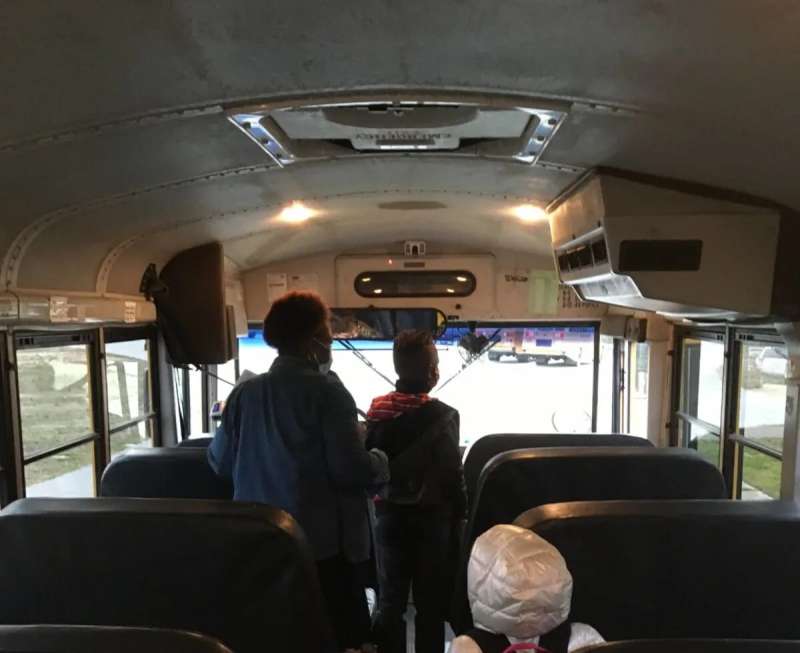
Cunningham, a rangy former basketball player at Liberty University, spoke in passionate, quotable sentences in the back of Bus 117 as students rode down NC Highway 481 in Enfield, North Carolina. They were bound for Inborden Elementary S.T.E.A.M. Academy, a local school named for a Black educator who led a historic junior college in Enfield a century ago.
“We pivoted,” Cunningham told me. “We gave everyone Chromebooks, learning packets. But it’s not the same as in-person, it is not the same. I think that’s an argument we’ve all settled now. Kids learn best in schools.”
Halifax County’s local school board voted March 1 to return grades K-5 on Monday. Grades 6-12 will return as well, albeit at reduced classroom sizes, on March 22. So far, about half of the district’s 2,300 or so students were returning to classrooms as of Monday.

We know North Carolina. Sign up for the free Cardinal & Pine newsletter here.
It’s a significant shift for Halifax and Cunningham, who recommended amid a sharp spike of COVID-19 cases in January that the county’s schools remain closed for the rest of the academic year. Cunningham said he’d vowed to be one of the last districts to return.
He had good reason. Halifax County’s 2020 principal of the year, Teicher Patterson, the beloved leader of Inborden’s middle school, died of COVID last July.
“On June 26, we were hanging out with Teicher Patterson,” Cunningham said. “July 3, he’s in a coma. Eleven days later, he’s dead. We didn’t know as much about the virus back then as we know now. So we were shocked. The last thing I wanted to do was be one of the first ones to reopen under that type of tragedy.”
But today he says the county is returning in the “sweet spot” of science and the law. COVID numbers are declining and state leaders, once divided on reopening, are of one accord.
Chastity Kinsey, principal at Inborden Elementary, seemed grateful for the plan on Monday. “I have been up since 3 o’clock this morning,” she said. “I was like a child on Christmas Eve.”
Students will have their temperatures checked at the bus or upon arrival to school under COVID protocols. Parents will also have to deliver signed forms each week attesting that their child has no symptoms of the dangerous virus.
The hallways of Inborden Elementary were lined with “X” marks, spaced 6 feet apart to help kids keep their distance while standing in line. It was a mostly smooth process Monday. Masked teachers stood in the doorways of their classrooms. Some wore plastic face shields too for extra protection.
Some students sat at socially distanced desks. Others, whose parents opted for remote learning, watched a live feed of the classroom. Kinsey called the two groups “roomers and Zoomers.”
Kinsey said it’s been a “challenging” year. There have been personal losses. Family members lost. Teachers and students who caught COVID-19. The virus has killed 102 people in Halifax County. It’s not only changed education, she said, it’s changed Halifax.
Last year, Kinsey said she could have differentiated between her kids who were “at-risk” and those who weren’t. These days, they’re all at-risk to her.
‘Teachers here have to be extremely creative.’
Halifax had other reasons for pause when it came to returning to classrooms.
North Carolina’s Black and low-income populations have been hit disproportionately hard by the pandemic. And about 96% of the students in Cunningham’s rural district are from Black and brown families, according to Public School Review, with Black students being the vast majority.
All of the district’s students also qualify for free or reduced lunch, generally an indicator of socioeconomic status in a community.
Since Cooper closed North Carolina schools for in-person learning statewide in mid-March 2020, school districts have been in a state of near-constant flux. All 115 districts tasked with educating the state’s 1.5 million public school students closed their school buildings for the remainder of the 2020 academic year and launched virtual learning programs, something that had never been done before.
Since August, some have resumed with a hybrid of in-person and remote learning.
But the closures didn’t happen in a vacuum. They tended to exacerbate lingering inequalities in North Carolina schools systems, particularly in rural eastern North Counties such as Halifax County.
The district spent federal COVID relief money to distribute laptops to students, but counties like these were plagued by massive broadband internet gaps. It’s not as profitable for providers to extend high-speed internet into sparse counties like Halifax, which has a population of about 54,000 near the Virginia border.
But local educators are used to being shortchanged, Cunningham said.
“The teachers here have to be extremely creative,” he said. “They have to make things. In other school districts, they buy things. I think that teachers here should be commended because of what they do in spite of.”
Halifax County is also historically linked to racial inequalities in North Carolina. It is one of the five counties in the long-running Leandro case. NC’s Supreme Court ruled in 1997 that state leaders had failed to adequately fund North Carolina’s constitutional guarantee of a “sound, basic education” in counties like these. School systems depend on a combination of local, state and federal dollars, but some counties have the local tax base to chip in more when state funding falls short, creating systemic inequalities.
Lawmakers and the courts are still wrestling over Leandro. Court-ordered consultant WestEd reported in 2019 that the state continues to fail students in Halifax County and other low-income districts that don’t have the tax base to support children from generally poorer families. It is generally more expensive to educate children from low-income families.
Despite two decades of wrestling with the case, the inequalities persist. A 2020 report on school financing from the nonpartisan Public School Forum of NC found Halifax County could afford to spend about $1,370 per student, but that significantly lags the state average of about $1,700. Compare it to affluent Orange County, home of UNC-Chapel Hill, which spent more than $5,000 per student.
Republican leaders in the state legislature, who hold most of the power over state budgeting, have bristled at the court’s calls for greater funding levels targeting high-need districts like Halifax.
“I don’t know that it is constitutional for a court to direct the state to appropriate a specific amount of money,” former state legislator Craig Horn, a Republican who chaired the state K-12 spending committee, said last February in the Carolina Political Review.

There are other racial inequalities at play.
A recent state lawsuit pointed out the relatively small county has been carved up into three racially distinct school districts too.
Students in Cunningham’s district, Halifax County Schools, and the neighboring Weldon City Schools are predominantly students of color. But a third district, the Roanoke Rapids Graded School District, is majority white.
Attorneys in the Halifax lawsuit pointed out the majority white district received significantly more in funding for facility needs, owing to a local system of county-distributed sales and land use taxes.
More prosperous districts tend to have more, said Cunningham. “When you come here and you don’t see it, it grips your heart.”
Halifax County is also the poster child for North Carolina’s massive K-12 infrastructure needs, which surpassed $8 billion in a report five years ago. The county’s needs, which include failing heating, air conditioning and ventilation systems, make reopening during a pandemic a daunting task.
School building renovations are historically a local government responsibility, but the meager tax base in poorer counties mean improvements come slowly if they come at all. Local officials have been asking state lawmakers to put a statewide school bond referendum on the ballot for the better part of a decade, although the GOP-led legislature has yet to act on those requests.
A ‘sound, basic education?’
The school funding inequalities only complicate an already muddy debate over school reopening. Many educators say it’s not safe to return with most school staff not yet fully vaccinated.
Critics point out it might also exacerbate the spread of the virus, putting teachers and their unvaccinated relatives at greater risk. Despite a quickening pace to vaccinations in North Carolina, just 12.3% of the state’s population was fully vaccinated as of Monday.
“The decision to open schools should happen at the local district level NOT Jones St or NCDPI,” Durham educator John V. Wood wrote on Twitter last week. “Trust your local superintendents and boards of education!”
Rodney Pierce is a Halifax County Schools graduate who teaches in neighboring Nash County. He sits on Gov. Cooper’s Teacher Advisory Committee.
Pierce told Cardinal & Pine that Halifax County’s complicated history should be considered when schools return.
“With all of the infrastructure and funding issues in the district, there should be strong echoes from the district school board and administration to the NCGA to lead with Leandro,” he said. “… It’s been over 25 years and the state, whether under Democratic or Republican leadership, still hasn’t met the state constitution’s obligation of guarding and maintaining that right to education, despite the WestEd report.”
“With all the rhetoric around learning loss, the mental health of our students, etc., what is (being done) to ensure that districts like Halifax have the resources they need to meet this obligation?” Pierce asked.
But some have countered that academic research has shown virtual learning to be a poor substitute for classroom teaching, putting already struggling children at particular risk.
Cunningham says that’s a valid concern in Halifax. “Our kids are so far behind,” he said. “They have severe deficits.”
And, despite the county’s well-documented facility needs, Cunningham argued that his district is prepared now to reopen, citing the continued decline in the percentage of the state’s COVID tests returning positive, generally considered a key metric for tracking spread. In Halifax County, that rate is 3.3% today. Public health officials generally want that rate to go no higher than 5%.
Cunningham says he trusts public health officials in North Carolina. Mandy Cohen, Secretary of the NC Department of Health and Human Services, supported Gov. Cooper’s reopening deal with the state legislature last week.

‘All kids matter’
The students on Bus 117 were so quiet Monday morning, the only sound was the vehicle’s mechanized rush. “It’s probably because they know the superintendent’s on board,” Cunningham chuckled.
The bus picked them up from mostly low-slung houses off country roads. Cunningham pointed out one outlier, a larger, suburban-style home in Enfield. “If our kids came from houses like that, it’d be a different story,” he said.
There is, of course, more to Halifax County than poverty and leaky school buildings. It is an agricultural hub, as well as an emerging destination for solar farms that thrive in eastern North Carolina’s sprawling, unshaded plains.
Downtown Enfield, about two miles from Inborden Elementary, was once home to one of the world’s largest raw peanut markets. Today, the downtown is quiet but stately, a cluster of aging brick buildings along the railroad track. A historic three-story theater built for the local Mason’s lodge on Railroad Street is the standout.
But its lingering story of educational inequalities is the headline around here. “All students count; all moments matter,” is Inborden Elementary’s motto.
Kinsey, the school’s principal, said state policymakers need to keep funneling cash to personal protective equipment, as well as funds for districts like hers that have trailed their more affluent peers.
“We do have some educational deficits that are going to need to be closed or narrowed,” Kinsey said. “I would invite any (legislators) to come into the building. It’s hard to write laws and regulations when you have not stepped foot inside the building.”
And Cunningham said he hopes that school districts take some lessons from the pandemic. Leaders need to come away with a greater appreciation for technology and broadband internet.
“All kids matter,” said Cunningham. “All kids matter. It shouldn’t be determined by your zip code. Every child is supposed to receive a sound, basic education.
“We know what that looks like now.”