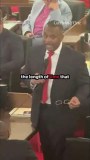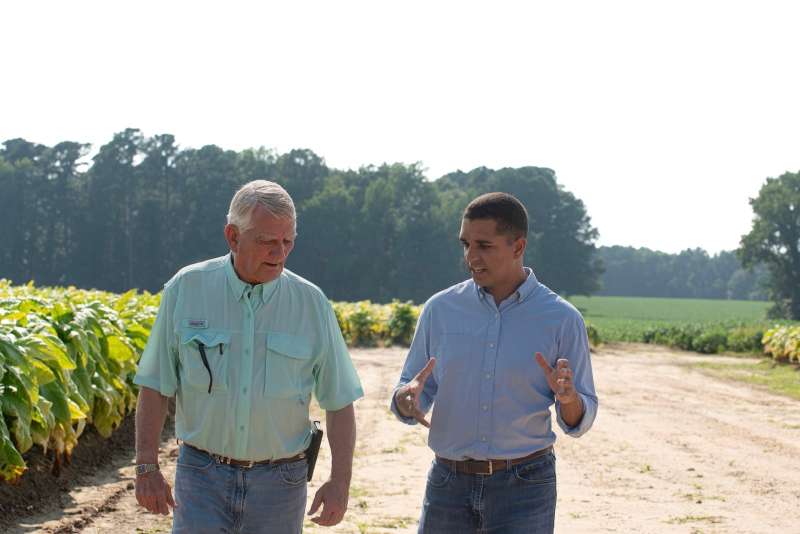
At 30 years old, Democratic Rep. Dante Pittman is among the youngest members of the North Carolina General Assembly, representing Wilson County and part of Nash County. He’s running for re-election in this year’s midterms.
Prior to his decision to run for the North Carolina House in 2024, Pittman met with the late Gov. Jim Hunt (D) at a meeting Hunt requested; an encounter he says stays with him to this day.
Hunt invited Pittman and his wife, Lucy Russell Pittman, to his farm in rural Wilson County to personally ask him to run for the seat.
“We found ourselves on his sofa in Rock Ridge, North Carolina and he told me something there that I have never forgotten. He cut me off mid-sentence when I was talking about why this was not a great time. He said, ‘North Carolina is a worthwhile project.’. And that is something I’ve held with me going forward,” Pittman told Cardinal & Pine in his office at the General Assembly.
Pittman entered the race in one of the most competitive districts in the state and went on to defeat incumbent Republican Ken Fontenot by just 918 votes in one of the closest legislative races that year.
Pittman, the fifth generation of his family to live in Wilson County, says the most rewarding part of the job has been the opportunity to provide constituent services to the community he calls home.
“We had a gentleman that called and said he had seen a consistent rise in littering on his property…He said all the time he was seeing folks just throw trash out there,” he said.
Pittman’s office reached out to the state Department of Transportation (DOT) and asked them to put up a ‘No Littering’ sign by the road.
“We got in contact with DOT, and within a couple of weeks they had a sign up, and he has since called us back and said, ‘I have seen a difference.’ That’s on a very small scale, but that just demonstrates what government is supposed to be: Responsive to the needs of its people,” Pittman said.
Advocating for public education
Pittman, who was educated in North Carolina’s public schools and graduated from Fike High School, criticized Republicans’ expansion of private school vouchers, calling it “the biggest motivating factor” in his decision to run for the legislature.
“We have great public schools in Wilson County. I know because I went. Seeing that rural schools were being shortchanged through the state, putting public dollars into private school vouchers, going to private schools in Raleigh or Charlotte, that’s not a good deal for us,” he said.
Since 2014, when the Opportunity Scholarship was implemented to allow taxpayer funds to supplement private school tuition costs, $1.6 billion in taxpayer money has been allocated to the program.
In 2024, the North Carolina General Assembly expanded the Opportunity Scholarship to allow people of any income level to apply for vouchers. Between 2024 and 2033, North Carolina’s funding of the program is projected to be $5.8 billion.
While funding for the voucher program will continue to increase in the coming years, North Carolina ranked 51st in the US in funding per pupil in a 2025 report, behind 49 other states and the District of Columbia. Pittman believes that the Republican majority in the legislature isn’t doing enough to support public schools.
“I hear it every time we have a funding bill come through this General Assembly, about how everyone supports public education. Well, everyone doesn’t act to support public education. That’s what public education needs right now,” he said.
Pittman advocated for a successful $42 million needs-based grant from the North Carolina Department of Public Instruction (DPI) that will consolidate Wells Elementary School, which he says was “outdated” when he was a student there in the early 2000s, with Hearne Elementary.
While Wilson County benefited from this grant, Pittman says more concrete funding is needed to meet the needs of his district.
“We should not have to rely on one-time dollars to make sure that our needs are being met,” he said.
Tariffs and rising costs threaten farms in the district
In 2025, 15,000 farms shuttered their operations nationwide, including 800 in North Carolina, where agriculture contributes around $111 billion to the state’s economy and employs nearly one-fifth of the overall workforce. Pittman’s district is especially reliant on farmers and the agricultural sector.
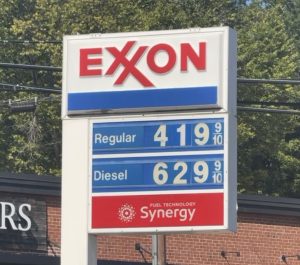
“The biggest thing that I’m hearing from our farmers and from folks who work in a variety of jobs in the agricultural sector is that diesel prices have really put a hurting on them, and in some cases it’s threatening their entire operation,” he said.
The average price of diesel is currently $4.93 per gallon, down from a record high of $5.81 early April, but up from $3.34 a year ago.
Adding pressure to the agriculture industry’s struggles are President Donald Trump’s tariff policies, which have increased costs for farming operations and limited farmers’ abilities to access foreign markets. Pittman says farmers in his community are feeling the pain.
“A farmer in my district, he was able to directly tie tariffs to costing him $68,000 last year. What it has also done is close some of our export markets. It’s no secret that how our farms are able to survive sometimes is not just being able to provide food and agricultural products here domestically, but also internationally,” he said.
Earlier this year, Carolina Journal reported that in North Carolina alone, the administration’s tariff policy could cost the industry nearly $700 million and around 8,000 jobs.
Rising prices and the Affordable Food Act
Pittman knows that the cost-of-living crisis is having a direct impact on his community, and says he’s heard from constituents that food insecurity is gripping the district.
“I was just at a community event this past Sunday and I heard from a minister that was at that event about how their church’s food program has been cut because the food bank did not have the resources that it needed,” he said.
Under President Donald Trump’s ‘One Big Beautiful Bill Act,’ the Supplemental Nutrition Assistance Program (SNAP), which supports Americans battling food insecurity, was cut by $186 billion, or 20% of its budget, over a 10-year period.
“We know there is a direct line from that choice in Washington to the impact on our people here,” Pittman said.
Pittman is a primary sponsor of the Affordable Food Act, which seeks to support both North Carolinians struggling with rising food costs, as well as farmers in getting their products to consumers.
“On the front end, we’re providing support to our farmers and our agriculture, investing $47 million dollars into the ADFP [Agricultural Development and Farmland Preservation Trust Fund] which is trying to make sure we don’t lose our small farms across North Carolina,” he said.
In addition to supporting local farms, the Affordable Food Act would also provide funding for food assistance in the state, including $11 million for SNAP and $16 million to offset federal cuts to the SNAP program to support its operations. Additionally, $8 million would go towards setting up mobile food banks in rural and underserved areas of the state.
The bill would also create a $140 million program to specifically support the nutrition of active members of the military, veterans, and their families.
Pittman notes that the bill would penalize dynamic pricing, which the legislation defines as the electronic changing of the price of an item more than once in a 24-hour period, and would apply to any ‘food, beverage, or household essential good.’ Each violation by a retail grocery store would result in a fine of not more than $5,000 for each violation.
“The worst thing that could happen as we’re seeing this crisis of affordability, is that people see prices that are already too high, skyrocket because technology is not working to help lower prices in this instance, but would be working to move prices higher,” he said.
Priorities for a second term
Pittman is running for reelection in the Nov. 3rd midterms and discussed his priorities moving forward.
He says that his top priority is expanding healthcare access for his constituents.
“We need to make sure that we have doctors, and nurses, and we have access to both primary care and preventive care in our communities,” Pittman said.
If healthcare options aren’t available in Wilson or Nash counties, it’s possible people may have to travel an hour east or west to Raleigh or Greenville.
“We need access right here, and that’s what we’re going to continue to work on,” he said.
Given the increased fuel prices, Pittman says local healthcare opportunities are more important than ever.
“People literally have to make that choice, ‘Am I going to use some of the money in my pocket to put in my gas tank so I can get to the doctor?’”
Beyond healthcare, Pittman continues to push for economic opportunities for his constituents and for companies to bring jobs to the area.
In January of this year, Johnson & Johnson announced it was bringing up to 500 new jobs to Wilson as part of a drug manufacturing facility.
“We have folks that are hungry and craving those opportunities,” Pittman said. “We’ve got to make sure that we continue to invest in workforce training so that folks that want the opportunity, and are willing to work for the opportunity, have true access.”
Pittman’s race is expected to be among the most competitive this fall. In 2024, his victory allowed Democrats to break the Republican supermajority in the House of Representatives. This year, his race could be one of the bellwethers in determining if the party will make further gains in the General Assembly.