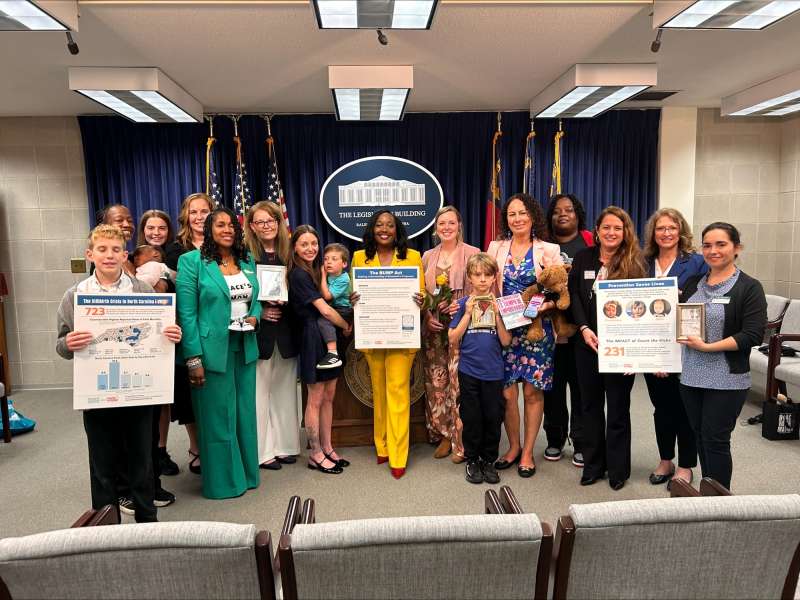
After losing her son to stillbirth, and nearly her own life, a NC mom is working with Sen. Natalie Murdock on the BUMP Act. The act would fund a statewide Count the Kicks campaign and require clearer warning-sign education for pregnant patients.
In North Carolina, pregnant people are warned about heartburn, swollen ankles, and drinking alcohol.
But they are not always warned about stillbirth.
In May 2018, Denver resident Tomeka James Isaac was 35 weeks pregnant when she was rushed to the hospital with the life-threatening H.E.L.L.P Syndrome (Hemolysis Elevated Liver Enzymes Low Platelet). Her son, Jace Alexander, was stillborn. Forty five hospital days, seven surgeries, and a missed funeral due to infection later, Isaac and her husband Brandon walked out of the hospital together, but without their baby.
Afterwards, they learned both Isaac’s illness and Jace’s death were preventable.
“No parent should endure that,” Isaac said. “No mother should come that close to losing her life. When we began searching for answers, what we found was devastating. Basic routine care was missed.”
Eight years on, Isaac’s story has now been written into a bill introduced at the General Assembly by Sen. Natalie Murdock (D-Durham, Chatham). Senate Bill 909, also known as the Building Understanding of Movement in Pregnancy (BUMP) Act, would fund a statewide campaign to teach pregnant women to “count the kicks,” and would require the state of North Carolina to give pregnant patients and their providers clear, evidence-based tools to act when a pregnancy is in trouble.
Jace’s Journey
In the months after Jace’s death, Isaac and her husband created Jace’s Journey, a nonprofit to raise awareness and improve the conditions of maternal and fetal healthcare disparities through education, advocacy, and community engagement.
It’s all help they wish they’d had.
After the hospital, Isaac learned that she was not given urine tests for a high-risk pregnancy, not educated on warning signs, and was never informed about tracking Jace’s movements.
“These are not complex interventions,” she said. “These are not experimental solutions. These are standard, evidence-based practices. It did not have to be this way.”
Through working with Jace’s Journey, Isaac hears versions of the same story again and again: high-risk pregnancies charted as routine, symptoms dismissed as “just pregnancy,” fetal movements changing with no explanation of what that might mean.
As part of her advocacy, Isaac joined Healthy Birth Day, Inc.—an Iowa nonprofit that created the “Count the Kicks” campaign which helped educate her on how to monitor fetal movement.
“Fetal movement is actually one of the first signs that something’s wrong or something’s going on,” Isaac said. “Not only does it help detect the distress in the baby, but it can also help detect stress in the mom, because I wasn’t really exhibiting symptoms until I was. Jace was measuring small at 34 weeks. At 35 weeks, he failed a non-stress test, so there was something going on there, and they didn’t act on it.”
What the BUMP Act would do
Nationally, nearly 21,000 babies are stillborn every year, and most expectant parents who experience stillbirth say they were never told it was a possible outcome. By definition, a stillbirth or fetal death, is the death of a fetus at or after 20 weeks of gestation.
In North Carolina, an average of 723 babies are stillborn annually, according to NCDHHS data. The same NCDHHS report found that at least one in four stillbirths are preventable and estimated that with evidence-based programs like Count the Kicks and timely intervention, roughly 231 North Carolina babies could be saved every year.
Sen. Natalie Murdock’s bill tries to put structure and state dollars behind that prevention work. If passed, the BUMP Act would appropriate $400,000 in recurring state funds to the NCDHHS starting in the 2026-27 fiscal year. Half of the funding will pay for educational materials and training, while the second half would fund the development of training programs for prenatal care providers.
Murdock said that even though stillbirth affects families across the state, those losses do not fall evenly.
“Families in Anson, Edgecomb, Samson, Lenore, and Vance face increased risk of stillbirth,” she said. “Anson County has the highest rate.”
State data show North Carolina’s stillbirth rate has remained largely unchanged since 2009 and has continued to sit above the national average for more than a decade.
“Black moms in North Carolina are two times more likely to experience the tragedy of stillbirth than all other groups,” Murdock said.
Throughout the state, stillbirth rates among Black women are more than twice those of white women, and according to the CDC, Black women account for 41.7% of pregnancy-related deaths despite making up a much smaller share of the population.
At the press conference, Murdock pointed to research showing that more than 15% of maternal deaths within 42 days of delivery occur in women who delivered a stillborn baby, and said that there is a “significant association between stillbirth and maternal mortality risk.”
That’s why she called the BUMP Act “an effort to address the maternal health crisis in North Carolina.”
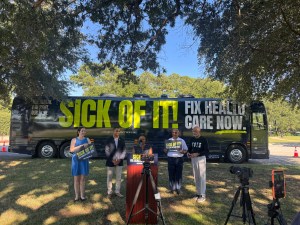
“May is Maternal Health Awareness Month, which provides an opportunity to shine a light on the alarming rate of maternal morbidity, maternal mortality and stillborn birth in our communities,” Murdock said in a press conference. “The health of a mom and the health of her baby are intrinsically connected. When one is struggling, there’s a strong chance that the other will struggle too.”
In addition to requiring that standardized, evidenced-based information on stillbirth prevention and urgent warning signs be given to pregnant patients, the bill would guarantee fetal-movement counseling by 28 weeks of pregnancy, including clear instructions to seek same-day care when a baby’s movements decrease or change.
NCDHHS would have to spell out major risk factors such as infections, hypertension, diabetes, smoking, sleep position, and substance exposure, and tell patients how to reach their prenatal care team, including after hours. Materials would be available statewide in English, Spanish, and other languages based on community needs.
Additionally, the bill would direct the state to develop or purchase training for prenatal providers that start no later than 28 weeks, and covers fetal-movement education, response protocols for decreased movement, and risks related to infection, the placenta, and the umbilical cord. That training must be available both virtually and in person.
Count the kicks
On top of the education and training dollars, another $200,000 in recurring funding would launch a statewide Count the Kicks public-awareness campaign.
The Count the Kicks campaign teaches expectant parents to track their baby’s movements during the third trimester using a free mobile app or a simple paper chart. Parents learn what’s normal for their baby, and how long it usually takes to feel a set number of movements.
“We have to talk about stillbirth as a potential birth outcome,” said Jenifer Rowray, director of advocacy and engagement at Healthy Birth Day Inc. “There are too many women and children that are being lost in this country, and yet most expectant parents that experience a stillbirth have never received any education or didn’t realize that was a potential birth outcome.”
She added that the BUMP Act is a chance to finally act on what the data already show.
“We have to shine a light on the issue,” Rowray said. “That is what the Bump Act really is going to do. It’s providing the action and the funds to take action, so that we don’t have these gaps of education that are occurring. There are many ways that that work can and should be done, and one of those ways is through stillbirth prevention.”
Where the BUMP Act stands
Murdock introduced the BUMP Act in the Senate in April, and it’s currently in committee. For it to pass into law, it still needs three floor votes in the Senate and three floor votes in the House. If it passes those votes, it heads to the governor’s office. There, Gov. Josh Stein can sign it, veto it, or allow it to pass into law without his signature.
North Carolinians can let their representatives know how they feel about the BUMP Act by writing or calling their offices. Find yours here.