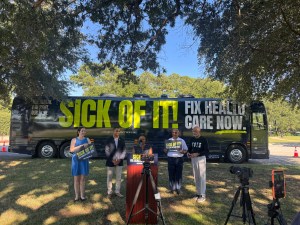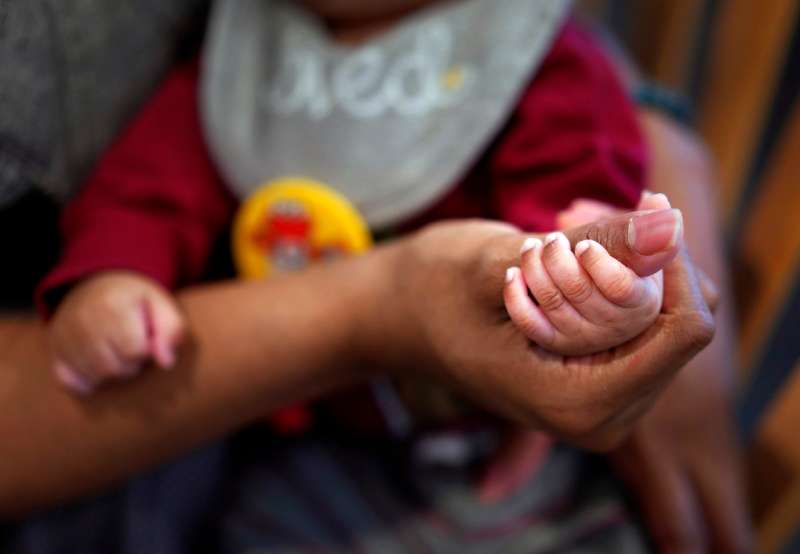
The March of Dimes released its annual report card on maternal and infant health in January, and for the third year in a row North Carolina got a D for its high preterm birth rate and poor record of protecting new mothers and their babies.
The United States is “one of the most dangerous high-income countries in the world” for pregnant women, Dr. Michael Warren, the March of Dimes’ chief medical officer, told Cardinal & Pine ahead of the report card’s release. And the problem is especially stark in North Carolina, where pregnancies and childbirth are more dangerous, for both mothers and babies, than in most of the rest of the country.
North Carolina has some of the best hospitals and medical schools in the world, but in 2023, 834 babies in the state died before their first birthdays, the report card found. Only 8 states in the country had a higher infant mortality rate.
North Carolina also has a higher rate of premature births than the rest of the country.
But while the March of Dimes issues North Carolina’s bad grades, it is also doing what it can to help the state improve.
The premature birth rate in the state highlights the need for robust, reliable and accessible neonatal intensive care units, Pat Campbell, the the March of Dimes’ director of maternal and infant health in North Carolina told Cardinal & Pine this month. And for the last quarter of a century a March of Dimes program has, slowly, helped move the needle toward progress.
The March of Dimes NICU Family Support program, which celebrated its 25th anniversary in March, provides education and resources to parents whose children are in the NICU. The group also provides a liaison who can help the families negotiate the bureaucratic, financial, and emotional turmoil that come with even temporary stays in the NICU.
The program helped more than 1,100 families in North Carolina last year, Campbell said.
The UNC Medical Center in Chapel Hill is the only hospital in the state that participates in the program, Campbell said, but its NICU serves patients from across the state, and the March of Dimes is looking to expand the program into other hospitals.
“Preterm birth is a complicated issue,” Campbell said, “so research is critical. And again, March of Dimes, we’re on that.”
But the organization can’t do it alone, she said. And though there are several state programs that do a lot of good for new mothers and infants, it is crucial that every entity in the state, including the state Legislature, does its part, Campbell said.
The state’s widely effective Perinatal Quality Collaborative of North Carolina temporarily ran out of funding last year because the General Assembly, which is fully controlled by Republicans, did not pass a formal budget until a year after it was due.
Legislators of both parties restored the funding in 2026 and then included the money in the full budget that was passed this summer.
“The needle moves slowly in an issue like this, but I do feel we are moving things in North Carolina and getting some traction,” she said.
We spoke with Campbell about the state of maternal health care in North Carolina, the importance of the March of Dimes NICU Family Support program, and what gives her hope that the state can improve on its next report card.
The following conversation has been lightly edited for length and clarity.
CARDINAL & PINE: The March of Dimes heralds its partnerships on its website. Is that the key to improving the state of maternal and infant care in North Carolina? Every institution working together to tackle the problem?
CAMPBELL: We’re not gonna solve the problem alone as an organization, but we pride ourselves in our partnerships and our collaboration efforts with the state of North Carolina, with the General Assembly.
The March of Dimes has done phenomenal work with education, and that’s education for communities, for providers, for legislators, the whole state really.
To truly move this needle, it is important that we have legislative policies that support movement.
And a good example of that is access to care. We have 20 counties out of the hundred that are identified as a healthcare desert. You’ve got to have some legislative action when you think about improving access to care. So that’s where the March of Dimes comes in.
You mentioned the health care deserts. Preterm birth rates are higher in NC than in a lot of other states, and especially higher in rural counties whose hospitals do not have NICU units. So how does the March of Dimes NICU family support program help families in these communities where access to care is so limited.
That is a great question. And I will tell you, it would be a waste of resources in my mind if every maternity hospital had a NICU. That’s not feasible. So you do have to have the big tertiary centers where you transport into. And the NICU family support program that we have in Chapel Hill does get transports in from these deserts.
So with the NICU family support program, those babies come in, and then our coordinator, just like she does with every other family, connects with them at the appropriate time, shares information and immediate resources and then, as the time goes on, continues to connect with them and looks at the community resources available to the family when they transition to home.
And as you can imagine, that varies with every different situation. The baby may be so critical and be in that NICU for three months. But the coordinator also follows our compassionate support care model that really wraps around that family while they are at the NICU and gives them the support they need. And this is all evidence-based material, obviously.
The program does entail meeting as a group with families weekly or more often, just depending on the time of the year. But providing, you know, education to the parents in a group setting or even one-on-one.
I’m going to ask a question I already know the answer to, but why is that compassionate care approach so vital?
You know, the physical part of the baby’s care is one thing, but we never can fully know what the family is going through. So it’s trying to think through, ‘OK, how do we keep that family’s life somewhat normal?’ We try to do educational sessions during lunchtime and provide lunch, because that’s another thing you have to think about with these families if, particularly if they’re from out of town.
We have sessions where we do craft activities, definitely at holidays and different events throughout the year, we try to make that real, too. ‘Cause so many times they’re so stressed and focused on the baby and the condition, and we can lose sight of that.
And then even if they have siblings, we have resources that can help them with that.
Pregnancies are already super stressful times for families, but stays in the NICU obviously send already high stress levels even higher. I imagine that the stress and anxiety are big parts of the impetus behind the family support program.
We know the numbers. We know that over the last two years, mental health issues are the leading causes of maternal death. Most hospitals now have implemented a screening tool for postpartum depression, and prenatal depression as well.
The March of Dimes sees the stressors and the anxiety that occurs with these moms and dads, so we are piloting an app in the NICU at UNC Medical Center in Chapel Hill that will screen for anxiety levels and stress. It’s called MAMMHA, and I have high hopes for this because it connects to the providers and lets them know what the screening results are, and it provides the moms with available resources.
The March of Dimes has given North Carolina some pretty bad grades for several years in a row, but what do you see as signs of progress?
There have been some positive things. Medicaid expansion in 2023 is an example. And we have great resources in the state, and a collaboration with The North Carolina Department of Health and Human Services. There’s a great entity there, the Perinatal Health Quality Collaborative, which is made up of numerous individuals that we sit at the table with. It’s wonderful. Hospitals don’t have to join it, but I would say there’s over 40 hospitals that are members. The group pulls from experts across the state, and evaluates the best evidence-based practices outside of North Carolina or within North Carolina, and then provides recommendations going forward.
We were working on this last year, and then unfortunately [the collaborative] lost funding in the state. But again, the March of Dimes advocated in October, November, December for funding to be reinstated.
Others did as well, and so in January, February of this year, the funding was reinstated for it. It was a temporary loss, but having to put the program back together cost a few resources from a personnel standpoint, so now [the collaborative] is bringing people back on.
The 2027 initiative is going to be this idea of screening NICU moms for anxiety, depression, whatever it may be, and then connecting them to appropriate resources with the provider’s input.
NICU doctors and nurses are already highly trained and skilled, so why is it so important that the NICU program provides education and resources to hospital staff as well as families?
It’s so important, because even if, and I’ll include myself in this, even if I’ve been educated in compassionate care policies, you still need to get updates. What does the word compassionate family care really mean and how do you support that when you’ve got a critically ill baby whose [diagnosis is not fully known.]
And as a provider, as a nurse, that is so stressful for your profession not to be able to provide parents with all the answers immediately. So you have to remind people, if a parent is responding a certain way or they’re not being allowed to be with the baby, what is that doing? It’s just causing more anxiety.
So it definitely is just as critical for the care providers to have the compassionate care training and updates as it is for the parents to get our materials.
What gives you hope in North Carolina on these long-standing issues, and what are the obstacles still ahead?
When you think about the nation and particularly zoning into North Carolina. To move the needle, we’ve got to ensure that every mom has access to prenatal care and even preconception care. The March of Dimes will continue our evidence-based and community programs to educate on preconception health and healthy pregnancies. But truly, it’s going to require more legislation: policies on maternal and infant health that are programmatic, that address the issue of the deserts, and that really address [invest in] research, too.
We had a grant to do seminars that involved doulas, midwives, perinatal mental health consultants, all the supports you can think of, maybe some traditional, some not traditional, that served women in underserved areas.
And it was just, it was amazing. So I think more of that: really looking at how systems outside of the family can help.