Democrats were hoping for a blue wave when results rolled in on election night. They got a wave plus a tsunami.
Across the US, including in North Carolina, Democrats won elections in legislative congressional districts that once seemed impossible.
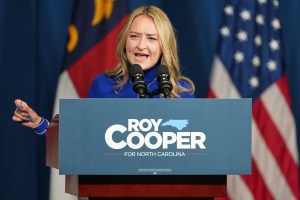
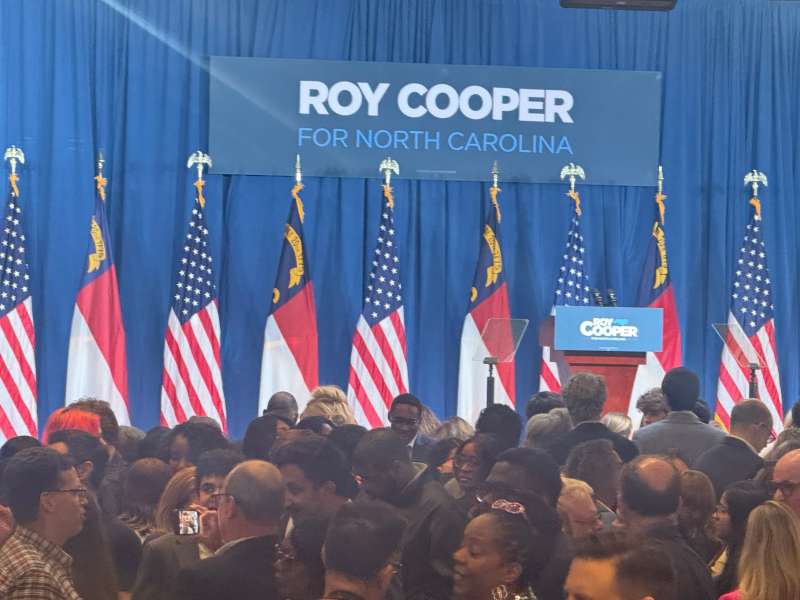
Former Gov. Roy Cooper defeated Republican Michael Whatley by more than 800,000 votes (19 percentage points), according to unofficial results from the North Carolina State Board of Elections.
The crowd at Cooper’s victory party in Raleigh erupted into cheers and chants of “Roy” after his victory was declared. During his victory speech, one supporter called for him to run for president.
With Democrats winning across various levels of government and geographic locations, North Carolina saw a seismic shift in state politics Tuesday night.
- Legislative priorities will be different
Since January 2011, Republicans have controlled both chambers of the North Carolina General Assembly, sometimes with supermajorities.
That will change in just a few months when the new legislature is sworn into office in January.
“Democrats are ready to fight for the policies that put us in this position. We understand the trust that voters have given us and look forward to hitting the ground running in January,” Rep. Robert Reives (D-Chatham County) said in a statement Wednesday.
In the email sent to the media, Reives confirmed he would seek to become speaker of the North Carolina House. If elected, he would be the first Democratic speaker in over 15 years.
2) Roy Cooper is ‘inevitable’
After nearly 40 years in office, Cooper remains undefeated as a political candidate. He won multiple elections to the General Assembly, four races for attorney general, two gubernatorial campaigns, and now, a US Senate race.
Cooper’s victory was a pivotal moment for the Democratic Party in winning back the US Senate, and it was the first Democratic US Senate victory in the Tar Heel State since former Sen. Kay Hagan’s 2008 win. Cooper’s nearly 20-point margin of victory created coattails, helping Democrats win down-ballot races as well.
Over 2.4 million North Carolinians voted for Cooper.
3) It’s Republicans who can’t win judicial races now
In 2020 and 2022, Democrats went 0-9 in statewide judicial elections, including in three state Supreme Court races.
In 2024, Justice Allison Riggs reversed this trend, beating Appeals Court Judge Jefferson Griffin to retain her seat on the state’s top court.
On Tuesday, Democrats continued racking up victories, with Justice Anita Earls being reelected to the NC Supreme Court by an unofficial 700,000-vote margin.
Appeals Court candidates Toby Hampson, John Arrowood, and Christine Walczyk retained seats held by Democrats. Democrats have now won five of the last five statewide judicial races. Walczyk succeeds outgoing Judge Allegra Collins, who opted not to run for a second term.
After beating Democrats in nine of nine judicial races over two elections prior, Republicans have now lost five out of five of the most recent.
4) Democrats competed in ‘ruby red’ districts
Two competitive districts Democrats targeted and won were the 1st and 11th Congressional Districts. In the 1st District, Rep. Don Davis (D) was reelected to a third term representing northeastern North Carolina. On the opposite side of the state, Jamie Ager, a farmer and first-time candidate for office, was elected in western North Carolina in the 11th District. Ager was billed as a “mountain Democrat” for his independent streak and focus on his rural community.
Ager won by around 16 percentage points, a near-complete reversal from 2024’s 14-point GOP victory.
Beyond these seats Democrat LaKesha Womack defeated Rep. Tim Moore, who was the longest-serving speaker of the North Carolina House of Representatives. The race was in the 14th District, which includes parts of the suburban Charlotte metro area, and Lincoln, Gaston, and Cleveland counties
Democrat Chuck Hubbard leads longtime Rep.Virginia Foxx (R-Watauga County) by 99 votes after all precincts reported. The race has not been called.
A Hubbard victory would be seismic, as Foxx has represented the district since 2005, and the Cook Political Report listed the race as “Likely Republican.”
5) North Carolina’s Congressional gerrymander was toppled by voters
The point of gerrymandered congressional and state legislative maps in North Carolina and other states is to lock in power for the party that drew the maps, which, in North Carolina’s case, has been the Republican Party for the last decade and a half.
An analysis of state gerrymanders by The News & Observer ranks North Carolina’s gerrymander as the fourth-worst in the country.
Last October, Republicans drew new congressional maps for this year’s election. Specifically, they redrew the 1st Congressional District, held by Davis, to make it more favorable to a Republican candidate.
In 2024, prior to the newly drawn, more GOP-friendly map, Davis defeated Laurie Buckhout by 6,307 votes. With all precincts reporting, Davis led by over 10,000 votes this year.
Democrats could hold up to 10 of North Carolina’s 14 congressional seats when results are certified—certainly not the intent of a gerrymander.