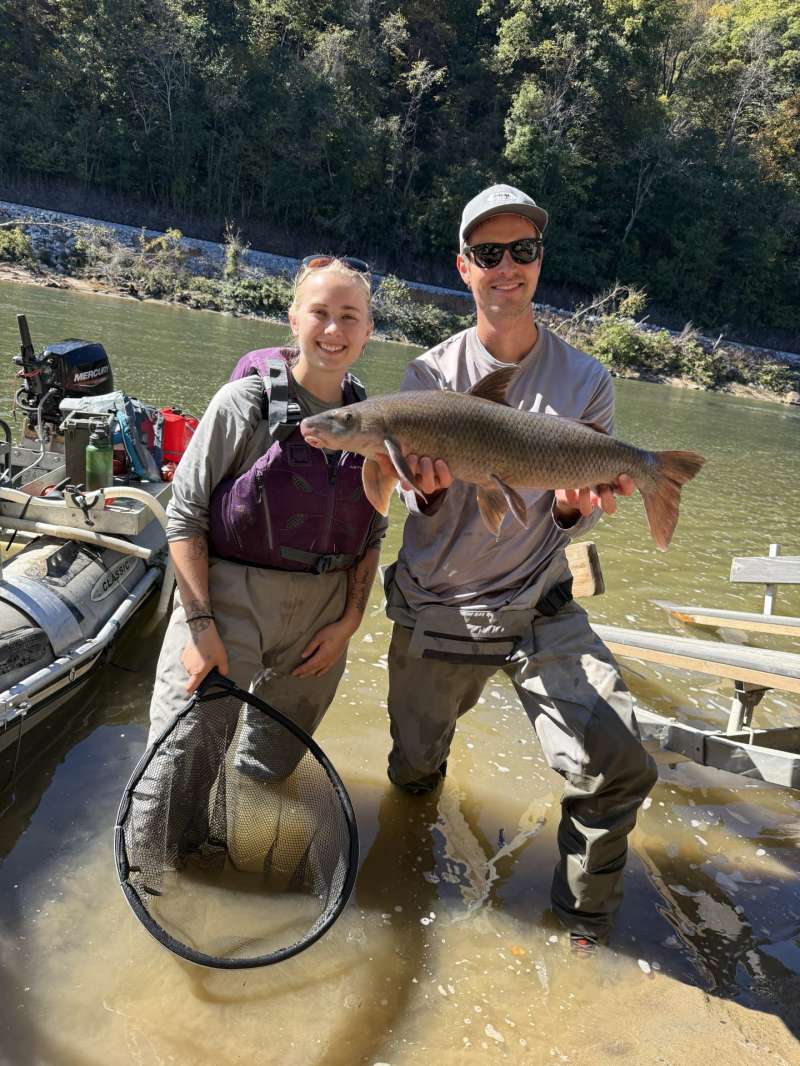
A rare fish that has never been recorded in North Carolina was discovered Oct. 21 in the French Broad River, according to state biologists.
The 29-inch male blue sucker was netted by biologists conducting a survey near Hot Springs.
N.C. Wildlife Resources Commission conservation biologist Luke Etchison, who helped capture the fish, told the Asheville Citizen Times Oct. 23 in an exclusive interview that he was “over the moon” with the discovery.
“It’s something I had basically fantasized about,” Etchison said. “When I saw it, … I was just overwhelmed with joy.”
The discovery of the blue sucker in the French Broad suggests the river’s health is improving, Etchison said.
In the 1960s, the French Broad River was heavily polluted from industrial manufacturing. Since the Clean Water Act was passed in 1972, the river has regained some health, but Tropical Storm Helene in 2024 was a blow, not just to the river, but to Western North Carolina as a whole.
State biologist Dylan Owensby, who was also present for the fish discovery, told the Citizen Times that the presence of the blue sucker is an indicator that the river’s water quality is continuing on the trajectory it was on before the hurricane.
“It shows that the ecosystem is resilient,” he said.
The only record of a blue sucker in the French Broad was in 2007, when it was found in Tennessee, Owensby said. He added that while the French Broad has a reputation for being a dirty river, it’s cleaner than it used to be.
The blue sucker can live longer than 100 years and can reach sizes of up to 40 inches. It prefers deep, swift water, and it also performs an important role in the ecosystem, Etchison said.
“During spawning season, they go from the lower big river that has more nutrients, more energy, and they take that energy with them upstream, through the form of eggs and waste and that kind of thing,” he said. “They basically give the headwaters and the tributaries a burst of nutrients that can really kick off stream productivity for all the species, insects, algae, all the way up to trout and bass.”
Sucker species are also a host for the federally endangered Appalachian elktoe. The elktoe larvae attach to a sucker’s gills for nutrients, ride to a new spot, and drop off, Etchison said. This mussel is only found in Western North Carolina, and its presence and expansion is likely tied to healthy sucker biodiversity and populations, Etchison added.
“We think the way to maximize their recovery is to maximize the species they could potentially have as a host, suckers being a main driver,” Etchison said. “It’s an important piece of the story if we really want to recover Appalachian elktoe and make sure they are around long-term.”
The fact that the blue sucker was discovered in the fall suggests there may be more, and they may be here year-round, he said. Suckers are a spring spawning migratory fish and are usually found in their highest numbers during that season.
“I think it’s a really big finding. We do a lot of these kinds of surveys,” Owensby said. “It’s pretty significant to find something that has never been documented, and also something that’s a good indicator of healthy water quality.”
Reporting by Kara Fohner, Asheville Citizen Times / Asheville Citizen Times
USA TODAY Network via Reuters Connect