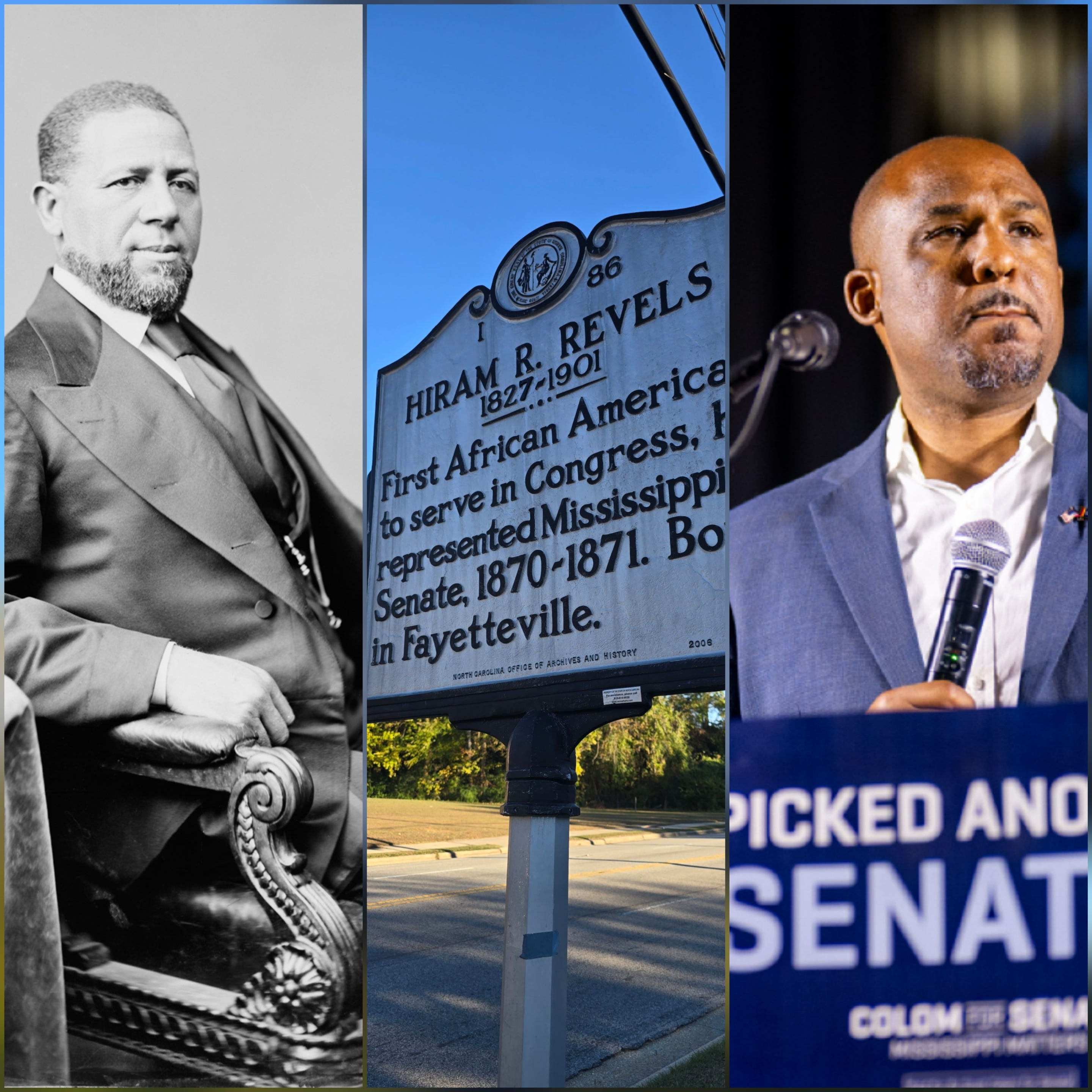
Democrat Scott Colom scored one of the most unexpected victories of the Nov. 3 election, when he won a U.S. Senate seat in deeply conservative Mississippi, becoming the first Black person to do since the 1800s Reconstruction era.
Fayetteville people have a reason to be proud, too, and remarks Colom himself made in a victory speech at historically Black Tougaloo College illustrate why.
“For people that don’t know, the first African American to be a United States senator was from the great state of Mississippi,” Colom said. “His name was Hiram Revels.”
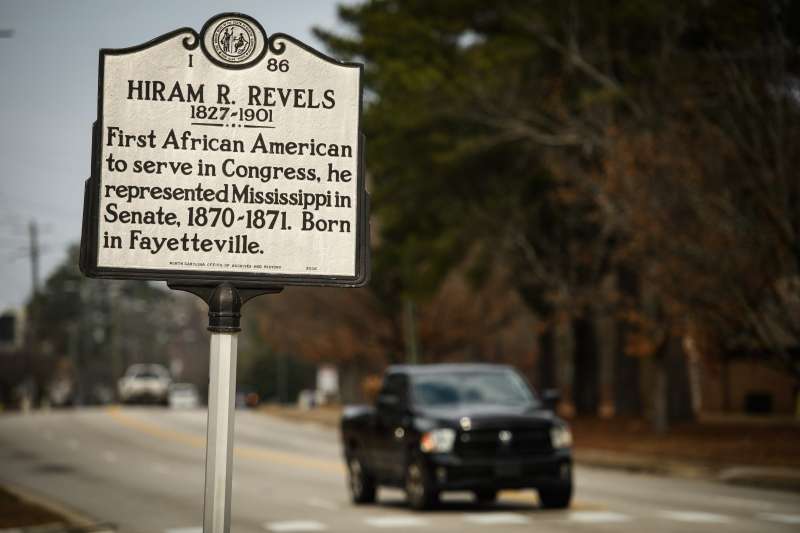
If the name sounds familiar, Revels is featured on a North Carolina historical marker on Murchison Road at Blue Street, which cites him as the “First African American to serve in Congress” and lists his Senate service in Mississippi as occurring from 1870 to 1871.
“Born in Fayetteville,” states the marker.
The Rev. Aaron Johnson of nearby Mt. Sinai Missionary Baptist Church said at the 2006 unveiling, according to The Fayetteville Observer: “We have brought home one of our most outstanding citizens. Some folks didn’t even know anything about him. We’ve come here today to say he will never be forgotten.”
From Fayetteville to the U.S. Senate
Hiram Rhodes Revels was born free around 1827 at a time when slavery was still in practice. His parents “were of mixed Croatan (Lumbee) Indian and African American blood,” according to NCPedia, a state-run site that is part of the North Carolina Department of Natural and Cultural Resources.
Revels was a cousin of Matthew Leary Jr., also from a free family and a co-founder of what became Fayetteville State University, which is just up Murchison Road from Revels’ marker.
Revels left Fayetteville in 1838, while still young. His eclectic background included a short time as a barber in Lincolnton; study at a Quaker seminary in Liberty, Indiana; a brief stint at a theological school in Drake County, Ohio; and formal study at Knox College in Illinois.
“Revels was ordained a minister in the African Methodist Episcopal church while in school and subsequently served religious missions to blacks in Ohio, Illinois, Indiana, Missouri, Kansas, Kentucky, and Tennessee,” according to NCPedia.
At the start of the Civil War, Revels lived in Baltimore, where in addition to his duties as minister, he became head of a high school for Black adults and organized Black residents for service in the Union Army, NCPedia states.
After the war, he settled in Mississippi to provide religious instruction to Black people who had followed Gen. Ulysses S. Grant’s victorious Union forces to the lower Mississippi Valley, the site states. He lived in Natchez, where he served on the City Council and in the state legislature, where he earned a reputation as a more moderate politician.
Senator-elect Colom, at his victory rally, provided an interesting account as to how Revels wound up a U.S. senator.
“He was a minister in Natchez, Mississippi. He was elected to be in the state House, and when they were trying to figure out who was going to do the opening prayer, someone suggested Hiram Revels,” Colom said. “He gave a prayer that was so powerful that people at that convention decided that he had a voice to be United States senator. That’s an example of the power of prayer.”
Toward the end of his term, Revels went on an extended tour of the Northwest, during a congressional recess in 1870.
He spoke “optimistically about the future of his race in America,” according to NCPedia.
He joined a Senate delegation that once included Jefferson Davis
Scott Colom and Revels’ Senate victories are historical in more ways than one.
One of Revels’ predecessors in the Mississippi Senate was none other than Jefferson Davis, the president of the Confederacy, who resigned in 1861 when Mississippi seceded from the U.S. This was the time before U.S. senators were elected by popular vote, and the Mississippi legislature elected Revels, a Republican.
When Southern states, through violence and intimidation, rolled back the federal Reconstruction and ended Black people’s voting rights, Black politicians throughout the South were driven from office.
That was not Revels’ fate. The historical record suggests that this minister and educator did not have a strong taste for partisan politics, and he left the Senate position when his term was up. Blanche K. Bruce would go on to become the second Black Mississippian to serve in the U.S. Senate, the first to serve a full six-year term and the last Black senator from the state until Colom’s election.
From 1876 to 1882, Revels served as president of Alcorn Agricultural College — now Alcorn State University — which was Mississippi’s first college for Black residents. He served a stint as well acting Mississippi Secretary of State and edited the Southwestern Christian Advocate, an official newspaper of the AME church.
Revels built a life on service and education
Dr. Kelli Cardenas Walsh, an associate professor of history at FSU, said Nov. 18 that Hiram Revels’ ties to Fayetteville were less about the years he physically spent here and more about the family tradition and values that shaped him before he left North Carolina. Revels’ family included a grandfather who fought in the American Revolution, according to Walsh, who responded to emailed questions.
“For free Blacks, service in the war could bring about an elevated status in communities even in the federal and antebellum eras,” said Walsh, who also mentioned Revels’ connection to the Leary family. “So, from Fayetteville and family, he was provided a sense of service, faith, and the importance of education. These factors would have been inculcated in him as he entered politics, church and education leadership.”
Walsh noted his service during and after the war as an educator and minister: “He eventually became a Chaplain for the Union army serving at Jacksonville and Vicksburg in 1862.”
She also gave more context on his becoming a senator, saying he had to overcome a challenge to his citizenship as a Black man. He took office after three days and seven ballots, she said.
Walsh said Revels’ election, followed by Bruce and years later, Colom, demonstrated the quote made famous by Martin Luther King Jr. that “the arc of the moral universe is long, but it bends toward justice.”
“To punctuate this arc of history, Revels was elected by MS state legislatures as was the law at the time,” Walsh said. “Colom was elected by the will of the people by popular vote in Mississippi.”
Asked if Revels would be surprised by Colom’s victory in Mississippi, almost 160 years after Revels earned a Senate seat, Walsh responded: “I don’t think he would be surprised by Colom winning the Senate seat. Revels was a man of faith. A man who believed in the people and expected excellence in his role as educator, minister, father.”
A Fayetteville native in America’s long fight for equality
Revels, who died in 1901, was the most prominent in a wave of as many as 2,000 Black office-holders elected at all levels of government during the Reconstruction period, according to Eric Foner, an eminent historian on the Civil War and Reconstruction, in a 2020 New York Times article about how the country by then had elected just 10 Black senators since 1865.
“Hiram Revels is worth remembering as both a pioneer of black political power and a refutation of racist stereotypes,” Foner wrote.
According to Foner, the first Black U.S. senator wrote about his tenure: “I did all I could for the benefit of my needy and much imposed-upon people.”
Foner quotes the newspaper New National Era, published by Frederick Douglass, which wrote about Revels when his term had just expired and recounted that his election in 1870 was hailed with joy by Black Americans “as the harbinger of a better time and a brighter period for the black man and the nation.”
What happened since is in line with Foner’s assessment of American history as “not a Whiggish saga of greater and greater freedom, but a more complicated story of rights gained and rights taken away.”
That a Fayetteville native is an important part of that complicated struggle on the U.S. Senate side of the equation is something for which our whole community can be justly proud.
Reporting by Myron B. Pitts, Fayetteville Observer / The Fayetteville Observer
USA TODAY Network via Reuters Connect