For Dominque, 34, safe and stable housing has been making all the difference as she rebuilds her life after incarceration.
In May, she earned her release from a North Carolina prison and landed at Benevolence Farm, a program in Alamance County that provides transitional housing and employment to women leaving incarceration.
For the past several months, she’s been living in a three-bedroom farmhouse with as many as five other women. Soon, though, someone will hand her keys to her own tiny home. There she can live independently and prepare for life beyond the farm.
Read More: Democrats made gains in Western NC. Now comes the hard part.
Dominque, concerned about stigma related to her conviction, asked NC Health News to use only her first name. She spent a total of about 13 years incarcerated.
Her second stint in prison came because she failed to register an address as required by the sex offender registry. She hadn’t committed a new crime; she just had nowhere to live and therefore nowhere to register.
“If you don’t have anywhere to go, you can’t tell the sheriff’s office where you are, so that can automatically get you in trouble,” Dominque said.
Now, she’s about to become one of the first residents of North Carolina’s first tiny home community built specifically for formerly incarcerated women and gender-expansive people of all conviction histories.
The seven tiny homes represent a new approach to post-prison housing in a state where the need for a stable place to land when leaving prison outpaces available options by thousands of units.
The addition doubles Benevolence Farm’s housing capacity on the property, which is a meaningful increase for a program that maintains a long waitlist.
“It’s really exciting because I’ve been very codependent for about eight years now, always having to depend on somebody on where I’m gonna go,” Dominque said. “This is going to give me my own home. It’s gonna teach me responsibility, how I need to budget myself. It teaches you things that you need to be prepared for when you do move off the farm and get your own place.”
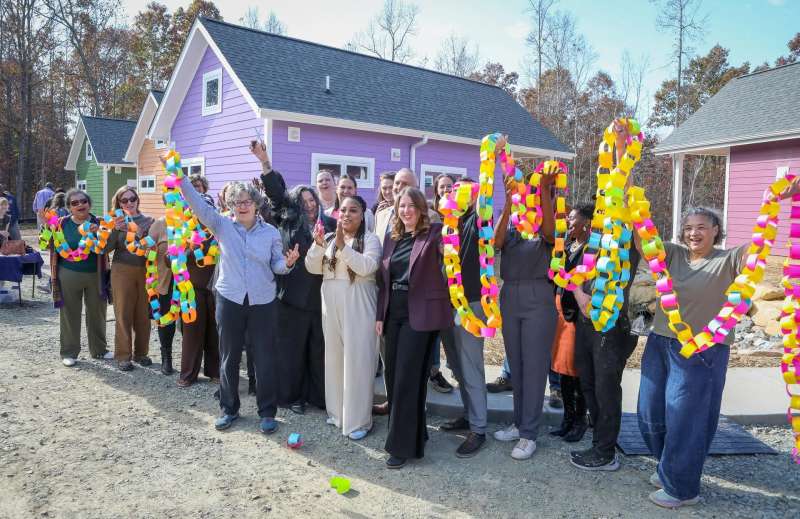
More than 100 people came to Benevolence Farm’s 13-acre property for a ribbon-cutting ceremony on Nov. 12 to mark the opening of the tiny home community, which cost about $1.8 million.
“These seven tiny homes have a huge impact for many years to come,” said Scott Farmer, executive director of the North Carolina Housing Finance Agency, which contributed $1.1 million toward the project. “It’s maybe small in size, but it certainly is not small in its impact.”
Seven years in the making
For Benevolence Farm — which welcomed its first resident in December 2016 — the tiny home community has been years in the making.
In 2019, a question from a resident who spent 27 years in prison shifted the organization’s thinking about reentry housing.

Benevolence Farm Executive Director Kristen Powers recalled a woman named Deb asking: “What would it look like to practice living free and independent amongst a community of people who get me?”
The tiny home community is one answer, Powers said. It’s a vision developed over years of planning, fundraising and gathering input from formerly incarcerated women.
When Deb was released in 2018 and came to live at the farm, she had a lot to adjust to. Powers said Deb had never seen a cell phone, let alone used a smartphone. The cost of living had soared since she was last free in 1994.
And even after spending time at Benevolence Farm, Deb was afraid to live alone, Powers said. Other women have similarly struggled with the transition from the shared farmhouse to their own apartments, unsure how to work with a landlord or budget for all their own expenses.
That led to plans for a next phase of housing — one that would give residents more independence, including their own space, while keeping them in a supportive community where they can get help navigating similar challenges.
“We’re trying to build the muscle to practice living by yourself and to have the opportunity to make mistakes without losing everything — whether it’s learning how to maintain a home, learning how to just live by yourself, or building that communication between different people,” Powers said.
Residents who come to Benevolence Farm will start out living in the shared farmhouse before moving into a tiny home when they feel ready. They can live at the farm for a total of two years across both types of housing.
“It will be more expensive living [in a tiny home] because you’re buying your own toilet paper, buying your own cleaning supplies,” Powers said. “We’re going to still try to make it as affordable as possible, but inevitably your monthly budget is going to go up by managing your own household, which is what we’re trying to mimic.”
More than a home
Mona Evans, a former Benevolence Farm resident who spent nearly five years incarcerated, provided input on the housing design. The end product exceeded her expectations.
“They did not feel tiny at all,” Evans said. “I was super overwhelmed in a joyful way.
“This is more than just a group of tiny homes for me. This is a community.”
Each 420-square-foot tiny home has a bedroom with a full-size bed, a full bathroom, a kitchen, a living area and a washer and dryer.
The homes face the woods, providing views of nature, and are painted an array of bright colors.
Every design choice was intentional and carefully considered, Powers said, and having formerly incarcerated people co-design the homes was crucial.
Gain unparalleled insights into N.C. with our essential statewide newsletter, delivered to your inbox twice a week — free.First NameEmail *Zip Code *Please verify your request. *
“The co-designers made sure the beds were on the ground floor, as bunked or lofted beds reminded them of prison,” Powers said. “They chose these joyful colors, making sure that none of them called back to what you might find in prisons, jails or psychiatric hospitals. The co-designers required that we center natural light, with the option to close out the world with curtains and blinds. They also chose doors that made them feel safe and secure.”
Take a virtual tour of the tiny homes
Evans said she wished she’d had the opportunity to stay in one of the tiny homes, but she’s glad they will be a stepping stone for other women.
“They give people the opportunity to live independently without judgment, room to make mistakes, room to feel safe and room to learn and grow,” Evans said. “They will learn how to manage these homes, communicate their needs, build relationships with neighbors, manage their responsibilities and develop the skills they need to eventually transition into permanent housing — all while being surrounded by a supportive community.”
Linda Cayton, a former Benevolence Farm resident who provided input on the design, got emotional as she described what the tiny homes meant to her.
“I cannot overstate the significance of this community because sometimes rebuilding a life begins with something as simple and profound as having a place to call your own,” Cayton said. “One home, one woman and one second chance at a time.”

Housing is foundational
Securing safe, stable housing is often the most immediate challenge that people leaving prison face. Without stable housing, people can struggle to comply with parole and post-release supervision, to get treatment and to find jobs.
“We can offer support to people all day long, but if they don’t have a stable home, it’s really maybe two steps forward and six steps back,” said David Crispell, co-founder and executive director of Jubilee Home, a reentry program in Durham that offers housing for men and women. “It’s just not sustainable.”
He attended the tiny home community ribbon cutting to celebrate the new reentry housing, which he said is desperately needed.
“We just need more of this across the state,” he said.
Benevolence Farm’s expansion comes amid a statewide push to expand housing opportunities for the state’s formerly incarcerated population.
Homelessness among people leaving prison is widespread, and data from the N.C. Department of Adult Correction shows the problem is growing worse.
Of the just over 20,000 people released from the state’s prisons in fiscal year 2025, 4,292 — or more than one in five — had nowhere to go, according to department data on the state’s Reentry 2030 dashboard. That was a 38 percent increase from fiscal year 2024, amounting to 1,190 more people facing homelessness at release.
Formerly incarcerated people and organizations that support them often say that limited housing options for people with criminal records are a major barrier to successful reentry.
Housing for people on the sex offender registry is especially limited, making their reentry even more complicated. By Benevolence Farm’s best estimates, there are only 32 reentry housing spaces for women on the sex offender registry in North Carolina. The tiny homes add seven more.
That’s significant because Powers said Benevolence Farm’s number one housing request is for people of all genders on the sex offender registry.
Need more housing
Data show unstable housing increases the risk of recidivism, which can be costly to the legal system, to the carceral system and to taxpayers. Housing one person in a North Carolina prison costs more than $54,000 per year.
Jubilee Home’s Crispell said that while building housing comes with a big price tag up front, he believes it is ultimately more cost-effective and humane than releasing people into homelessness.
“The up-front investment undermines so many downstream costs that we bear as a society — the emergency room visits, all of the different pieces of our social safety net that people have to rely on when they don’t have stable housing,” Crispell said.

His organization is brainstorming ways to expand housing options, Crispell said, particularly how to build more permanent housing for people with convictions. He said many Jubilee Home residents have difficulty finding landlords willing to rent to them.
Another women’s reentry organization, Arise Collective in Raleigh, is expanding. Chief Executive Officer Jennifer Jackson, who attended the tiny home ribbon cutting, said her organization bought almost one acre in South Raleigh in October with plans to build 10 affordable townhomes to serve formerly incarcerated women. The homes are expected to be completed in late 2027 or early 2028, she said.
Powers hopes Benevolence Farm’s tiny homes can serve as a model that can be replicated across the state — and that communities can come together to expand housing options to address the unmet need.
“The demand [for housing] has not gone away, and it will still continue even with seven more homes because there are hundreds of women who need housing… and there are not hundreds of places for people to return home to right now,” Powers said. “It’s going to continue to take a community effort.
“This is one of the models. Shared housing is a model, backyard housing is a model, having people rent out your room and/or in-law space is a model,” she said. “It is going to take a group effort.”