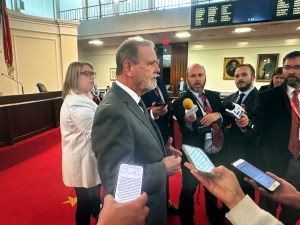
Newly elected Western North Carolina U.S. Rep. Jamie Ager wants lawmakers out of the stock-picking business.
The 11th Congressional District’s representative-elect says the new House should start by barring members and their spouses from owning or trading individual stocks.
Ager is helping lead a push by 51 incoming House Democrats to include those restrictions in the chamber’s rules when the new Congress convenes in January. With fellow representative-elect Sarah Trone Garriott of Iowa, Ager spearheaded a letter to current House Democratic Leader Hakeem Jeffries, Democratic Whip Katherine Clark and other party leaders demanding action on the first day of the new session.
“Members of Congress are getting rich trading stock in the industries they regulate while the people they represent fall behind on rent and groceries,” the lawmakers wrote.
The proposal goes beyond prohibiting lawmakers from buying and selling shares. It would bar members and spouses from owning or trading stocks, commodities, futures, derivatives and other related securities, while allowing limited exceptions for diversified mutual funds and investments placed in qualified blind trusts.
Stock trading by elected officials has generated controversy across both parties. President Donald Trump’s investment accounts executed nearly 28,700 securities trades during the first 17 months of his second term, including transactions involving companies affected by administration policies. Trump maintains that independent financial managers control the investments.
Democratic former House Speaker Nancy Pelosi has faced scrutiny over lucrative stock and options trading by her husband, Paul, particularly involving major technology companies.
Former North Carolina Republican U.S. Sen. Richard Burr sold approximately $1.6 million in stocks before the COVID-19 market collapse in 2020, prompting federal investigations into possible insider trading. The Justice Department and Securities and Exchange Commission eventually closed their investigations without taking action against Burr.
More recently, Indiana Republican U.S. Rep. Victoria Spartz faced accusations over millions in stock transactions involving her husband’s holdings. She denied personally trading individual stocks, but lost reelection to Democrat J.D. Ford on Nov. 3.
Ager announced the effort Nov. 13. The letter frames the proposed restrictions as an early test of whether Democrats will respond to voters’ concerns about public officials using their positions for personal gain.
“This is a good first step to root out corruption and grift, and it’s an action we can take on day one,” Ager said in the release.
Their argument links financial ethics to affordability, suggesting that a party promising relief from high living costs should begin by limiting opportunities for its own members to profit from investments.
Ager also connected the effort to his priorities for Western North Carolina, including securing federal assistance for recovery from Tropical Storm Helene and bringing down everyday costs.
Stock trading ban targets lawmakers and spouses

The proposed House rule would apply to members and their spouses, a provision intended to address financial holdings within lawmakers’ households rather than only transactions conducted in a member’s name. Under the language proposed in the letter, lawmakers could retain diversified mutual funds or investments in a qualified blind trust. The distinction would permit certain forms of investment while restricting direct exposure to the individual securities affected by federal policy decisions.
The letter argues that current laws have not done enough to reassure the public about lawmakers’ financial conduct. Its signers want a broader standard that prevents perceived conflicts before individual trades raise questions.
“The existing laws around insider trading are insufficient,” the lawmakers wrote. “We should hold ourselves to the highest standard and work to restore faith in government.”
Rather than ask Congress to first pass a separate bill, the incoming lawmakers are pressing Democratic leaders to adopt the restriction through the House rules package. Their request is specifically for action when the new Congress is sworn in, making the timetable as central to the effort as the policy itself.
The letter acknowledges that a trading ban would not address every concern about ethics in Washington. Its authors instead present the rule as a starting point for further restrictions involving elected and appointed officials and their spouses.
Among the signers are several other incoming North Carolina Democrats — Paul Barringer of the 13th Congressional District, Chuck Hubbard of the 5th, Cyril Jefferson of the 6th, Raymond Smith of the 3rd and LaKesha Womack of the 14th.
That gives North Carolina six signatories, including Ager, and places the effort within a broader coalition of newly elected Democrats from across the country.
Signers include other newly elected Democratic lawmakers from Iowa, Pennsylvania, Texas and California.
The appeal also contains an unusually direct acknowledgment that the blue wave election that propelled many of the signatories to Washington does not automatically mean restored public confidence in government.
“Democrats may have won the election, but we have a long way to go to earn back the trust of voters across the country,” the letter states.
The Nov. 13 release does not say whether Jeffries, Clark or other House Democratic leaders have committed to the proposed rule. For now, Ager and his fellow signers have laid out a specific demand, identified the first day of the new Congress as their deadline and made clear that incoming members want financial ethics at the top of the party’s agenda.
Jeffries did not immediately respond to an inquiry from the Citizen Times.
Reporting by Cory Vaillancourt, Asheville Citizen Times / Asheville Citizen Times
USA TODAY Network via Reuters Connect