North Carolina’s population is rapidly growing and becoming older. By the early 2030s, the population of people older than 65 is projected to surpass the number of residents who are younger than 18.
At the same time, the state is forecast to have a worsening nursing shortage. By 2033, North Carolina will need at least 12,500 more nurses, according to data from the Sheps Center for Health Services Research at UNC Chapel Hill.
“It’s not good news for our nursing shortage in North Carolina, period.”
That’s why researchers like Erin Fraher, who crunched the nursing workforce numbers, started raising the alarm this winter about the Trump administration’s Department of Education rule change narrowing the definition of “professional degree.” The new rule was finalized the first of this month and takes effect July 1.
Read More: North Carolina has a shortage of nurses. It’s expected to get a lot worse
The new definition excludes post-baccalaureate nursing degrees — such as master’s-prepared nurse practitioners and doctorates awarded to nurses who often educate the rest of the nursing workforce — from the “professional degree” classification that gets applied to physicians, dentists and ministers.
That means the amount of federal loans that graduate nursing students can take will be capped at $20,500 a year up to a total of $100,000. It can take more than five years for a doctoral nursing student to complete their advanced degree.
“It’s not good news for our nursing shortage in North Carolina, period,” Fraher said of the new loan limits.
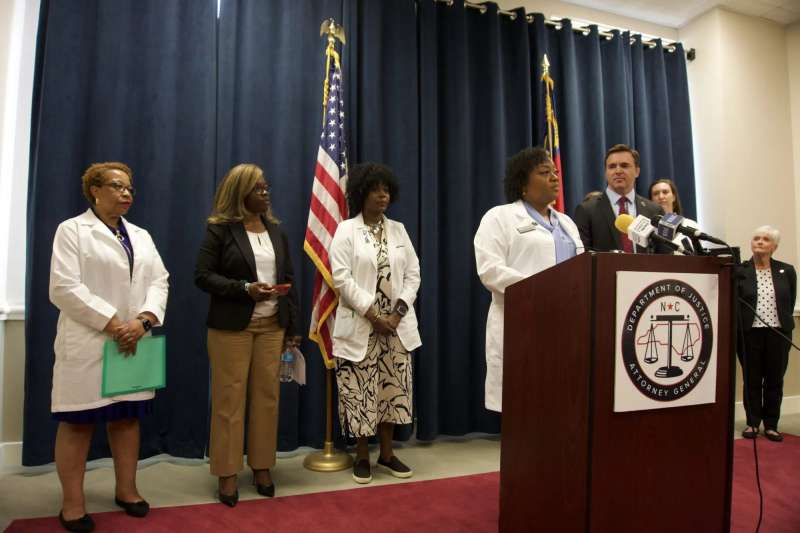
Now, state Attorney General Jeff Jackson argues that the education department’s rule change was unlawful. Jackson told reporters during a news briefing on Tuesday that he is joining a lawsuit being filed by 24 other states and Washington, D.C., against the federal Department of Education over the new rule.
“Congress has already been explicit and said ‘Here are the degrees that constitute professional degrees,’” Jackson said. “But the Department of Education said, ‘No, we’re not going to listen to what Congress said. We’re going to come up with our own list, and we’re going to exclude all nursing and all physical therapists and all physician assistants.’
“That is wrong. It is unfair, and it is unlawful.”
Limiting financial lifelines
Tuition for healthcare professional programs are all over the map. According to their websites, Duke University’s School of Nursing has a tuition rate of about $35,000 per semester for advanced degree nurses, UNC Chapel Hill’s graduate nursing program charges $18,610 per semester and graduate nursing school tuition runs around $5,366 a semester at NC A&T State University.
Many students get financial aid and scholarships that cut their costs. For many, though, student loans also go toward living expenses accrued while in school. It can be tough for nursing students to go to school and shoulder a job at the same time. Their education typically requires clinical hours as well as classroom time.
“Access to federal loans were a lifeline for me,” said Leigh Habegger, a student in Wake Forest University’s program to train physician assistants, another profession affected by the new rule.
Habegger had a decade-long career in public policy work before going back to school last year. She called her program “rigorous” and said she’s unable to work while studying, even though her program costs more than $50,000 a year.
“For those of us who pivot in mid-career to this profession later in life, it’s clear what this rule will do,” she said. “One of my fellow classmates in the class above me shared that from his class that just graduated last weekend, nearly 90 percent of students said that they would not have been able to attend PA school without federal loans. Not ‘would have struggled,’ not ‘would have needed to budget a little differently,’ flat out ‘would not have attended school.’”
“It’s really our future students in North Carolina who will bear the burden of this policy change,” Habegger added. “This rule stands to have a significant negative impact on the number of students who are able to attend PA school … in North Carolina precisely at a time when our state needs us the most.”
Choking off the pipeline
Some, including the Department of Education, have argued that professional programs have jacked up their prices, knowing that students borrow money to pay ever-higher tuition and fees.
“Placing a cap on loans will push … graduate nursing programs to reduce their program costs, ensuring that nurses will not be saddled with unmanageable student loan debt,” reads a Q&A on the department’s website. The website also contends that “95% of nursing students borrow below the annual loan limit and therefore are not affected.”
Advanced degree students might comprise only about 2 or 3 percent of all nursing students, but they are some of the most critically needed nurses, said Bonnie David Meadows, president of the North Carolina Nurses Association, which has opposed the new rule and the loan limits.
“There is an alarming shortage of nursing professors. If we restrict access to graduate degrees, it could severely cripple the nursing faculty pipeline,” Meadows said.
Nurses with doctoral degrees in nursing make up fewer than 2 percent of the 188,735 nurses licensed in North Carolina.
Meadows noted that each year, North Carolina nursing schools turn away qualified candidates for bachelor and associate degree programs because of a lack of faculty, who need at least a master’s in order to teach.
“This change will disproportionately impact nursing students from lower income backgrounds and could force determined students to utilize more expensive and even sometimes even more predatory private loans,” Meadows said. “The $100,000 cap on student loans for graduate nurses is short-sighted. We should be maximizing the capabilities of our entire profession.”
She and other speakers also argued that by hamstringing students’ ability to borrow, the pipeline of nurse practitioners, physician assistants and other highly trained healthcare professionals to rural parts of the state will slow.
“Nearly one in five advanced practice registered nurses works in rural areas,” said Deborah Barksdale, a doctorally prepared nurse who heads the American Academy of Nursing. “A study published in Health Services Research noted that certified registered nurse anesthetists make up to 80 percent of the anesthesia providers in rural counties.”
“Ninety-three of our 100 counties are healthcare professional workforce shortage areas,” said Sen. Gale Adcock (D-Cary), a nurse practitioner for close to four decades. “Twenty-eight of our counties lack any OB-GYN certified nurse midwives or hospitals that offer obstetrical care, 97 counties are designated mental health healthcare provider shortage areas, 31 of our counties have no psychiatrist, 25 have no mental health or substance use prescribers of any kind. While all counties, except eight, are a healthcare provider shortage area, many of the others lack adequate and timely access to primary care clinicians.”
Will the past be prologue?
Jackson said he believes the lawsuit has a good chance of succeeding. He compared some of the legal questions to those that arose last year when the federal Department of Education tried under the Trump administration to withhold $165 million in education funding that Congress had approved from the state. Jackson and other state attorneys general prevailed in getting the education department to unfreeze the funds after taking court action.
Jackson acknowledged that the cost of higher education is challenging not only for many students, but also the federal government. But the Trump administration action could have far-reaching detrimental effects, he added.
“Congress has a legitimate issue on its hands with respect to affordability of education, and that’s why they put these caps in place,”Jackson said. “This really is not a policy question — for ‘Was Congress right or wrong?’ there. This is a legal question — for ‘Was the Department of Education right?’ and how they misconstrued congressional intent.”“They really willfully mischaracterized what Congress passed,” Jackson contended, adding that he thought the education department had “plainly broken the law.”
“The downstream consequences of that are going to be very harmful for the state,” Jackson said. “That’s my lane. That’s my case.”
Reporting by Rose Hoban, NC Health News / Asheville Citizen Times
USA TODAY Network via Reuters Connect