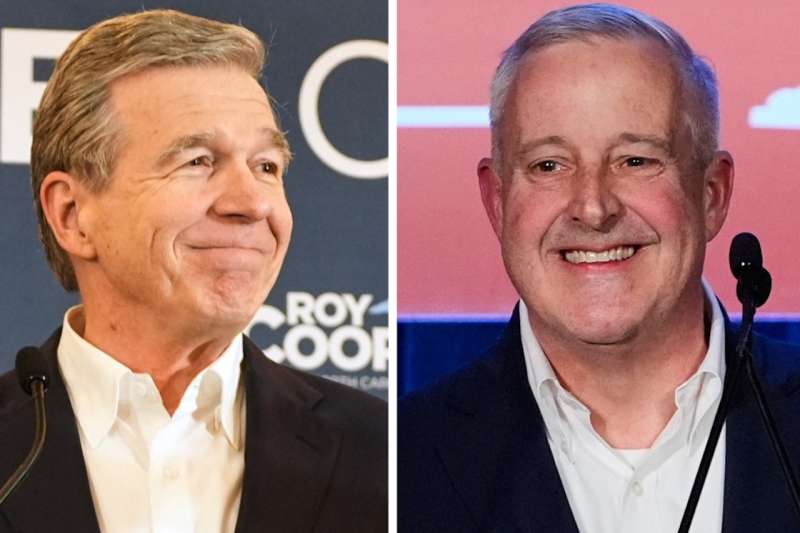
North Carolina’s 2026 US Senate election between former governor Roy Cooper (D) and Republican Michael Whatley has long been billed as a vital and expensive race that could help determine which party controls the chamber next year.
Each party has thrown millions of dollars into the race, seeing it as a hinge election that could decide whether Congress will serve as a bulwark against President Donald Trump or fully free him of nearly all constitutional checks and restraints.
All of that is still true.
But what do these candidates actually believe and stand for? What issues are at play in North Carolina beyond the political calculus and narratives?
Here is a quick primer on where Cooper and Whatley stand on several key issues facing North Carolina and the country at large.
The Backdrop
There are stark differences between the candidates on most issues, but the subtext of the race itself is just as important.
There is no bigger example of the bulwark role that a single senator can play than the man Cooper and Whatley are looking to replace. US Sen. Thom Tillis, a Republican, said last year that he would not run for re-election soon after refusing to vote for President Trump’s budget bill and its “devastating” Medicaid cuts, which could eventually kick hundreds of thousands of North Carolinians off their health insurance.
Trump vilified Tillis and said he would back a primary challenger against him. Tillis removed himself from the political fray, but he will not leave office until January 2027 and has remained a barrier that Trump often fails to clear.
In a statement last year explaining his decision not to run again, Tillis decried politicians who put themselves over the needs of their constituents.
“Too many elected officials are motivated by pure raw politics who really don’t give a damn about the people they promised to represent on the campaign trail,” Tillis said.
“After they get elected, they don’t bother to do the hard work to research the policies they seek to implement and understand the consequences those policies could have on that young adult living in a trailer park, struggling to make ends meet.”
Tillis’ framing was prescient.
It would have felt right at home in Cooper’s attacks against Whatley.
Affordability
Cooper had made affordability a centerpiece of his campaign, framing his appearances across the state as a “make stuff cost less” tour.
To be clear, the Senate overall, much less a single Senator, does not have the power to bring down costs all by itself, and the full story of inflation has many authors. But several aspects of Trump’s policy initiatives have directly contributed to rising costs and accelerated the rate of inflation.
A recent Congressional study showed that Trump’s tariffs cost US families an additional $2,500 this year.
And Trump’s war with Iran has further driven up the cost of fuel, fertilizer, equipment, and goods, costing US households $1,100 on average so far.
A separate report by Defend America Action found that the war, tariffs and other Trump policies are “wreaking havoc” on North Carolina farmers and the US agriculture industry.
Cooper lists several economic proposals on his campaign website, including banning grocery stores from using algorithms to charge certain customers more per item and reversing the Trump Medicaid cuts.
Cooper has also vowed to push against Trump’s tariff and war policies. Whatley has embraced them with no hesitancy.
The Trump effect
Trump has won North Carolina each time he’s run for president, but his approval rating in the state is falling, and though he is not on the ballot this year, he is one of the key issues.
Whatley has few policy details on his campaign website, and only added those vague points in June after the News & Observer asked him for details of his plans. But he has made it clear that his biggest pitch to voters is his vow to be a wide-open doorway for anything Trump wants or demands.
“I am committed to advancing President Trump’s America First agenda as the next U.S. Senator from North Carolina,” Whatley says in the first issue on his campaign issue page.
Despite the glaring evidence to the contrary, Trump has denied that the Iran war has caused economic hardship, and even refuses to acknowledge there is an affordability crisis.
When voters and journalists have pressed him on the campaign trail about rising inflation and the rising costs crisis, he often sticks to attacks against taxes and says little about costs.
In June, Whatley told a Wake County roundtable of college students and small-business owners that he wanted to lower their taxes.
“People want to take home more money. They want to keep more money, right? And so, we want here in Wake and everywhere else to have them focus on what we’re going to do to make sure that their tax burden is low,”
He did not elaborate or explain how he planned to help increase anyone’s take-home pay. And state income taxes in North Carolina are already among the lowest in the country, while the tax cuts in Trump’s 2025 budget bill mostly benefitted the nation’s wealthiest individuals.
Hurricane and other disaster relief
Trump appointed Whatley as the recovery czar for western North Carolina after Hurricane Helene and to a panel charged with improving FEMA, an agency that provides states much-needed assistance in the wake of natural disasters but has faced bipartisan criticism for a lack of urgency and efficiency in times when both are desperately needed.
The panel’s formal recommendations called for reforms that would significantly reduce the amount of money provided to states after disasters. But it did not call for dismantling FEMA as many conservatives, including Trump himself, have called for.
But at a campaign event in May, Whatley told an attendee that he indeed had pressed Trump to abolish FEMA, not just reform it.
In the exchange, which was caught on audio obtained by Cardinal & Pine and other news outlets, a woman asked Whatley if the US can “get rid of FEMA.”
Whatley responded: “I’ve suggested the president do that.”
Abolishing or significantly diminishing FEMA would push the bulk of the costs and logistics of disaster response to the states, costs that states and local communities simply can’t cover on their own.
Helene caused between $60 billion and $78 billion in damages in the state, depending on the estimate.
Whatley told the attendee that he would rather the federal government provide block grants to states to address disaster relief.
In an analysis of previous attempts to replace or supplement FEMA with block grants, the Center for Budget and Policy Priorities said that because block grants are fixed rather than responsive they are often inadequate in addressing widespread disaster relief where costs can balloon suddenly with changing conditions.
Congress approved $9 billion in disaster relief, much larger than the $2.4 billion the General Assembly was able to allot for the same purpose. But much of the federal aid has been delayed or hung up by Trump officials, and even Republican Senator Ted Budd criticized the federal effort.
As the conservative-leaning Carolina Journal reported last month, Budd criticized the delayed dispersal and called for even more federal funding.
“Too many projects in western North Carolina have stalled due to insufficient funding, or because of financial shortfalls from expensive debris removal and rebuilding efforts,” Budd told a Senate hearing in July.
Disinformation from Trump and other far-right conservatives about aid and recovery efforts in Helene’s immediate aftermath caused some North Carolinians to reject FEMA’s help and falsely painted Cooper as unresponsive.
During the campaign, Whatley has also accused Cooper of botching the recovery effort.
Other issues
- Whatley has said he approves of Trump’s desire to create a $1.8 billion fund to pay Trump supporters convicted of crimes, including the rioters who broke into the US Capitol on Jan. 6, 2021, and injured more than 150 police officers. Cooper criticized the fund and Tillis was instrumental in quashing the fund for good.
- For decades, the Chemours facility in Fayetteville contaminated private wells and drinking water across the southeastern part of the state with PFAS, the industrial ‘forever chemicals’ that have been linked to several serious health issues, including infertility, liver problems, and cancer. While governor, Cooper pushed to hold Chemours responsible for the cleanup. So far during the campaign, WUNC reported, Chemours has donated $5,000 to Whatley’s campaign.
- Whatley has come under intense scrutiny for his ties to Harvey West Jr., a GOP official whom Whatley frequently promoted despite West being accused of raping three minors in 1999 and serving six years in prison.