Healthcare scarcity and looming Medicaid cuts are top of mind for North Carolina’s doctors, leaders, and residents.
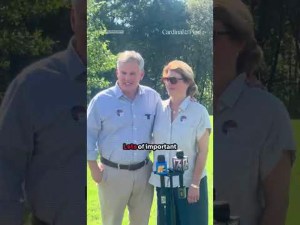
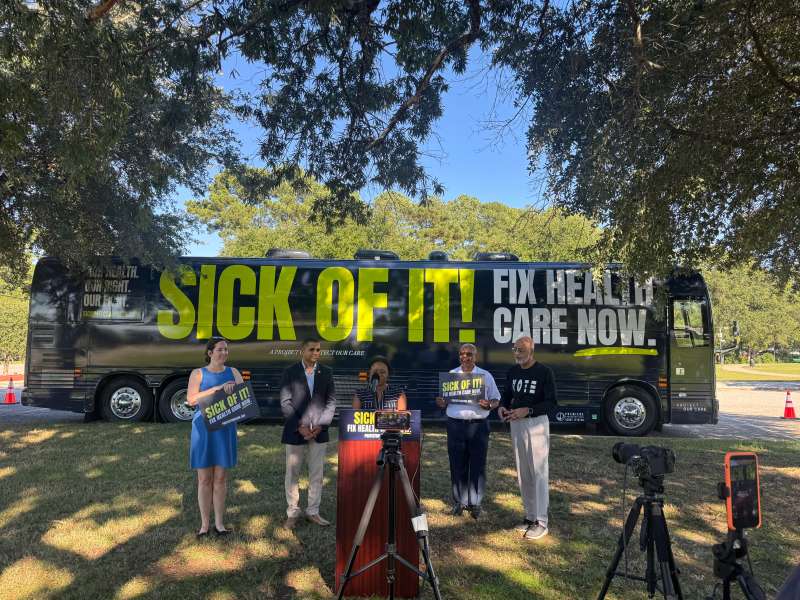
As part of a 15-state, 35-stop nationwide tour in a bus dubbed “Care Force One,” Protect Our Care, a healthcare advocacy organization, held a press conference in Rocky Mount last week to highlight the challenges facing the community and North Carolina as a whole.
Speaking at Martin Luther King Park on the Nash County side of Rocky Mount, State Rep. Dante Pittman (D-Wilson County) spoke out about the looming threat of Medicaid cuts from H.R. 1, commonly known as the One Big Beautiful Bill Act.
“ We need federal leadership that will stand up and reverse these terrible decisions. I stand ready with my colleagues now and with my future colleagues coming back to the General Assembly,” Pittman said. “But the truth is, we need leaders in Washington that will also be willing to stand up against special interests and look out for us right here in Eastern North Carolina.”
The community is currently represented in Congress by Democratic Rep. Don Davis, who voted against the One Big Beautiful Bill Act. He is running for re-election in a race Cook Political Report lists as a “tossup”.
“Rural hospitals are having difficulty staying open, and H.R. 1 will restrict the amount of Medicaid funds available to rural hospitals, as well as hamstring them. Rural hospitals may be forced to reduce services or possibly close,” Davis previously said.
Pittman told Cardinal & Pine after the press conference that eastern North Carolina residents are already facing serious healthcare challenges.
“ Even before these cuts have come into place, it is an incredibly difficult time in parts of Eastern North Carolina. We’re talking about seniors being able to find a doctor. We’re talking about specialists. We’re talking about nurses that are available, not to mention rural hospitals and the amount of closures that we’ve seen,” Pittman said.
Over the next ten years, an estimated $1 trillion in total Medicaid cuts will take effect, with federal Medicaid funds for rural communities specifically set to decline by $137 billion over the same period.
Dr. Maureen Andreassi, a volunteer with the Committee to Protect Healthcare, practiced medicine in several North Carolina communities. After 31 years, she retired in Dec. 2025.
Andreassi says loss of Medicaid coverage would be detrimental to North Carolinians who get coverage through the program.
“If they don’t have anything, it’s going to be really bad,” she told Cardinal & Pine. “There’s going to be people in the ER for everything.”
Specialty care is harder to come by in rural communities
Rural communities like much of eastern North Carolina have fewer options for healthcare specialists like psychiatrists and cardiologists.
Urban areas of the US average roughly 263 specialist doctors per 100,000 people. By comparison, rural areas average 30 specialists per 100,000 people.
Andreassi says this is a serious issue worsened by the rising price of gas this year.
“If you say to somebody ‘the only doctor that can see you is 40 miles away,’ they’re going to be like ‘I can’t pay for that gas,’” she said.
As of Oct. 19, the price of regular gasoline is up 85 cents year over year, while diesel is up $2.16 per gallon over the same period.
Rev. James Gailliard, the senior pastor at Word Tabernacle Church in Rocky Mount and a Democrat running for the North Carolina House of Representatives, has personally experienced the difficulty of accessing specialty care.
“ I have healthcare coverage, thank God, but because of the lack of accessibility and the lack of specialists, I called to get a colonoscopy, ’cause I’m of that age now, need a colonoscopy, and the wait for my colonoscopy was seven months,” he said. “Can you imagine how many people die prematurely, how many people miss a diagnosis because they had to wait seven months, eight months, 10 months?”
Galliard says this hasn’t been a one-time inconvenience for him, and that he waited months to see an eye doctor.
“ I called in June and was told the first available appointment was December. Imagine the implications of that for our young people who need to have their eyes checked before they go to school. So this is a critically important matter,” he said.
A senior speaks out about healthcare options for the elderly
Haywood Watson spoke at the Protect Our Care event about how scarce healthcare options affect older North Carolinians. Watson is 75 years old.
“ Healthcare isn’t something I just take for granted. I need regular care, medications, and doctors who know my history. That’s what allows me to stay independent and live my life with dignity,” Watson said.
One of the biggest challenges the One Big Beautiful Bill Act presents to rural communities is the potential closure of hospitals.
The law is estimated to reduce Medicaid reimbursements to rural hospitals by 21%.
An analysis from the University of North Carolina Cecil G. Sheps Center estimates that the law puts 338 rural hospitals at risk of closure, including five in North Carolina.
Most recently, Martin General Hospital closed without warning in Aug. 2023 after 73 years of operation in Martin County.
Davis has sought federal funding to reopen Martin General and expand healthcare access in eastern North Carolina, seeking $175 million.
“Since the closure of Martin General Hospital in 2023, there has been an increased travel distance for families. In support of reopening the hospital, I held a town hall in the county, engaged with local, state, and federal officials, including sending a letter to President Donald Trump to make him aware of this situation,” Davis said. (Read more about Martin General Hospital in Cardinal & Pine’s coverage of the effort to reopen the hospital.)
Watson said that rising costs across the board are forcing North Carolinians to make difficult choices.
“ No one should have to choose between paying their medical bills or paying for food, housing, or electricity. We need a complete reversal of all the bad policy choices that have been made over the past couple of years. We need funding restored to Medicaid,” he said.
Andreassi, the retired doctor, believes Medicaid cuts will have serious consequences for both patients who lose coverage and the healthcare system as a whole.
“It will strain the emergency network. For people on Medicaid now, I think if they lose their Medicaid then their quality of care will drop significantly. Now you’re going to have more long-term complications of diabetes. You’re going to have more long-term complications of lung disease, heart disease, and none of it’s going to be paid for,” she said. “Over time, I really think it can break the system.”