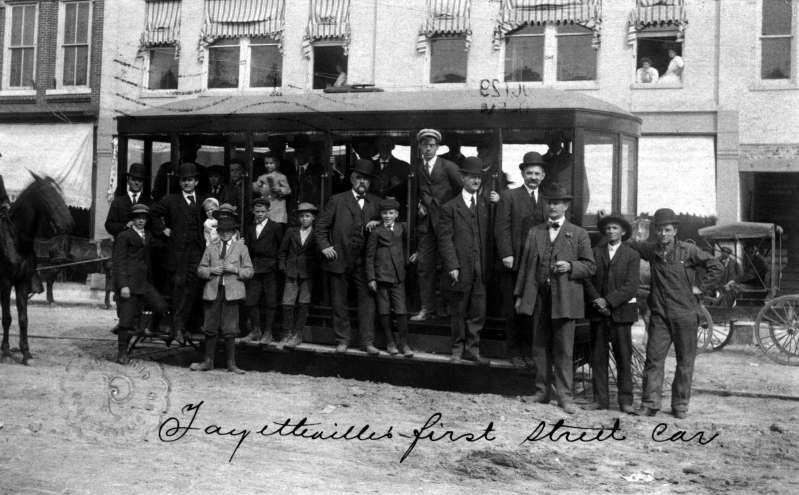
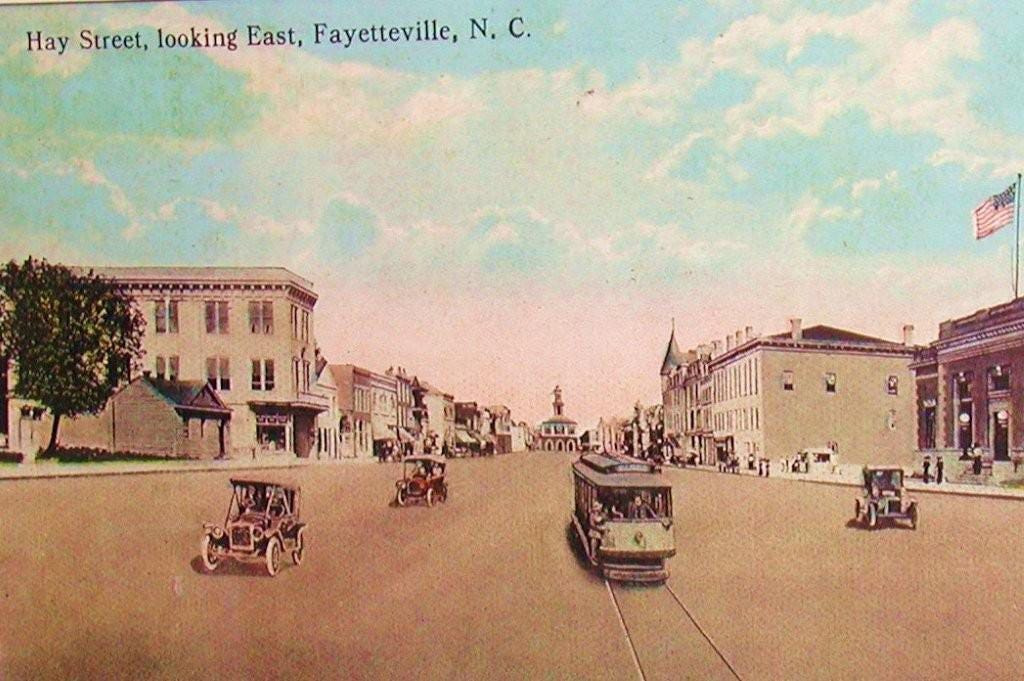
Today, as in most city’s across the country, transportation in downtown Fayetteville is dominated by automobiles. In the early 1900s, however, streetcars once crisscrossed the budding metropolis on steel rails that stretched out from the city center.
From 1907 to 1921, Fayetteville operated a system of electric rail vehicles, which carried passengers along tracks embedded in the city streets from the Market House to textile mills in Massey Hill and Camp Bragg.
How the Fayetteville streetcars started
According to Hattie Presnell, historic properties supervisor for the city of Fayetteville, four different streetcar companies operated in Fayetteville during the streetcar era. The four companies were the Consolidated Railways Light & Power Company; Fayetteville Street Railway & Power Company; Fayetteville Traction & Power Company; and Cumberland Railway & Power Company.
While the first streetcar didn’t begin operating until 1907, plans began much earlier. In 1867, the Fayetteville Street Railway & Power Company incorporated in the city. State legislation that year gave “the power to construct a street railway and to run car, upon the track of the same, propelled by animal or other power, in any of the streets or alleys of the town of Fayetteville, for a distance of two miles from the market house.”
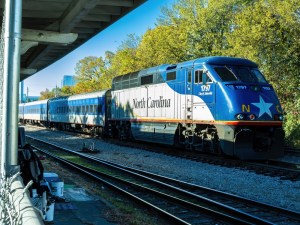
Forty years after the initial interest, the Fayetteville Street Railway & Power Company laid its tracks in 1907. The route ran 1.25 miles, connecting the Atlantic Coast Line Railroad, which is now the Fayetteville Amtrak station at at 472 Hay St., to the fairgrounds on Gillespie Street. Streetcar travel was more convenient than walking and gave downtown dwellers access to areas like Massey Hill, where some found work in the textile mills that populated the area.
Upgrades to the Fayetteville streetcars
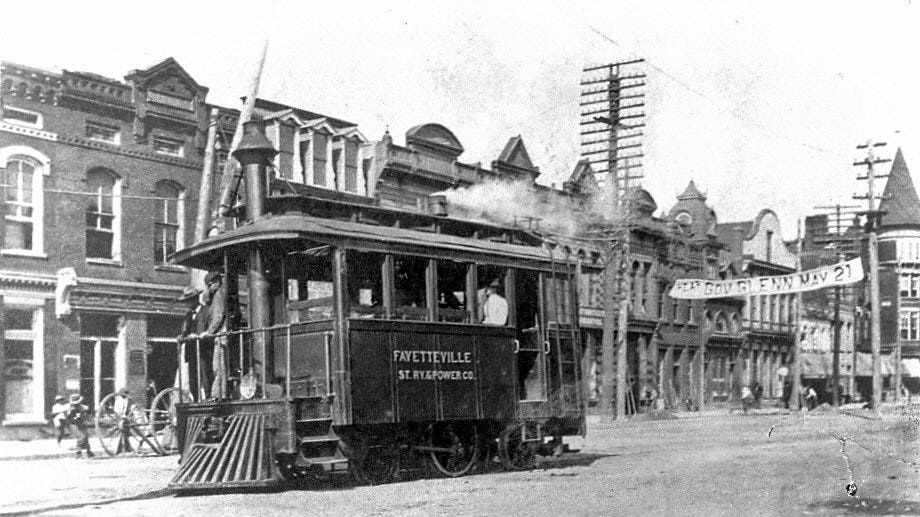
In 1908, there was a change in how the streets cards were powered. The gas-powered trolley that ran from Haymount Hill to Massey Hill was replaced with a new electric trolley, that operated like the traditional streetcar setup of the 1800s.
The three trolleys that ran the Haymount Hill to Massey Hill route became known as the Toonerville Trolleys, as reported by The Fayetteville Observer. The nickname was possibly inspired by the early 20th-century comic strip Toonerville Folks, which often depicted cheap and crowded streetcars. The slang term Toonerville refers to “a rickety or inefficient railroad line” according to Merriam-Webster.
Route to Camp Bragg
Other streetcar routes in the city came from unconventional sources.
In 1920, Fayetteville city leaders and then-Camp Bragg officials wanted to connect the city to the installation, as reported by The Fayetteville Observer. After some deliberation, Army Gen. A.J. Bowley proposed a streetcar that would run from the Market House to Camp Bragg.
In 1921, the proposal became a reality. The Fayetteville Observer reported that Bowley established a line connecting the city and Army installation along a wooden plank road that is the now-closed route that once connected Bragg Boulevard to Fort Bragg.
The end of the Fayetteville streetcars
Citizens of Fayetteville nick-named the street cars the “Toonerville Trolleys.” The fee for riding these cars was only 5 cents. The first trolley ran on steam; the second street car was powered by a gasoline engine, and the third was electric.
Dr. J.W. McNeill of the Fayetteville Street Railway & Power Co. received the city’s approval to establish and operate a street railway system for 30 years, but the company changed ownership and the system began to unravel in the early 1920s, according to Presnell.
In 1920, Haymount Hill was repaved after sewer infrastructure was upgraded. When it came time to lay new streetcar tracks, a dispute arose over who should pay for them. Residents argued the railway company or the city should cover the cost, while the railway company maintained taxpayers or the city should pay, according to a story in the June 15, edition of the Fayetteville Daily Observer.
The growing popularity of automobiles also contributed to the streetcar’s demise, though not simply because people stopped riding them. As automobiles and streetcars shared Fayetteville’s streets, crashes became more common, particularly at night. The streetcars had no lights, and neither did the tracks they ran on, making them difficult for motorists to see, according to Presnell.
“Several issues led to the end of streetcar operations in Fayetteville: the cost of re-laying tracks, concern over the number of streetcar-related accidents rising, and the rise of personal automobile purchases,” Presnell said.
By the early 1920s, streetcars were gone from the city’s landscape, leaving behind only photographs, newspaper accounts and a little-known chapter in Fayetteville’s transportation history.
Reporting by Ryan Medlin, Fayetteville Observer / The Fayetteville Observer
USA TODAY Network via Reuters Connect