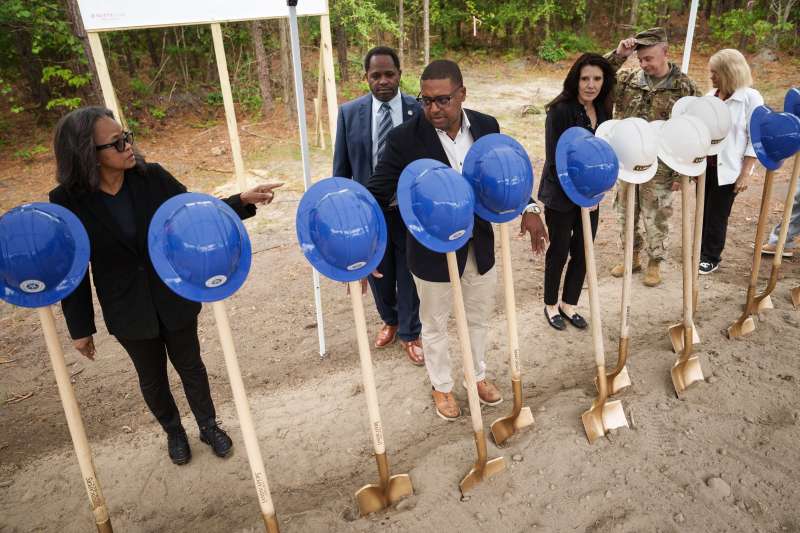
City Council members are pursuing bond money to pay for a major sports complex on McArthur Road in north Fayetteville — a project that has been a long time in the making and is expected to be an economic draw.
I am here for it. The project is well in line with what this community has said it wants, dating back years.
Staff presented to the council at its Sept. 28 meeting a resolution to seek approval for limited-obligation bonds totaling $28.5 million to pay for the sports complex and, separately, for six new fire trucks. The city will formally seek the permission of the state’s Local Government Commission, which must approve such municipal financing arrangements.
The city of Fayetteville would pay back the bond money in yearly payments.
“There is no tax increase associated with this,” said David Cheatwood, managing director of First Tryon Advisors, which provides financial advice to the city, in remarks to the council last Monday. “You all, as you well know, allocate a certain number of pennies on your tax rate to your capital fund. This debt service would get paid out of that capital fund.”
A decade-long vision is taking shape in Fayetteville
City and city-county parks and recreation officials broke ground in April for the sports complex, slated to be built on McArthur Road between Interstate 295 and Lake Mont Court.
The complex will span over 70 acres of land leased from Fort Bragg to the city and is planned to include 12 baseball and softball fields; a multi-use building with restrooms; concessions and office space; an open-air pavilion; office space; family amenities that include a playground and splash pad. The bond would dedicate $18 million to the complex, which would include $13.6 million for the construction contract awarded to Group III Management.
The sports complex is the second-to-last major project from the $36 million parks and recreation bond package that voters approved in 2016. The final project on that list is the Cape Fear River Park, which the city lists online as in a design phase.
As I’ve shared before, that original bond led to a number of top-notch facilities in a community that needed them — two senior centers; the Rowan Street Skate Park downtown; Mable C. Smith Park and the Deep Creek Road Community Center; improvements to the Jordan Soccer Complex near Methodist University; and many splash pads.
The facilities tend to be well-used, showing the need. The Bill Crisp Senior Center, with its beautiful views of Lake Rim, played host in August to the National Senior Citizens Day Conference and Recognition Luncheon, which drew hundreds of people, according to organizers.
Additionally, the bond took care of several maintenance and repair issues at various parks, enabling the council to dig into its budget to quadruple the number of pools from one to four. I continue to describe the 2016 bond as one of the best investments a city ever made in itself — voters went for the package by a wide margin, nearly 60% in favor.
The reality of rising construction prices over time has meant big-ticket items like the sports complex have outstripped the original funding, however.
Nevertheless, a strong case can be made the investment is well worth it. All solid parks and recreation offerings enhance quality of life and can make people see the city and county as a place they want to stay. But this sports facility in particular is meant to tap into the market for sports tourism. With its location right off I-295, the hope is it will snag traveling sports tournaments, which can add to local coffers with guests staying in hotels and patronizing restaurants and retail outlets.
A council member raises questions about debt concerns
Meanwhile, the fire-truck portion of the new bond would fund two fire engines, one heavy rescue vehicle, two ladder trucks and a pumper truck.
City Council members passed the resolution unanimously.
Shaun McMillan, who represents District 8, did ask about the debt payback timelines for these projects — 20 years for the complex and 15 years for the trucks — and the payback timelines for other capital projects. He also shared what he said were residents’ concerns that the city would spend a long time paying down debt with investments, like Segra Stadium and the proposed downtown convention center.
He asked whether the council had a way to evaluate its overall debt picture, when it comes to such projects. This, he said, “gives us a realistic assessment of when we’ll come out of the debt that we’re accruing in the last several years.”
Both Cheatwood and Murray indicated the city does track all existing debt and proposed debt, as part of a long-term capital plan.
Murray said: “The city is not in a position to cash flow all our needs at any given time,” she said. “Debt is a part of our long-term financial plan.”
Colvin pointed to the city’s bond rating, mentioned earlier in the meeting by Cheatwood — the second highest municipal bond rating which the financial advisor said was “indicative of the good financial health of the city.”
Colvin said “The city is an almost $400 million entity,” one that would inevitably need to finance some projects. The city’s rating shows its growth has been responsible, the mayor said.
“If you’re a growing city and not a shrinking city, you are always going to need to buy fire trucks,” he said. “You’ll need to pave streets, or you’ll need to build things.”
Comparing it to a business, he added: “If you’re a business and you don’t have ongoing expenses, then that means you’re not moving and moving forward.”
There’s something to be said about that.
On parks, this community has moved forward since 2016, and let’s keep the momentum going.
Reporting by Myron B. Pitts, Fayetteville Observer / The Fayetteville Observer
USA TODAY Network via Reuters Connect