The debate around data centers has become a critical issue in communities across North Carolina and the United States.
As things currently stand, more than 50 local governments across the Tar Heel State have passed some version of a moratorium on building data centers.
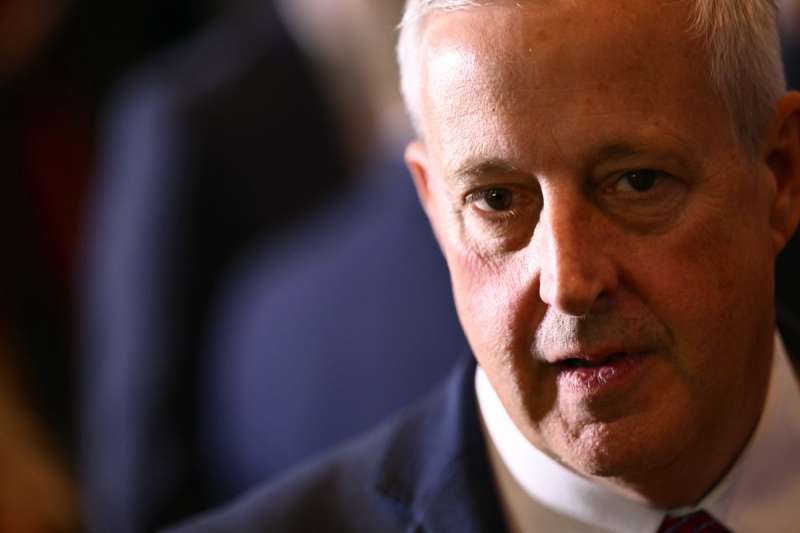
Republican US Senate nominee Michael Whatley has said he opposes subsidies for data centers, though he supports tax breaks for them.
He has also accepted $27,000 in contributions from partners, executives, and investors affiliated with private equity firm Kohlberg Kravis Roberts & Co. (KKR), which co-owns data center company CyrusOne. CyrusOne operates a data center campus in Durham and is building another campus in Lee County.
Whatley has also disclosed that his family holds investments in several companies involved in the data center industry, including Apple, Nvidia, Alphabet (Google), and Microsoft.
Whatley has also come under scrutiny from Democrats, including his opponent, former Gov. Roy Cooper, over his individual stock holdings in recent months.
These include investments in companies like Duke Energy, which is one of the largest utility providers in North Carolina. Whatley’s family holds up to $410,000 in individual Duke Energy stock.
Whatley took tens of thousands from group which owns data centers
One of Whatley’s KKR donors, Raj Agrawal, who gave Whatley $5,000, referred to the company as a “one-stop shop for hyperscalers.”
Alongside Global Infrastructure Partners, KKR jointly owns CyrusOne, a Dallas-based company that manages more than 55 data centers, including facilities in North Carolina.
CyrusOne’s DUR1-DUR2 data center campus, a 420,000 square-foot, 40 megawatt facility, is already operational and is located in the Research Triangle Park, located near Raleigh-Durham International Airport.
CyrusOne is also in the process of developing a data center campus in Lee County near Sanford.
Over 2,800 Lee County residents signed a June petition calling for a moratorium on data centers.
A third-generation farmer in the community got emotional at an Aug. 17 county commission meeting as he discussed his concerns about the data center and how it could affect his farm, quality of life, and livestock.
“I’ve been down there for 47 years. […] I’m thinking about selling every damn thing I got because of y’all,” he said.
At a July commission meeting, another Lee County farmer, Jeff Kidd, expressed similar concerns about noise pollution coming from data centers.
“Sounds like a helicopter landing on your house. This is what’s going to happen to us in Lower Moncure,” Kidd said.
What has Whatley said about data centers?
In an interview with Fox News’ Brian Kilmeade, Whatley dismissed some of the grassroots opposition to data centers.
“You also got to remember that this opposition to data centers is not organic. This is being ginned up the same way that we saw opposition to energy projects around the country. You know, they’re trying to build a new nuclear plant. All of a sudden, people come out of the woodwork and they hate nuclear,” Whatley said.
Whatley’s campaign has previously said he opposes subsidies for data centers.
“Michael Whatley’s standard is simple: data centers pay their own way, families pay nothing, and communities decide. That means Big Tech builds or buys every megawatt it needs and covers every dime of the grid upgrades to deliver it, with zero costs shifted onto residential ratepayers,” campaign spokesperson DJ Griffin said
However, Spectrum News reported that Whatley said he supports tax breaks for data centers. The two are related concepts, but technically different. A tax break would mean companies pay less in taxes, whereas a subsidy would involve the government providing money or other financial support directly to the data center developer.