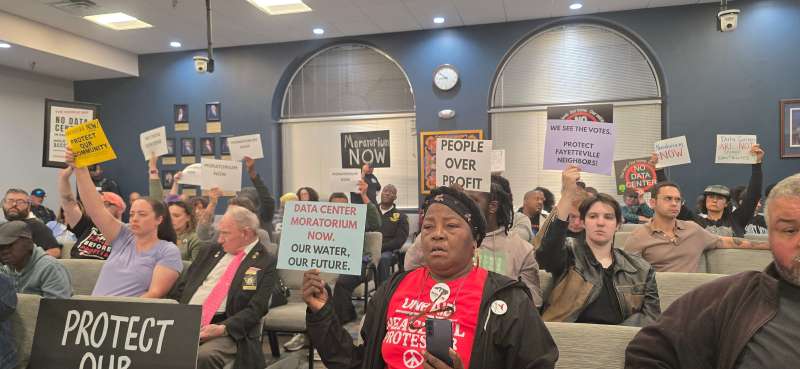
Amid repeated crowd outbursts and the removal of a protester by police, the Fayetteville City Council voted 6-4 Monday to approve revised data center regulations.
The council voted 6-4 to adopt the amendments at its Oct. 26 meeting. Council members Lynne Greene, Antonio Jones, Stephon Ferguson and Shaun McMillan voted against the amendments. Mayor Mitch Colvin, Mayor Pro Tem Derrick Thompson and Council members D.J. Haire, Deno Hondros, Brenda McNair and Malik Davis voted in favor of the amendments.
Although the amendments were approved, they will not take effect until after a public hearing on the proposed data center moratorium. When that hearing will occur remains uncertain.
The vote marked the latest step in Fayetteville’s months-long debate over how to regulate data centers. In August, the council sent proposed data center regulations back to staff for revisions. The revised ordinance returned at a special meeting Oct. 19 with additional amendments. At that meeting, the council directed staff to make further changes and bring the proposal back for consideration at its Oct. 26 meeting.
Read More: 4 reasons North Carolina residents are pushing back on data centers
The council also voted 6-4 on Oct. 19 to schedule a public hearing on a proposed data center moratorium, though a date had not been set by the end of Monday’s meeting. Colvin, Thompson, Haire and Hondros voted against scheduling the hearing. Greene, Jones, Ferguson, McMillan, McNair and Davis voted in favor of the hearing.
Monday’s meeting sparked another debate among council members. Supporters argued the amendments would provide immediate safeguards for potential data center development. Opponents argued that the city is moving too quickly and should focus on developing stronger protections through the moratorium process.
The debate also drew repeated outbursts from the audience, with one protester ultimately removed by police.
Repeated outbursts and comments from the crowd prompted multiple gavel strikes from Colvin, who warned attendees that further disruptions would result in removal from the chamber.
Colvin said Monday that the council has learned from city staff, the public and community members who attended the three community listening sessions held on data center regulations. He acknowledged that residents and council members may not agree on every aspect of the issue, but said the city should continue working toward a solution.
“I think there’s an opportunity to continue to get it right to work together to have a positive discussion,” he said.
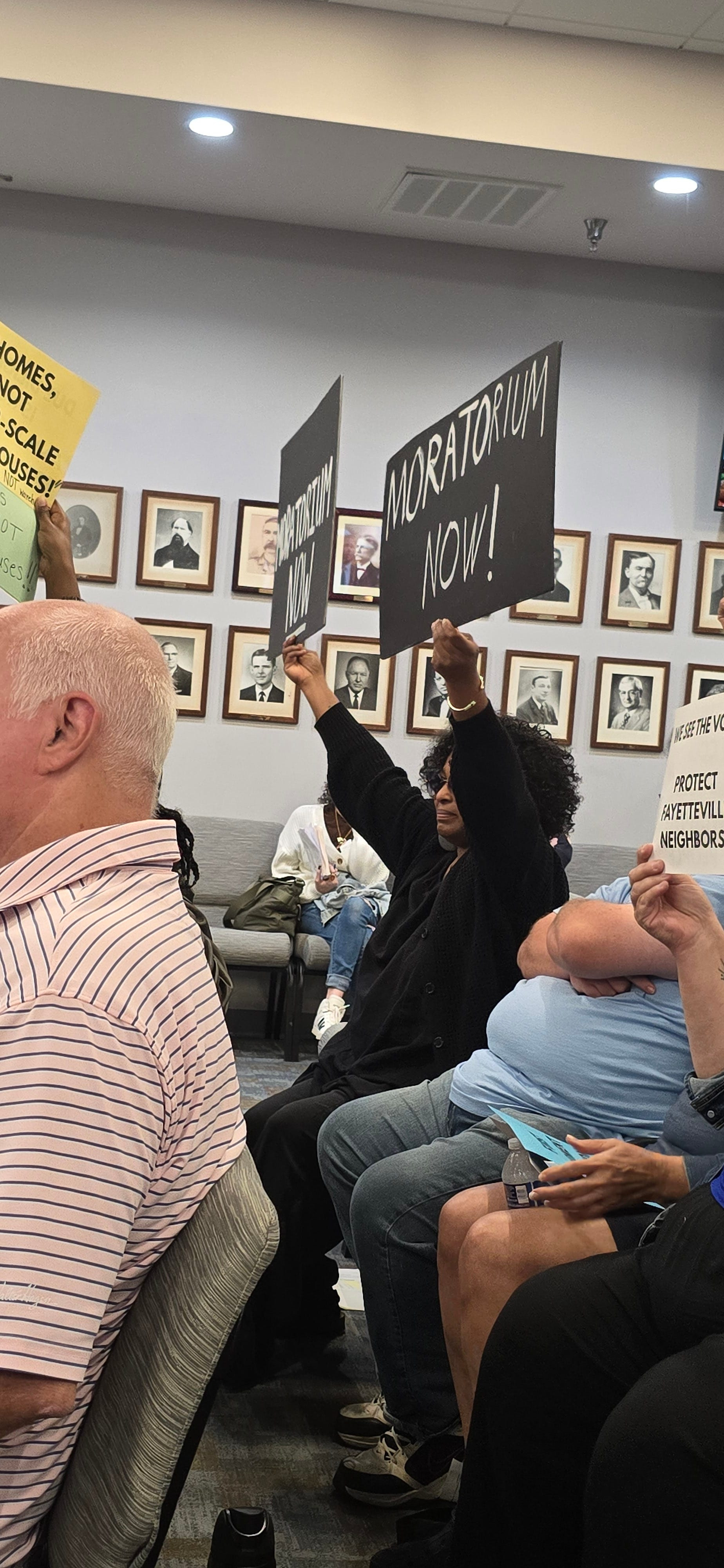
The disruptions were the latest in months of public opposition to potential data center development. Since April, community members have regularly attended council meetings to call for a moratorium, leading to packed chambers, protests and heated public hearings on the issue.
UDO amendments
While audience members continued to urge the City Council to adopt a moratorium, the council ultimately voted to approve the UDO text amendments establishing standards and protections for future data center development. The ordinance includes requirements related to noise, utility impacts, power demand, water consumption, air emissions, setbacks and appearance.
Nick Tosco, land-use and zoning lawyer and the town attorney for three municipalities — Highlands, Ranlo and Elon, two of which have data center UDOs — was hired by the city to advise council members and staff on the legal issues surrounding the proposed text amendments. City staff used his recommendations to draft the amended UDO, which was approved by the council Monday.
The amendments that were approved included:
- Removing language that prohibited unlisted uses, which are types of development not specifically mentioned in the zoning ordinance. Even if the development isn’t listed, developers can argue that it’s similar to a use that is already allowed.
- A new definition for data centers and an additional definition for warehouse storage
- Data center-specific standards that address noise, utilities, lighting, air quality compliance and a 24-hour contact person
- Adding conditional rezoning, which would give the city the authority to consider each developer’s proposal on a case-by-case basis and develop restrictions based on the proposal
Thompson made the motion to approve the amendments, arguing the city needed to put protections in place before a developer submits a data center proposal.
“Let’s make sure that we do something now, so we can have the protections that we need for our constituents,” Thompson said Monday night.
The Cumberland County Board of Commissioners has already drafted its first ordinance for the facilities. The ordinance will be presented to the Board of Commissioners for approval later this year, as it nears its six-month moratorium, which was approved in June.
Questions leading up to the vote
The data center ordinance builds on the city’s existing warehouse storage ordinance, which has its own standards, including a 500-foot setback from a residential district, school or child care center.
Council members questioned whether the 500-foot setback was sufficient.
“Instead of wrapping them into warehouse facilities, why don’t we wrap them into something that already has a 2,000- or 1,000-foot setback?” Hondros asked.
Tosco said staff opted to use the city’s existing warehouse storage standards in Chapter 30 of Fayetteville’s UDO because uncertainty over data center regulations and North Carolina’s down-zoning law could leave new restrictions vulnerable to legal challenges.
“There is an argument to be made that if you put a new 1,000-foot setback requirement on, that reduces development or decreases development density,” Tosco said. “So that’s why by doing the 500-foot setback that is currently in there, you are not decreasing development density because it’s already an existing setback.”
Tosco said North Carolina’s down-zoning law prevents cities from adopting zoning changes that significantly restrict property owners’ development rights. That includes reducing how property can be developed, eliminating previously allowed uses, or creating new requirements that would put existing properties out of compliance.
“What the staff has painstakingly done is try to figure out a way to have the most amount of protections and regulations in place without violating one of those three things,” Tosco said.
Ferguson, however, asked whether a 1,000-foot setback could still be considered if the city had more time to study the issue.
The city’s Development Services Director, Gerald Newton, said additional protections could be explored through the proposed moratorium process.
“There are items that should be addressed, that a moratorium can address, that we cannot, that we cannot cover with zoning regulations that are in Chapter 30,” Newton said.
Davis raised additional questions about environmental protections and the closed-loop or recycled water cooling system, asking whether placing it in the UDO would violate down-zoning laws.
“I do not believe that a closed-loop cooling system requirement does violate down-zoning,” Tosco said. “That is my legal opinion.”
Davis then recommended that the closed-loop system be added to the UDO as an additional amendment.
Ever-changing UDO
After lengthy deliberation, McMillan said, “We’re clearly not ready to adopt text amendments tonight.”
He said Fayetteville is rushing its approach compared with other municipalities that have adopted moratoriums and are continuing to research and refine data center regulations.
Earlier this month, Raleigh adopted a six-month moratorium on data center applications and permitting. On Monday, Charlotte extended its moratorium for up to one year after its initial 150-day moratorium was set to expire Nov. 5.
Newton said additional time could improve the ordinance, but said data center regulations are evolving rapidly and any ordinance adopted now would likely require future revisions.
“What we see this month and what we see in three months, six months, and in a year, it’s going to continue to change,” Newton said.
Colvin said that the city has to decide on a UDO at some point, especially as Cumberland County nears the end of its moratorium in December.
While Colvin had the floor, audience members in the chamber erupted into chants of “Shame,” prompting the removal of the protester who started the chant.
Colvin then warned that anyone responsible for another outburst would be removed by security.
“We’re gonna finish this business tonight,” Colvin said.
As debate continued, Colvin said the council ultimately had to make a decision on the ordinance despite ongoing disagreements over the city’s approach to data center regulations.
“We’re gonna try to get it right, but at some point, we’re gonna have to come to a decision,” Colvin said.
Concerns over Thompson’s motion
Part of Thompson’s motion stipulated that the amendments would not take effect until after the public hearing on the proposed moratorium. Thompson said the amended UDO would move forward if the council ultimately decides against adopting a moratorium on data center development. If approved, the moratorium would temporarily halt new development while additional regulations are considered.
“What you’re proposing could put us in danger,” McMillan said. “You say it’s putting something in place, but that something is worse than just focusing our attention on a moratorium. The moratorium is the best protection that we have.”
Colvin argued that the best way forward is with protections because right now the city is “vulnerable to everything.”
Public hearing date unknown
Council members questioned when the public hearing could be held and how long it would be before the regulations become effective. The council’s remaining scheduled meetings this year include a work session Nov. 2, regular meetings Nov. 9 and Nov. 23, and a special meeting Dec. 7.
It was unclear whether the moratorium ordinance would first have to go through the Planning Commission, which could delay when it reaches the council.
“When is the soonest we can have the public hearing on the moratorium, because I don’t think it can wait until January,” Hondros said.
City Attorney Lachelle Pulliam said she would follow up with staff and provide clarification on the proper process and timeline for scheduling the public hearing on the proposed moratorium.
Reporting by Coral Aponte, Fayetteville Observer / The Fayetteville Observer
USA TODAY Network via Reuters Connect