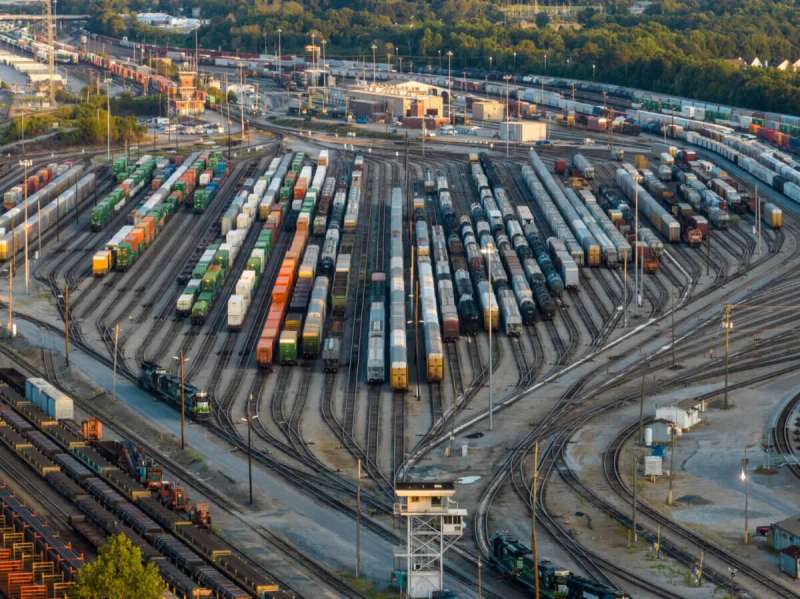
President Joe Biden on Friday signed a bill that forces a deal between national freight railroads and their unions, averting a potential strike that could have had serious ramifications on travel and the economy, but also denying rail workers their key demand in negotiations: paid sick days.
The legislation, which passed both the House and Senate in bipartisan fashion, requires the rail worker unions to adopt the tentative agreement reached in September by union and company leaders.
It’s unusual for Congress to insert itself into collective bargaining negotiations, but under the 1926 Railway Labor Act, Congress can step in to resolve disputes between rail unions and the railroads as part of its constitutional power to regulate commerce.
On Tuesday, Biden said that he was sympathetic to the unions’ demands for paid sick leave and would fight to pass a national paid sick leave law, but he stressed again that a rail strike had to be avoided because of economic ramifications, which include possible supply shortages of key commodities like lumber, coal, and chemicals and economic losses of up to $2 billion per day.
Under the agreement, rail workers will see 24% wage increases over the four-year life of the deal, the biggest pay increases won by the unions in more than 50 years. They’ll also gain slightly more flexibility to take time off for doctor’s appointments, and they’ll gain one paid personal day. The agreement does not, however, include any new, dedicated time off for illnesses.
Union members spent two years negotiating with the extraordinarily profitable rail companies, with their primary request being paid sick leave, but the rail companies refused to budge—to the outrage of rail workers and some Democrats.
“It’s unacceptable for these CEOs to be raking in huge salaries while denying workers a single sick day,” Rep. Ro Khanna said on Twitter earlier this week.
Congresswoman Alexandria Ocasio-Cortez of New York echoed a similar sentiment, saying that “railroad workers grind themselves to the bone for this country as their labor produces billions for Wall Street.”
Democratic lawmakers tried to pass a second bill that would have added paid sick days to the agreement, but were unable to reach the 60-vote threshold needed in the Senate, due to most Republican senators opposing the measure.
Union officials reacted with anger to the failure of the paid leave vote.
“It is shocking and appalling that any Member of Congress would cast a vote against any sort of provision that raises the standard of living for hard-working Americans. In fact, such a vote is nothing less than anti-American, an abdication of their oath of office and you are deemed, in my eyes, unworthy of holding office,” Tony D. Cardwell, National Division President of the Brotherhood of Maintenance of Way Employes Division, said in a statement.
Cardwell also criticized the federal government for intervening in the labor dispute to protect the economy, without protecting the interests “of the citizens that make this nation’s economy work – American Railroaders.”
“Members of Congress were obligated to vote to pass paid sick leave for all Railroad Workers. The Representatives were not obligated to protect the exceeding profits of the corporations. A number of Members of Congress chose – yet again – to trample on the Workers, in their rush to cozy up to the corporations,” Cardwell said.
Rank-and-file workers also expressed frustration.
Tom Modica, a rail mechanic in Chicago, told The Washington Post that rail workers “carry the country on their backs” and criticized the federal government for forcing the deal on the unions.
“The fact that [Congress] are willing to force a contract down our throats to keep the railroads from shutting down means we’re important,” he said. “But they get sick days, and we’re out here in the snow all day and we don’t. It’s pretty hypocritical.”