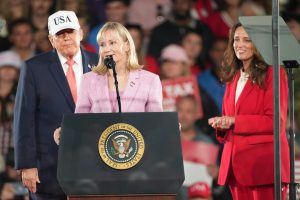
On Aug. 27, Laurie Buckhout, the Republican nominee in North Carolina’s 1st Congressional District, posted a now-deleted graphic thanking the North Carolina Soybean Producers Association’s political action committee, NC SoyPAC, for complimentary remarks.

This election is a rematch from 2024, when Rep. Don Davis (D-Greene County) defeated Buckhout. The deletion comes as both candidates court soybean farmers, while NC SoyPAC remains neutral in the contest.
“The NC SoyPAC has donated to both Rep. Davis and Ms. Buckhout in the past and in the current election cycle (2026 general election) because both individuals have been strong supporters of North Carolina farmers,” NC SoyPAC said in an email. “The NC SoyPAC will not be making an endorsement in this race, or in any other race this election.”

Buckhout’s campaign said in an email statement they deleted the post to avoid implying NC SoyPAC had formally endorsed her campaign.
“NC SoyPAC sent our campaign a letter, along with a contribution to Laurie’s general election. The letter praised Laurie’s commitment to North Carolina farmers and the work she will do in Congress,” Campaign Manager Stephen Gallagher said in an email to Cardinal & Pine. “Our post quoted directly from that letter. We removed it to avoid any confusion between the PAC’s kind words and a formal endorsement.”
The soybean industry is important to the district and North Carolina as a whole, with 1.6 million acres of farmland dedicated to soybean production.
Soybeans are the largest agricultural commodity in the state, with over 62 million bushels produced in 2024.
Four of the top 10 counties for soybean production are in the first district, highlighting the industry’s importance in the race between Buckhout and two-term Democratic incumbent Don Davis.
In that election, NC SoyPAC gave $1,000 to Buckhout’s campaign. In 2022 and 2023, SoyPAC donated a total of $2,000 to Davis.
Tariffs: the elephant in the room for the soybean industry
The tariff policy implemented by Donald Trump has emerged as a major issue for North Carolina’s agriculture sector and farmers across the state.
Tariffs increase the costs of imports, while retaliatory tariffs from other countries raise the costs of American goods being shipped across the globe.
Overall, the agriculture industry contributes over $110 billion to North Carolina’s economy and accounts for 20% of the state’s jobs.
In January, The Carolina Journal reported the president’s tariff policies could lead to the loss of 8,000 jobs in North Carolina and economic loss of around $700 million.
The US Supreme Court ruled in February that Trump had no authority to enact most of his tariffs.
Both Buckhout and Davis have commented on the president’s tariff policy during the campaign.
“It’s time that we level the playing field. And I know that President Trump is doing that, and it takes some time,” Buckhout said in support of the tariffs during a Republican primary debate in February.
Davis called on Congress to reclaim authority over tariffs.
“The current wide-reaching and unpredictable approach has hurt farmers and manufacturers in eastern North Carolina,” he said.
North Carolina lost about 800 farms between 2024 and 2025. Tariffs cost North Carolina an estimated $3.5 billion just last year.
Tariffs continue to be an imminent problem for North Carolina farmers. This week, in response to Trump levying 50% tariffs on Canadian goods entering the United States, Canada implemented reciprocal tariffs on $20 billion worth of American goods.
These tariffs will especially hurt the agricultural industry, as Canada is the second-largest importer of American agricultural products, behind Mexico.
North Carolina farmers could feel the financial impact of these tariffs, as America’s neighbor to the North is the largest export market for the Tar Heel State, with machinery and vehicles among the top products sent to Canada.