by Will Atwater, North Carolina Health News
September 10, 2026
Key Takeaways:
- The Veteran’s Farm teaches agricultural skills while offering former military members structure, community and a path into civilian life.
- A state grant will help the nonprofit expand programs and support veterans in crisis as they wait for VA benefits.
- The program connects veterans interested in farming with an industry seeking its next generation.
After serving five years in the Marine Corps and another 10 as a Department of Defense contractor, Robert Elliott found the transition away from military life difficult. The jobs he took did not last, he said, and neither did his first attempt at college.
Elliott was at a low point.
“I started going down to a really dark place in my mind,” he said. “A lot of folks that get out of the military in the first year, statistically speaking, wind up having really hard transitional issues.”
Read More: The 2026 guide to fall foliage in North Carolina
Missing the camaraderie and structure of military life, Elliott said he returned to something familiar: farming. He was raised on a family farm in Louisburg, North Carolina, where he helped tend tobacco, corn and cattle, and he drew on that experience and the discipline he developed in the Marine Corps to give agriculture another shot.
Farming restored Elliott’s sense of purpose, he said, and he began to wonder whether it could offer other veterans a route into civilian life. In 2015, he founded The Veteran’s Farm of North Carolina, a nonprofit that provides veterans with agricultural training and support as they pursue farm careers.
A way to ease into civilian life
The Veteran’s Farm of North Carolina trains military veterans in agriculture, with the goal of helping them build careers and find community after service. The nonprofit aims to address two challenges: helping veterans navigate civilian life and preparing a new generation to enter an aging farm workforce.
Before founding The Veteran’s Farm in 2015, Elliott helped create Soldiers to Agriculture, a five-week training program now offered through N.C. Cooperative Extension in Cumberland County. The program introduces veterans, military spouses and active-duty service members preparing to leave the military to agricultural careers through classroom and hands-on instruction.
The General Assembly provided new support for The Veteran’s Farm in its 2026 state budget; the nonprofit is slated to receive a $250,000 nonrecurring directed grant. Elliott, now 47, said the money will help the organization expand.
The grant comes as North Carolina’s agricultural sector looks to bring new farmers into the industry.
The average U.S. farm producer was 58.1 years old in 2022, according to the U.S. Department of Agriculture’s Census of Agriculture. That aging workforce is a concern in North Carolina, where agriculture and agribusiness had an estimated $111.1 billion economic impact in 2022, according to a 2024 analysis of USDA data by NC State University economist Mike Walden.
“Encouraging the next generation of farmers and ensuring they are prepared is important to the long-term success of agriculture in North Carolina,” North Carolina Agriculture Commissioner Steve Troxler shared in an emailed statement. “The Veteran’s Farm program works with military members who are interested in farming after their service ends, providing a solid educational foundation and mentors to help them prepare for a career in farming.”
Retired Army Lt. Col. Andrew Scruggs served 21 years before retiring in 2025. The Cumberland County resident said he and his wife became interested in homesteading during the COVID-19 pandemic, when he began to see “how fragile our economy can be, and also our food supply and supply chain.”
The couple began considering a land purchase and looking for ways to become more self-sufficient by growing food, Scruggs said. His wife learned about The Veteran’s Farm of North Carolina, and he decided to enroll after attending one of the nonprofit’s open houses.
Scruggs began the training program in January and finished in May.
Scruggs says one of the key points about the program is how it prepares veterans to enter agriculture without overextending themselves.
“[Elliott] gives you a baseline understanding of what it means to be a small production farmer and helps you start in a smart, controlled way that fits your capabilities, instead of slinging out $200,000 on equipment and going down the wrong path,” Scruggs said.
Classroom and hands on training
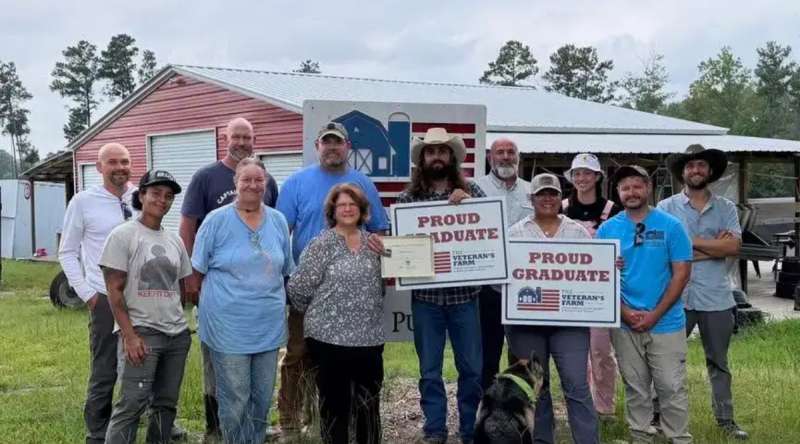
The Veteran’s Farm offers several training options for veterans and service members interested in exploring agricultural production, volunteer staff member Robin Tutor said. Its flagship program, the Veterans Agricultural Training and Education Program, is a five-month course that combines classroom instruction, labs and farm tours with hands-on farm experience.
After the first two months, which cover core agricultural skills, veterans move into a more individualized phase of the program. That portion includes a farm project, a business plan and more work experience, Tutor said.
For active-duty service members preparing to leave the military, the organization offers the Farm Military Agriculture Program. The two-month course uses the same classes, labs and tours as the five-month course but is designed as a military-transition and career-exploration opportunity. Participants typically stay on active-duty pay while enrolled, Tutor said.
The Veteran’s Farm also offers Basic Agricultural Training, a five-day course available by request for people seeking an introduction to farming. For participants who want to continue beyond VATEP and Farm MAP, the organization offers or connects them with apprenticeships and additional hands-on work experience through partnerships with workforce development, apprenticeship, university and community college programs.
Building more than farm skills
Elliott said some veterans enter The Veteran’s Farm’s training programs seeking more than the skills needed to pursue agriculture as a career. He recalled one participant who was dealing with a traumatic brain injury and a knee injury from military service.
“One day he came to me and he was like, ‘Hey, listen, if it’s OK with you, can I just go sit with the cows today?’” Elliott said. “That’s what he wanted to do for the remainder of the time that he was here. I’m like, that’s absolutely fine with me.”
Elliott said he knew the participant was unlikely to graduate from the program and become, as he put it, a “rock star farmer.” But the farm could offer time and space to adjust to life outside the military.
“What the farm is doing is giving them time to decompress while they’re trying to get out of the Army,” Elliott said. “It kind of brings them down out of the tempo of the military.”
Elliott said that one of the obstacles that former military personnel face when they leave the service is the lack of routine. “There’s no structure,” he said. “In the military, everything you need is pretty much taken care of for you, or by somebody on your left and right.”
Suicide prevention
The loss of structure combined with other challenges can have devastating effects.
Suicide is a serious concern for veterans. In 2023, 6,398 veterans died by suicide nationwide, according to the Department of Veterans Affairs. The agency reported that 61 percent of those people had not received VA health care in the last year of their lives.
“We’ve lost six of my guys to suicide,” Elliott said, speaking about people he served with.
He and Tutor are developing a suicide-prevention model with the University of Arkansas that draws on what he sees as overlapping pressures facing veterans and farmers.
“The same issues that veterans face that are leading to the suicide statistics in the veteran community are the same exact things, just in a little bit of a different format, that farmers are facing now,” Elliott said.
Farmers and others in farming, fishing and forestry are among occupational groups with elevated suicide rates, according to the Centers for Disease Control and Prevention. In 2021, the rate among men in that occupational group was 49.9 deaths per 100,000 male workers, compared with a rate of 32 deaths per 100,000 males in the general population.
Elliott said The Veteran’s Farm works with a mental health expert who spends time getting to know the students, and teaches coping mechanisms to deal with stress. One goal is to make sure that veterans are signed up to receive health care through Veterans Affairs because the process can take a while, he said.
“If they’re not enrolled in it already, they’re looking at eight to nine months before they get to see the first therapist, and you know that’s usually just a basic intake,” Elliott said. “If we’re talking about [roughly] a year between getting someone who is having a life crisis to the point where they can actually get in front of somebody with the benefits they have, there’s a lot that can go wrong in that year.”
To help address this, Elliott said the organization plans to use part of their new state funding to pay for veterans experiencing crisis to receive treatment from local providers while waiting for their VA benefits to become active.
But Elliott and others involved with The Veteran’s Farm say that, for some veterans, farming can offer a way to carry forward the purpose they found in military life.
“In farming, there is a sense of continuation of service,” said Scott Marlow, a former board member. “For people in the military, it’s very much about [that], and farming is a way to continue serv[ing] other people by growing food. And that’s not a small issue.”
For more information about The Veteran’s Farm and their courses, visit their website or call 919-721-2039.
This article first appeared on North Carolina Health News and is republished here under a Creative Commons Attribution-NoDerivatives 4.0 International License.