But he warned that his ability to veto any anti-abortion laws pushed by the Republican-controlled General Assembly was at risk in the November elections.
South Carolina lawmakers this week are considering whether or not to ban all abortions from conception, except to save the life of the mother. The move comes after a six-week ban—before many women even know they are pregnant—went into effect after the fall of Roe v. Wade last month.
In fact, in the two weeks since the US Supreme Court struck down the constitutional right to abortion care, nearly a dozen states have severely restricted access to abortion or banned it outright, either through new laws or trigger laws that were automatically reinstated once Roe was overturned.
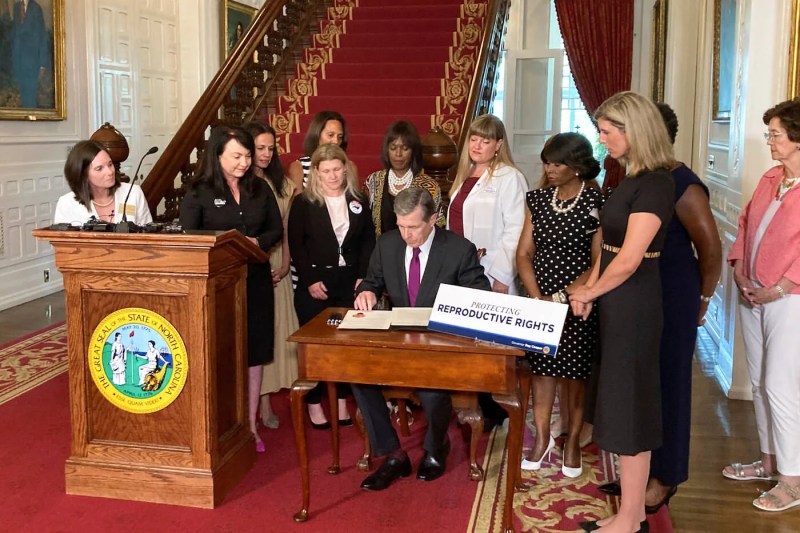
On Wednesday, Gov. Roy Cooper took a step to ensure, at least for now, that North Carolina would not join them.
Vowing to “never back down when women’s health is on the line,” Cooper signed an executive order that helps ensure patients have access to abortions here and protects doctors and abortion providers against lawsuits from other states.
Cooper also warned that his ability to veto anti-abortion laws pushed by the Republican-controlled General Assembly, so far the only thing that has kept them at bay, was at risk in the November elections.
“We know the direction of women’s healthcare in our state isn’t just up to me,” Cooper said at a press conference before he signed the order. “The state legislature makes the laws and they can pass some bad ones.”
The executive order would “help us make sure that patients can get the care that they need in North Carolina,” Cooper said, “even if they come from out of state.”
The order’s provisions:
- Help local law enforcement officials enforce state law prohibiting anyone from obstructing or blocking access to a healthcare facility.
Cooper said he had already spoken to police officials throughout the state and would continue to do so, reminding them that while free speech protections allow some protests at abortion clincis, they do not allow anyone to prevent patients from going in the building or to harrass them as they do so.
- Prohibit any North Carolina state agency from requiring a pregnant employee to travel to states that have severely restricted or banned abortion.
Though the vast majority of abortions take place in the first 20 weeks of pregancy, most of those that happen later are because of a serious health risk to the mother. Many of the laws in the states banning abortion provide no exceptions to the health of the parent.
- Bar any North Carolina cabinet agencies from cooperating in lawsuits from other states against North Carolina abortion providers, advocacy groups, or women who traveled here from those states to get an abortion.
Abortion rights advocates and health officials fear that legislatures that have banned abortion could try to punish anyone who help a resident cross state lines to get the procedure, including doctors in states where it is still legal.
Any law enforcement officials from other states “trying to enforce one of these oppressive criminal laws,” Cooper said, “would have to get information from North Carolina about what happened, and this executive order instructs cabinet agencies not to provide that information.”
Dr. Katherine Farris, the chief medical officer of Planned Parenthood South Atlantic, said at the press conference that this week alone, her group’s abortion providers in North Carolina were set to deliver care to nearly 200 patients from other states, a third of currently scheduled visits. This number is expected to rise, she said.
While North Carolina is one of the only Southern states where abortion remains legal, there are some restrictions. And if North Carolina Republicans in the General Assembly win a supermajority in November, that is all but assured to change.
Republican leaders have said they would not try to bring these kinds of bills up for a vote as long as they lacked the numbers to override Cooper’s veto. But they will revisit the issue after the November elections, they said.
“The consequences for this November’s elections have never been more serious,” Cooper said. “If Democrats lose just two seats in the [NC] Senate or three seats in the House, then North Carolina loses the ability to protect women’s reproductive rights.”
And these races, he said, “could be decided by a handful of votes.”
The legislature has already tried to pass highly restrictive measures, including a ban after six weeks.
“Too often we’ve expected the worst for this legislature,” Cooper said, “and too often they have delivered.”
The “bad bills” he has vetoed in his term, he said, “were introduced before this terrible Supreme Court ruling,” and the General Assembly will now “be even more brazen and dangerous,” if they win enough votes.
“We cannot allow those bills to become laws in North Carolina,” Cooper said.
Alexis McGill Johnson, the president and CEO of Planned Parenthood Federation of America, was one of several abortion rights advocates who attended the signing.
She said that abortion rights access in North Carolina was essential beyond its borders.
“People throughout the Southeast rely on North Carolina as an access point,” McGill Johnson said. “Without Gov. Cooper’s help, without his veto, access for people in North Carolina, and South Carolina, Tennessee, and the entire region would be devastated.”
Still, she said, this executive order was a small, but important step.
“There are a lot of people out there who I know are feeling hopeless,” she said. “But today right here in North Carolina, we are rebuilding some of that hope.”