Republicans in the General Assembly say they are almost ready to turn in their homework a year after it was due.
North Carolina is still the only state in the nation operating without a budget, but Republican leadership in the General Assembly said this week that they had agreed on a “framework” that could become a formal budget deal next month and finally provide some relief for public school teachers and state employees who have gone more than two years without a raise.
Republicans control both the NC House and the NC Senate, but House Speaker Destin Hall (R-Caldwell, Watauga Counties) and Senate leader Phil Berger (R-Guilford, Rockingham Counties) were unable to overcome their differences and pass the budget last year.
But the framework agreement, Hall and Berger said this week, would provide teachers an average raise of 8% and would add some bonuses and other supplements that would make the average starting teacher salary the highest in the southeast. So far, there is no written or published bill that shows these figures, just the spoken words of Berger and Hall.
The lack of a budget effectively amounted to a pay cut for teachers, already among the lowest paid in the nation, as their cost of living rose even and their income stalled.
Gov. Josh Stein expressed some optimism about the teacher provisions announced in the deal, but said that lawmakers still had work to do to make it real.
“It is past time that our teachers, state law enforcement officers, and state employees get a meaningful pay raise and recognition for their service to the people of North Carolina,” Stein posted on X on Tuesday.
“If the final budget actually includes real salary increases, it would be welcome. The proof, however, will be in the pudding.”
‘Smoke and mirrors’
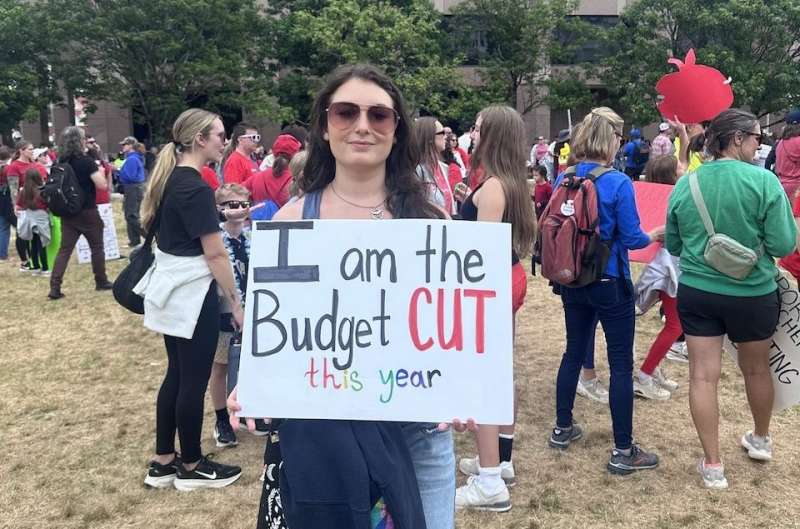
More than 10,000 teachers and educators marched through Raleigh this month to protest the lack of a budget. This week, the North Carolina teachers union criticized the budget framework as “smoke and mirrors.”
“They announced an 8% average raise for teachers, but no back pay for the work already done this school year,” Tamika Walker Kelly, president of the North Carolina Association of Educators, said in a press release.
“Eight percent may sound like a raise — until you pay Duke Energy’s skyrocketing electric bill, Aetna’s ballooning insurance premium, and more at the gas pump. Meanwhile, teachers are still spending more than $1,000 of their own money just to stock their classrooms.”
The damage has already been done, the NCAE said, and this fix doesn’t do enough to fix it.
“The same politicians who spent a decade draining billions from public education now want applause for giving a fraction of it back,” the NCAE said in the press release.
“They deserve none.”
Hall and Berger said that under their framework, state employees would get a 3% raise and bonuses up to $1,750 depending on where they work.
North Carolina law enforcement officers would see much bigger raises than teachers or state employees. The smallest raise for law enforcement would be 13%, and could be as high as 20.3% for officers with the State Bureau of Investigation and Alcohol Law Enforcement.
North Carolina Democrats also said that given the length of the impasse, they were underwhelmed by the agreement, characterizing it as mere talk until there was an actual bill to vote on.
“Just so we’re all on the same page – a budget deal was *announced* yesterday, but there is no actual, final budget deal,” state Rep. Lindsey Prather (D-Buncombe County), wrote on X.
“They have a “framework” (their words). We have nothing in writing to even consider or discuss, much less vote on. Still waiting.”
Tax provisions could lead to future funding cuts for schools
The agreement also includes several tax provisions that would lower state income tax rates and reduce property taxes, which would lower individuals’ costs but could also create future revenue shortfalls for communities and harm public schools.
The framework would reduce the personal income tax in the state every two years until 2034 and include two constitutional amendments that would prevent future legislatures from increasing the state income tax above 3.5%. It would also limit property tax increases, a key source of income for small towns and rural governments.
State income taxes account for 29% of all state and local revenue, according to the Tax Foundation, a national non-profit. That revenue helps the state, counties, and small towns pay for public schools and other services.
With less revenue, there will be less money for the services the public depends on.
Though Stein seemed to support the teacher raises, he was far less eager about the tax provisions.
“The proposed constitutional amendment would put North Carolina in a financial straitjacket that could wreak havoc on our public schools and public safety,” Stein said in his post on X.
“If we want to continue to be the best state to live, work, and raise a family for years to come, we must be fiscally responsible and not make working families bear an unfair burden.”
NC Rep. Robert Reives, the Democratic minority leader in the House, told NC Newsline that even if income tax rates fall, the bills those taxes pay for will remain. Local governments will have to find that money in other ways, and North Carolinians will still pay the price through increased sales tax and fees.
“You’re still getting taxed,” Reives (D-Chatham, Randolph Counties) told NC Newsline. “It’s just not coming through personal income tax.”
The amendments, which will be on the ballot in November if they are part of the formal budget, will hurt schools, Kelly said in the NCAE press release.
“Lawmakers are proposing additional limits on income and property taxes — deliberately shrinking the revenue pie — which means next year, and the year after, there will be even less for public schools and working families,” Kelly said.
“This is not a solution. It is a setup, and everyone loses.”