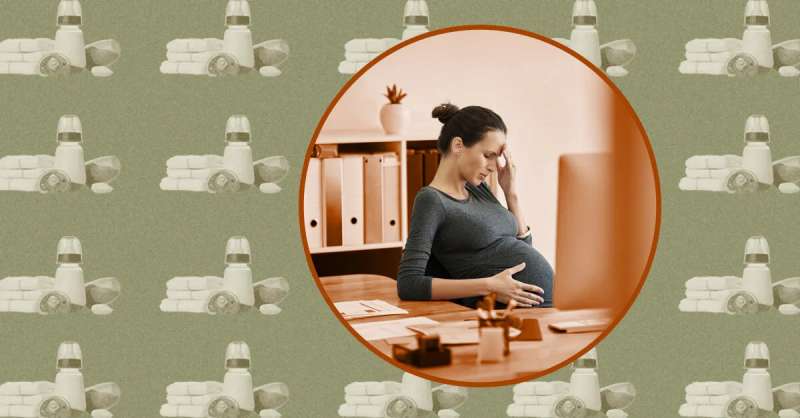
Discriminating against a pregnant person is illegal in the United States for more than 40 years, but as these women’s stories show, it still happens.
Before becoming pregnant with her first child, Catherine was riding on a high point in her career as an internal wholesaler for a prominent investment firm in Pennsylvania. She worked closely with external vendors and financial institutions to increase sales and acquire new markets for the firm. In 2016, she applied for an opportunity to advance in her company: The job would have required more time and effort, but she felt qualified. She was also excited at the prospect of an increase of up to $10,000 per quarter.
“I was the most senior member on the regional team, and I had a great working relationship with the client,” Catherine told COURIER. She asked not to be identified by her real name to avoid retaliation from her former employer. “I immediately put the request in writing and emailed it to management.”
Catherine, 38, however, was promptly dismissed by her manager: He told her she’d be out of the office for doctor’s appointments too often, and he felt she’d “miss too much work,” she recalled. She had recently informed her employer she was expecting.
Sorting Fact From Fiction: Sign Up for COURIER’s newsletter.
She and her colleagues knew she would be able to cover the additional workload far better than anyone else in her department. She also would have had two months to transition someone to cover her during her maternity leave—which was unpaid.
“I didn’t understand why they felt I’d miss work,” she said. “Every doctor’s appointment I had made at that point was before work or during my lunch break.”
After going down the line of several employees who weren’t willing to take on the additional duties, the job went to a man with half of Catherine’s tenure with the company and lower performance numbers.
Catherine, meanwhile, continued working until the day she was admitted into the hospital to deliver her firstborn. “The additional income would have meant a lot to me,” she said.
Discriminating against a pregnant person is illegal in the United States for more than 40 years, but—as Catherine’s story shows—it still happens. Over the past decade, more than 50,000 pregnancy discrimination claims were filed with the Equal Employment Opportunity Commission and Fair Employment Practices Agencies in the United States.
RELATED: Landmark Legislation Seeks to Reduce Black Maternal Health Risks
But pregnant workers are now one step closer to finally get the protections they deserve. Last month, the US House of Representatives passed the Pregnant Workers Fairness Act (PWFA) with an overwhelming majority vote of 329-73.
The measure, HR 2694, prohibits employment practices that discriminate against making reasonable accommodations for job applicants or employees affected “by pregnancy, childbirth, or related medical conditions.” This applies to private sector employers with over 15 employees as well as public sector employers.
The bill, which now awaits action in the Senate, makes it illegal to, among other things:
- deny a pregnant employee’s requests for accommodations unless doing so would pose an undue hardship
- deny employment opportunities to qualified individuals on the basis of their pregnancy
- require an employee to take leave—both paid and unpaid—in place of offering any of these accommodations are all deemed unlawful.
Though the PWFA had been introduced in Congress every year since 2012, this is the first time the legislation actually received a vote.
Filling Gaps in Current Federal Law
Pregnancy discrimination is defined by the Equal Employment Opportunity Commission as unfavorable treatment of women at work due to pregnancy, childbirth or medical conditions related to pregnancy or childbirth. Pregnant women perceive discrimination when they experience subtly hostile behaviors such as social isolation, negative stereotyping, and negative or rude interpersonal treatment.
Under current federal law, the Americans With Disabilities Act (ADA) has provided employees with disabilities with the right to accommodation since 1990.
“While pregnancy-related complications can be considered disabilities, simply being pregnant is not a disability and therefore does not currently mandate accommodations,” Lisa McGlynn, an attorney with Fisher Phillips in Tampa, Florida, told The Society For Human Resource Management.
Over the past decade, more than 50,000 pregnancy discrimination claims were filed with the Equal Employment Opportunity Commission and Fair Employment Practices Agencies.
The Pregnancy Discrimination Act (PDA) of 1978, meanwhile, does provide some protections for pregnant workers. But—despite being law for more than four decades—many employers aren’t familiar with the provisions of the PDA, and inadvertently violate it. According to A Better Balance, courts have also misconstrued and misinterpreted the PDA more often than not, which has left many pregnant workers behind their peers.
According to the House Committee on Education and Labor’s research, this discrimination disproportionately affects Black and Latina employees, “who are overrepresented in low-wage, physically demanding jobs.”
In short, there is no federal law on the books that explicitly guarantees workers the right to a reasonable accommodation so they can continue working without putting their pregnancy at risk.
This is problematic because working women are the primary “breadwinners” in more than 41% of American families, and low-wage women workers are even more likely to earn income that is vital for their family’s survival.
According to a 2013 report from the National Women’s Law Center and A Better Balance, however, pregnant workers in physically active workplaces are especially vulnerable to being forced out of their jobs.
The Toll of Experiencing Discrimination While Pregnant
A study published in the Journal of Applied Psychology shows a distinct connection between pregnancy discrimination at work and the health of pregnant persons and their babies. For example, perceived pregnancy discrimination indirectly relates to increased levels of postpartum depressive symptoms for mothers and lower birth weights, lower gestational ages, and increased numbers of doctor visits for babies.
“I think the biggest surprise from this research is that pregnancy discrimination not only negatively impacted the mother, but also negatively impacted the baby she was carrying while experiencing the discrimination.”
“I think the biggest surprise from this research is that pregnancy discrimination not only negatively impacted the mother, but also negatively impacted the baby she was carrying while experiencing the discrimination,” said Kaylee Hackney, study lead author and an assistant professor at Baylor University, in a statement. “This just shows the far-reaching implications of workplace discrimination and highlights the importance of addressing it.”
The Need for Accommodations Beyond Pregnancy
The coronavirus pandemic has presented a whole host of unprecedented challenges for pregnant workers, who have had to adapt to new quarantine requirements. The Centers for Disease Control and Prevention’s list of at-risk factors for severe complications related to COVID-19 include pregnancy.
To decrease the risk of contracting COVID-19 prior to delivery, many health providers are strongly encouraging pregnant persons to self-quarantine at home for two weeks prior to their expected due date.
That was the case for Elena, a 34-year-old occupational therapist at a nationally renowned healthcare organization. She asked COURIER not to reveal her full name for fear of retaliation from her employer.
“I gave birth in April and was told by my doctors to take two weeks off prior to my due date in case I were to contract COVID,” she said. “My employer approved this accommodation and assured me that it wouldn’t count against my 12-week maternity leave.” Only two of those 12 weeks were paid, she said.
When Elena called into work to report the birth of her daughter, her employer informed her that was no longer the case. She was told, in no uncertain terms, that she was to return to work in 10 weeks. “I went round and round with my supervisor, regional director, etc., and just ended up giving up and giving in,” she said. “I returned after 10 weeks even though I had documentation that supported a two-week accommodation in addition to a 12-week maternity leave.”
RELATED: Pregnancy Is Now a Risk Factor for Severe COVID-19. Here’s How One Black Woman Is Handling It All.
Elena attempted to negotiate with her employer, where she’s working again just months after delivering her daughter. “The [labor] lawyer I met with confirmed I was entitled to the full 12 weeks and gave me legal information to use in discussions with my employer, but it just became a futile effort,” she said. “They weren’t going to give in.”
Serious health issues surrounding pregnancy and the postpartum period aren’t relegated to just physical complications. Catherine said she developed postpartum depression after delivering her second son in 2018. Her doctors advised her to enter an intensive outpatient treatment program, which would have required her to be out of work three days per week after her maternity leave. She requested short-term disability through her company so she could still get paid—her family couldn’t afford to lose more money after her unpaid maternity leave.
“I asked if they would be willing to do a flexible schedule,” she said. “They refused. They said it was ‘all or nothing.’” Her company also told her that bonuses were given out at the discretion of management, and that if she took short-term disability, she wouldn’t receive the bonuses. “The majority of my money was made in bonuses, and there was no way that we could survive losing that much income, so I had to choose between my health and well-being, and being able to afford food and housing for my children.”
Catherine eventually settled on therapy sessions twice a week for one hour each, far from the recommendations from her therapist. “When it was decided, my manager told me that I needed to start filling out a timesheet and that I would be docked any time that I was out of the office,” she said. “In my 10 years there, no one had ever had to do this for doctors’ appointments.”
She eventually left her job to start over at a new company.
“The Pregnant Workers Fairness Act is for all the pregnant workers who just want to do their jobs and support their families, but who are stymied when employers refuse to make even minor temporary changes to accommodate their medical needs,” said Emily Martin, the NWLC’s vice president for education and workplace justice, in a statement. “The pandemic makes it indisputable: when many pregnant workers are on the frontlines keeping the country going, it’s indefensible to deny them the accommodations they need to stay healthy. Now it’s the Senate’s turn to make it official: In 2020, no one should be forced to choose between a paycheck and a healthy pregnancy.”