The US Supreme Court overturned Roe v. Wade four years ago, but the earthquake it caused in healthcare and politics has not abated.
The ruling, Dobbs v. Jackson Women’s Health Organization, threw the issue of abortion rights to the states, creating a chaotic mix of outright bans in some states, firm protections in others, and a confusing mess in several others where doctors now defer to lawyers and pregnant women face dangerous barriers to the care they need.
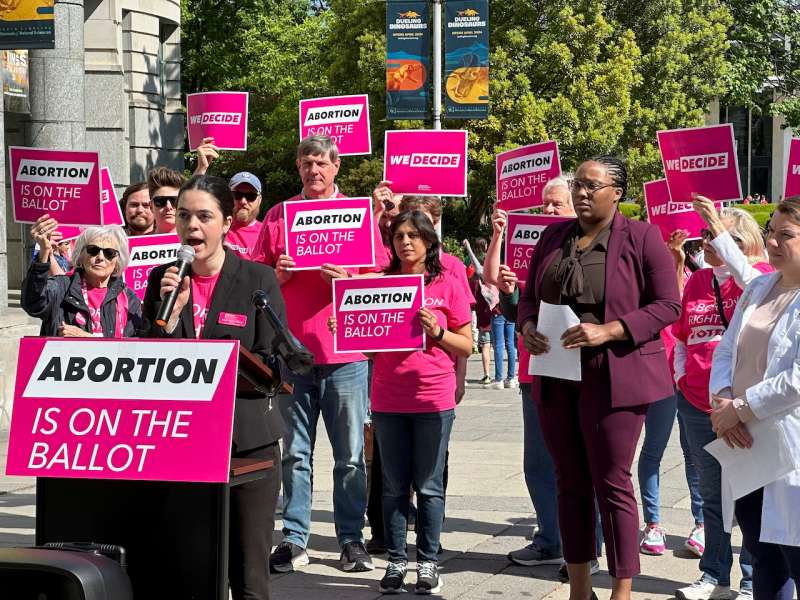
Though economic concerns and widespread disapproval of President Donald Trump’s current policies have emerged as key issues for voters in North Carolina ahead of the 2026 midterm elections, reproductive rights remain a huge motivator to vote, polls show.
And in several major races in the state, the divide between parties on the issue remains as stark today as in the immediate aftermath of the Dobbs ruling.
Though a majority of North Carolinians oppose abortion restrictions, North Carolina’s Republican-controlled legislature passed a 12-week ban in 2023 with exceptions for rape, incest, and the physical health of the mother. Gov. Roy Cooper and Democrats opposed the bill, but the Republican supermajority in the legislature overrode Cooper’s veto of the ban.
Cooper is now running for North Carolina’s open Senate seat.
Though NC’s Republican candidates have largely hit mute on reproductive issues publicly and downplayed any new threats to abortion care, reproductive rights will feature prominently in several key North Carolina races. Here’s a look.
All eyes are on North Carolina
North Carolina’s US Senate race is arguably the biggest election in 2026. It could help decide if Democrats retake the chamber from Republican control.
Cooper, a Democrat who has never lost a statewide election in North Carolina, leads his Republican opponent Michael Whatley by double digits in several recent polls.
And though Democrats have mostly focused their attacks against Whatley on his support for Trump’s policies and his ties to a known sex offender whom he appointed to leadership roles in the NC Republican Party, voters have plenty of material to discover the candidates’ polar opposite views on abortion bans.
Cooper vetoed North Carolina’s 12-week abortion ban in 2023, and criticized as “extreme” what Whatley and other Republicans framed as “common-sense.”
In a press release on Wednesday, Cooper vowed to “beat back extreme policies and protect reproductive freedom,” if elected.
“Four years ago, the Dobbs decision threatened women’s reproductive freedom across the country,” Cooper said in the release. “As Governor, I vetoed an extreme abortion ban and fought to protect and expand reproductive rights of women in our state.”
Whatley, who served as the chair of the NC Republican Party from 2019 to 2024, celebrated the fall of Roe v. Wade after the Dobbs decision, and told a national Republican gathering in 2024 that he was “proud to be the most pro-life chair in the history of the Republican Party.”
If GOP regains NC House supermajority, more restrictions could follow
Republicans lost their veto-proof super majority in the NC House in the 2024 election, making it far less likely that the legislature could enact new restrictions. But the desire is still there among some Republicans, and the 2026 midterms will once again be a battle for which party controls the legislature and by how much.
North Carolina is one of the most closely divided swing states in the country, and though Republicans have gerrymandered state legislative election maps that allow far-right candidates stay in power, it is much more difficult for Republicans with extreme views to win a statewide election.
Though North Carolina has voted for Trump in every election he’s run in, state Republicans have had far less success in statewide races. In the 2024 election, Democrats won every high-profile statewide race, and the most extreme Republican candidates—Mark Robinson, Michele Morrow and Dan Bishop—all called for full abortion bans and all lost by huge margins.
North Carolina’s 12-week abortion ban passed over the objections of nearly every medical association and a majority of North Carolinians, but Republicans at the time said the measure was a compromise.
Just look at what they could have done, they said.
A month before they passed the abortion bill on party lines, Republicans introduced separate legislation that would have enacted a complete ban, with few exceptions for the life of the mother and none for rape or incest.
Republican leadership pointed to their rejection of this most extreme version as evidence of a willingness to find common ground, even though the medical consensus overwhelmingly shows that abortion restrictions are dangerous and oppressive.
The compromise may have been only with themselves; critics say the full ban was introduced to help make the 12-week ban seem reasonable.
While current Republican leadership in the General Assembly has said there is no appetite for further abortion bans in the state, two party members introduced a bill this session that if passed would be the most extreme ban in the country.
The bill, which Republican House Speaker Destin Hall said was not serious, would not only ban all abortions, but also make abortion providers subject to prosecution for murder and included language that could permit private citizens to kill providers to prevent an abortion.
If Republicans regain their supermajority in the NC House, it would still be unlikely that the most extreme bills would have enough support, but they could very well set the stage for further restrictions that would endanger lives and create even more confusion for providers and patients needing care.
Other key races
The issue of abortion care could also help decide whether Democrats retake the US House and the state Supreme Court.
NC Supreme Court Justice Anita Earls, a Democrat, is facing Republican Sarah Stevens, a former state representative, for the only open seat on the court. Republicans have a 5-2 majority on the court, so this election won’t change party control, but if Earls wins in November, Democrats can retake the court in 2028. If Stevens wins, Republicans secure control for the next decade.
Political campaigning can be trickier for judicial candidates, but Earls has frequently criticized the US Supreme Court for overturning Roe
“Four years ago today, the Supreme Court’s decision in Dobbs v. Jackson Women’s Health Organization overturned nearly fifty years of precedent established by Roe v. Wade,” Earls posted on X on Wednesday.
“Roe v. Wade recognized that the Constitution’s protections for privacy encompassed a woman’s right to privacy and her own body,” she wrote.
The Roe ruling, and the subsequent abortion bans in North Carolina and other states, “rapidly changed the landscape of reproductive healthcare in this country. And [have] had real life and death consequences for North Carolinians,” she wrote.
Stevens, who resigned from the NC House this month to concentrate on her court race, voted for SB 20 and was one of the leading public advocates for the bill before the vote.
The party divide on reproductive rights is equally clear in North Carolina’s competitive US House races.
Richard Ojeda, an Army veteran and former teacher, is running against Republican Richard Hudson in district 9, a swath of several counties in the central part of the state that includes Fayetteville.
Ojeda has campaigned on codifying the reproductive protections that existed under Roe, and in a written statement to Cardinal & Pine on Wednesday he said that North Carolina’s 12-week abortion ban was a glaring example of the harm that can come from “politicians inserting themselves into deeply personal healthcare decisions that should be left to women, their families, and their doctors.”
The issue, he added, is personal.
“My daughter has faced serious health challenges that mean a pregnancy could take her life. As a father, I cannot accept a world where politicians think they know better than a woman and her doctor when it comes to making those decisions,” he wrote.
Hudson has made his opposite position equally clear.
Immediately after the court overturned Roe, Hudson framed abortion care as murder and praised his own record in seeking to end access to it.
“I have been a vocal advocate for the rights of the unborn all my life. In Congress, I have stood up for life and am proud to have a 100% rating from the National Right to Life for my voting record,” Hudson said in a press release.
The end of Roe v. Wade was “overdue news for life and the unborn,” Hudson said.
“Five decades of prayer have been answered,” Hudson wrote.