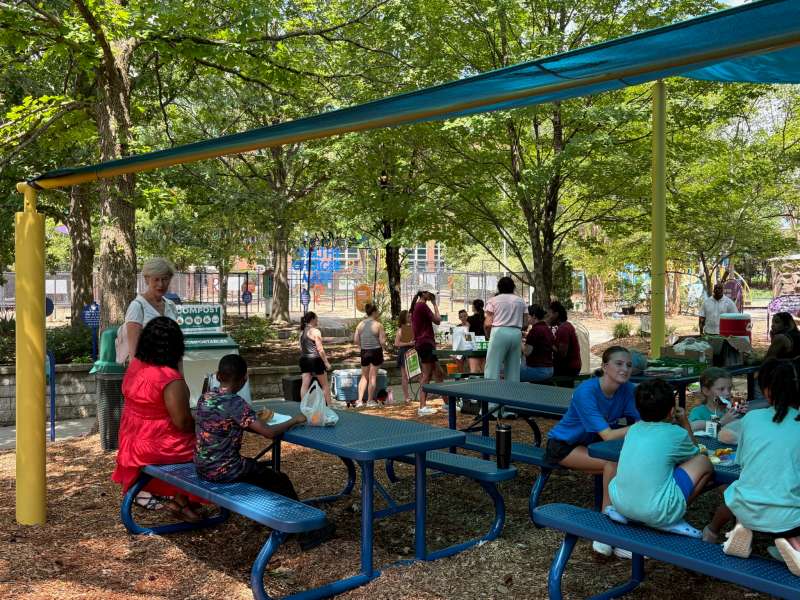
On Wednesdays in Raleigh, the promise at PlayWELL Park is simple: If a child can make it to the Poe Center for Health Education between 11:30 a.m. and 12:30 p.m., they will be given a free lunch to eat.
RELATED: Wilson workshop takes on SNAP cuts, hunger, and county budgets for NC families
“This is a resource that families who bring their children under 18 can count on,” said Jennifer Bell, communications senior director at the Poe Center.
Bell has spent years helping families find their way to the park’s SUN Meals site, the first long-running summer lunch program since 2013 that serves any child in the public under 18 with meals to eat onsite.
“We were Wake County’s first open site, meaning we were the first site where anyone from Wake County could come and get lunch,” Bell said. “You didn’t have to be associated with a program or with a camp or anything. It was just open to the public, and we have been doing that for years.”
She and the organization are still feeding children, but are doing it with less, as this July marks the one-year anniversary of Republicans’ “One Big Beautiful Bill Act,” also known as H.R.1. This week, Congresswoman Deborah Ross (NC-02) visited PlayWELL Park in partnership with the Carolina Hunger Initiative to “really put a highlight on how the federal government is failing our kids.”
READ MORE: Trump says millions are ‘lifted’ off SNAP. A Charlotte nonprofit says hunger hasn’t gone away in NC
“I call it the big ugly law, not the big beautiful bill, which cut 20% from food assistance,” Ross said. “This year it’s particularly difficult because the federal government has cut 20% from SNAP, and so the Poe Center has relied on federal funds to do what they do. The state government, we hope, will be giving some more now that we have a state budget, but really it should not be up to the state and local government to make up for a 20% deficit from the federal government.”
What the SUN Meals program is
The Poe Center has partnered with Wake County Child Nutrition Services for well over a decade. Meals are served once a week on Wednesdays for an hour between 11:30 a.m. and 12:30 p.m. According to Bell, the center served over 300 meals last summer. This year, at their kickoff event on June 24, they served 60 meals—and regularly average between 25 and 60 meals depending on daily walk-ins.
SUN Meals is a part of the Summer Food Service Program (SFSP) administered nationally by the Food and Nutrition Service, an agency of the United States Department of Agriculture (FNS), and run in North Carolina by the Department of Public Instruction’s Office of School Nutrition. The program allows millions of low-income children to access free meals and snacks during the summer when school breakfasts and lunches are out for the year.
At PlayWELL Park, those meals come with what Bell calls “edu-tainment.” Each Wednesday features health-themed activities—sometimes led by partners like Delta Dental, Bee Downtown, Marbles Kids Museum, the Museum of Natural Sciences and others—that help children learn about pollinators, dental health, and cooking skills alongside lunch.
With funding gone…
According to Feeding America, a national nonprofit, over 1 million North Carolinians are facing hunger, with 1 in 5 being children. From their Map the Gap data, they claim people facing hunger in North Carolina are estimated to report needing over $1 billion more per year to meet their food needs.
Funding to aid this problem comes from the federal Supplemental Nutrition Assistance Program (SNAP) and SNAP-Ed, the educational arm of SNAP. More than 1.4 million North Carolinians rely on SNAP, with 850,000 being children.
READ MORE: Rep. Lopez proposes $85M plan to keep SNAP running for North Carolinians
For more than 20 years, the Poe Center relied on SNAP-Ed to fund much of its work.
According to a statement made last year by executive director Ann Rollins, SNAP-Ed funded over “50% of the Poe Center’s budget for programs, social marketing, and community work.”
Those dollars allowed schools across the state to bring students on field trips to the Poe Center. On average each year, over 9,000 children and adults participate in the center’s programs, with many returning annually.
From Poe Center data, 87% of program participants report making healthy choices after a program at the center. Each summer, the center’s social marketing campaign, which encourages families to drink more water, eat more fruits and vegetables, and be more active, reaches about 9 million people. On average, 70% of people surveyed said they ate healthier and became more active as a result of seeing the center’s campaigns.
RELATED: Food insecurity is hitting thousands of NC children—and it’s following them into the classroom
Bell said the funding loss is already showing up in everyday decisions. In the final year of SNAP-Ed, she saw how “the need is still there.” Families and schools accustomed to free nutrition education continued to ask for programs even as the money disappeared.
“We still have schools who are reaching out to us, who may not know that the nutrition education funding is eliminated, and ask, ‘Hey, can we come for this?’” Bell said. “And it’s saddening to say we can still provide it, we just can’t provide it at no charge.”
Camp PlayWELL, the center’s nutrition and physical activity themed summer camp, is another place where the loss will be felt.
“We have seats set aside for SNAP-eligible families to send their children, and those seats fill up fast,” Bell said. “Without this continued funding, our ability to do that will be significantly limited.”
A ‘double whammy’ for families
Ross said the cuts in H.R.1, combined with tariffs and other trade decisions, have created “a double whammy for families.”
RELATED: SNAP cuts and ICE raids leave North Carolina children hungry
“We already had the need for poor families, but now we’re seeing middle-income and lower-middle-income families struggle with those groceries, and that is just unacceptable,” Ross said. “And it’s time for change.”
At PlayWELL Park, Ross said the strain in SNAP funding was visible in those who showed up.
“The parents certainly were focused on that,” Ross said. “In addition to some of the childcare groups coming in, there were individual parents coming in, because they’re having a harder time making ends meet, and they knew that if they brought their kids today they could get free meals for them, and that’s a great service. But more parents are needing that than ever before, which then puts our most vulnerable in a situation where there might not be enough for them.”