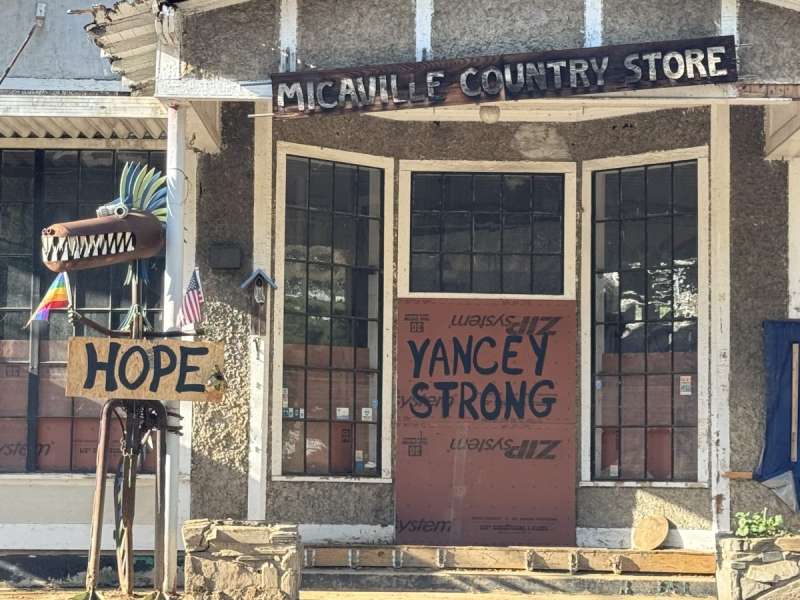
Last week, after visiting communities still recovering from Hurricane Helene, Gov. Josh Stein (D) reiterated his request for an additional $10 billion in federal money to help western North Carolina rebuild.
To date, the federal government has committed just 14% of the $60 billion needed to rebuild western North Carolina after Hurricane Helene ravaged the region on Sept. 27, 2024, and claimed the lives of at least 107 people in the state.
This is a fraction of the 32-78% typically provided by the federal government for recovery from a storm like Helene.
There has not been any new congressionally approved federal funding for Helene relief since December 2024, when North Carolina received funding as part of a broader $100 billion disaster relief package.
Over the past year and a half, that money has slowly trickled down.
Canton Mayor Zeb Smathers told Cardinal & Pine he and the broader Western North Carolina community simply want the federal government to make good on its promise to help the region recover.
“We need the money we are owed to be delivered to us more efficiently. Promises that were made need to be kept. We’re not asking for much,” he said. “If you give the resources to the people of western North Carolina, we will get the job done.”
State legislator says more needs to be done about private roads and bridges.
Eric Ager is a Democrat serving in the North Carolina House, where he represents communities in eastern and southern Buncombe County, including his hometown of Fairview, along with Black Mountain, Montreat, Arden, and others.
He still sees the lingering damage of Helene locally.
“Ten minutes past my house on 74A, it’s still one lane, we’ve got a traffic light, and it’s not open to anything but local traffic,” he said.
Across western North Carolina, there are untold thousands of private roads and bridges, many of which were damaged or destroyed during Helene.
North Carolina created a fund to repair private roads and bridges, but officials announced earlier this year that the program could only fund around 300 projects.
This is one area where Ager believes additional federal funding could aid western North Carolina’s recovery.
“Private roads and bridges are still a big issue. We haven’t gotten much from the federal government in that regard, and that would be important,” he said.
On the eve of the one-year Helene’s anniversary last September, Stein asked Congress for $1.6 billion to repair private and municipal roads and bridges.
Some still don’t have permanent housing
Across western North Carolina, around 73,000 homes were damaged by the storm. Nearly two years removed from the storm, some people are still waiting for a permanent housing solution.
Hendersonville City Council Member Gina Baxter says people in the community are still living in temporary housing, with federal funding scheduled to expire at the end of September after being extended by six months in March.
This means those receiving FEMA housing assistance will have to pay the full cost of rent just after the community marks the storm’s two-year anniversary.
“It’s incredibly frustrating that people who are in that temporary housing have to pay rent,” she told Cardinal & Pine.
Currently, those living in temporary housing are asked to pay 50% of the fair market rate.
“In August, we’re going to enter into that rental scale being 75% of the HUD [Housing and Urban Development] fair market rate […] these are folks who, a year and a half ago, lost everything,” Baxter said.
The NC Budget and Tax Center estimates that home repair funding is short by $5.3 billion.
Smathers says that while local municipalities like Canton need to be reimbursed for Helene-related expenses, he wants people directly impacted to be helped first if Congress allocates additional funding.
“There are people who have lost everything. Get the money to them first,” he said.