by Ryan Oehrli, NCLocal
October 27, 2026
Editor’s note: This story is the last in a series about changes to the Supplemental Nutrition Assistance Program, or SNAP, sometimes called food stamps.
Part 1: Food assistance changes by Congress and General Assembly put pressure on N.C. counties
Part 2: Food pantries, nonprofits seeing greater demand amid changes to program
Between supper at Monroe’s New Covenant Baptist Church and a meeting hosted by Common Heart, Shane Gordon ran through a litany of bad breaks.
First, his back went out, and he needed surgery. Then he needed a hip replacement. He hasn’t always able to get care immediately; Gordon once went six years without health insurance, he said.
Before his health problems, he was an electrician for 18 years, he said.
The free, award-winning newsletter 100,000+ North Carolinians trust. Get Cardinal & Pine here.
This month, Gordon attended the Common Heart meeting to learn about free resources that could help him and his family.
“I kind of hit a real bad streak,” he said.
Recently, Gordon saw his monthly SNAP benefits cut from $160 to $27, he said. He wasn’t sure exactly why. After he did not have enough credits to qualify for disability insurance, Gordon worried he might have to volunteer for 80 hours every month for his medical insurance — a work requirement for SNAP and Medicaid. It’s hard for him to stand comfortably, he said, let alone to do dozens of hours of volunteer work.
“This little bit of help will keep you from falling into that gutter — and keep you out of it,” Gordon said.
He’s not alone.
About five million people across the country have lost SNAP benefits since H.R. 1, or the federal “One Big Beautiful Bill Act,” was signed into law last July.
Despite applications not slowing, the number of SNAP recipients in North Carolina has dropped consistently for more than a year, according to data kept by the state Department of Health and Human Services. In September 2025, there were more than 1,358,000. A year later, the number had fallen almost 120,000, reaching just over 1,239,000 this September. County governments are also paying more for the program because of Congress’s changes, and food pantries report increased demand.
What’s changed?
H.R. 1 made several SNAP changes that affect eligibility. For example, it raised the upper age limit from 54 to 64, so now adults aged 18 to 64 must also meet the pre-existing work requirements: 80 hours per month. Those who volunteer or are in a training or education program are also eligible.
In addition, people who are homeless, veterans and those under 24 years old who aged out of foster care are no longer exempt from the work requirements. Previously, any SNAP recipient with a child under 18 was also exempt. Now, a child must be under 14 for their parent to be exempt from the work requirements.
Under other changes in the bill that went into effect in February, refugees, asylum seekers and other people who are not citizens but in the country legally are ineligible for SNAP.
World Relief, a Christian humanitarian group that helps refugees, criticized that change, characterizing it as taking food away from people who came to the United States to rebuild their lives and calling it “wrong,” according to KFF Health News.
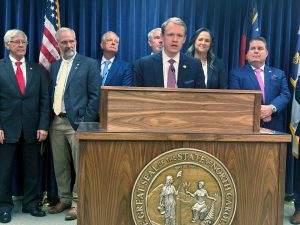
Before the bill passed, North Carolina’s Democratic Gov. Josh Stein said it would thrust the state “into perilous budget decisions,” such as whether North Carolinians should lose access to food or other “essential services.”
The General Assembly’s Republican leaders, State House Speaker Destin Hall and Senate leader Phil Berger, backed the bill, with Hall saying broadly that the law “roots out waste, fraud and abuse.”
A federal report shows that of the approximate 1.3 million SNAP recipients in North Carolina in 2025, about 590,000 were adults, and nearly 190,000 were working.
North Carolina employers with the most SNAP recipient employees were Walmart, Food Lion and Amazon — each with thousands of employees on the program, according to the report.
At Atrium Health, one of the state’s largest hospital networks, about 550 employees were SNAP recipients.
In a statement to NC Local, Amazon spokesperson Rachael Lighty disputed the report, saying it counted “raw numbers” of employees rather than a percentage. She added that the company pays full-time employees in the state at least $20 an hour.
Epidemiologist points to growing need
Epidemiologist Patrick Baron surveyed about 3,600 people who get food from MANNA FoodBank sites across 16 Western North Carolina counties. The survey captured a comprehensive strain on families, he said: cut benefits, rising costs for food and medicine, lost income after Hurricane Helene, transportation problems and more. The issues overlap and compound.
Food pantries are taking on an outsized role now, Baron said.
“It’s a supplementary system that was never designed to do that,” he said. “The role it’s playing now is not supplementary.”
Baron said the full effects of last year’s tax and spending bill still haven’t been felt.
“Not even close,” he said.
Lost your benefits? Here are some numbers to call
There are resources available in North Carolina to those who lost their benefits.
- North Carolinians — especially those who are pregnant, have children or have a green card — can reach out to the Charlotte Center for Legal Advocacy if they have lost their benefits. The nonprofit offers free help, Chief Philanthropy Officer Kelly Lynn said. The CCLA can be reached at 980-256-3782.
- Anyone can dial 211 or (888) 892-1162 to confidentially speak to a community resource specialist with United Way of North Carolina who can help with finding resources.
- MANNA FoodBank keeps a database, searchable by zip code, of food pantries in Western North Carolina. Second Harvest Food Bank of Metrolina has a similar tool that can help people in the Charlotte area, and Food Bank of Central & Eastern North Carolina also has one.
This article first appeared on NCLocal and is republished here under a Creative Commons Attribution-NonCommercial 4.0 International License.