Two years ago, on Friday, Sept. 27, 2024, Jennie Boyd Bull made a consequential decision as rain from Hurricane Helene poured down on Yancey County, North Carolina.
“The driveway was just a river. My car was parked by the porch and I saw it getting deeper in the water,” Bull told Cardinal & Pine on Monday, Oct. 7, ten days after the storm.
Worried her car might be washed down the mountain she lived on in Micaville, a community on Highway 80, and seeing the water rise and rise, she moved it in hopes of saving it. While Bull was trying to save her car, the car would be her savior.
”I am forever grateful for that impulse to protect my car, because it protected me,” Bull told Cardinal & Pine in Burnsville during a recent interview.
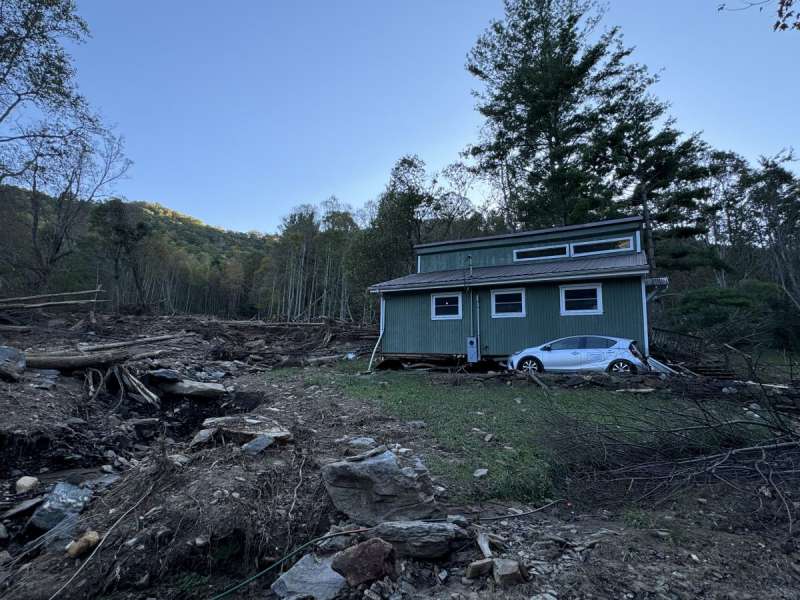
Shortly after moving the car by the house, a mudslide was triggered on the mountainside above her home. Hundreds of trees were sent down the mountain and ripped her home from its foundation. Below, logs and debris were sent further down the mountain toward the South Toe River.
“The house was lodged against the car, which kept it from rolling down the hill,” Bull said.
Yancey County was deeply affected by Helene. At least 11 people died in the county.
Yancey is home to Mount Mitchell, North Carolina’s highest peak, which saw winds of 106 mph. Yancey County also recorded the highest rainfall of any county in North Carolina, with 30.78 inches of rain. The South Toe River rose 25 feet above normal, breaking a record from the infamous 1977 flood.
Bull’s story, and those of her neighbors, was a common theme across the region. That day neighbors helped neighbors across western North Carolina.
After the log slide crashed into her home, three neighbors, Tony Beaver, Michael Kline, and Larry Thomas came to Bull’s rescue.
With rain still coming down, the three men helped Bull and her cat, Lilly, get to safety.
Speaking to Cardinal & Pine almost two years later, she credits the three men with saving her life.
“ They were wonderful, and continue to be wonderful,” Bull said.
The home Bull was renting was destroyed, but in April 2025, she moved into a new home that she rents just down the road.
She was, however, able to save the car that had protected her.
“ I later got $8,000, which repaired my car, which was wonderful. It was a great body shop here in town that does good work,” she said.
Driving through the countryside, you can see bridges have been repaired, and construction crews are hard at work, but the scars of Helene remain.
Communities such as Cattail Creek and Pensacola were among the hardest hit.
You can still see the remnants of mudslides that took out countless trees, rivers altered by the excessive flooding, and, occasionally, cars piled up in creeks. The remains of homes destroyed by the storm still stand as a reminder of what the community endured.
A place of refuge and support
Since 1983, Reconciliation House, a block over from the town square, has supported those in need in the Burnsville community, and a place people can get a hot meal and needed supplies.
When Hurricane Helene hit, the organization’s work was critical at a time of crisis. It provided food to a community where people were displaced and many did not know where their next meal would come from.
“ People started walking here for food because they knew we were here. So we started serving people, lots and lots of people,” Director John Miller said. “ We have a backup generator, so we still had our frozen and refrigerated products, and we were just giving it out as people were coming. We did that for six straight days, about 14 hours or so a day.”
In communities across the region, communication was a huge issue for residents trying to get information and for leaders trying to get information to the public. For Miller and the staff and volunteers at Reconciliation House, it also created challenges.
Two days after Helene, Miller left the area and went to Hickory, a town around an hour and a half away in Catawba County. There, he was able to get cell service and contact organizations and companies to get critical supplies.
” I got phone and internet back, and just started talking on the phone for, like, 17 hours,” he said. “I made connections with the CEO with Food Lion, and got two big [tractor-trailers] to the distribution site, helped orchestrate a food drop in Buladean with a helicopter pilot out of Asheville,” he said.
To meet the community’s needs after Helene, Program Coordinator Nancy Henkelman said support from volunteers, nonprofit organizations, and the private sector was critical.
One moment that has stayed with Henkelman and illustrates the way the community looked out for one another two years ago, is a time when someone had a mental health crisis and a volunteer was there to get her the help she needed.
“ I thought she was gonna run into the side of the building. She said, ‘Nancy, I’m hearing voices,’” Henkelman, wiping away tears, recalled. “One of our volunteers walked up, she’s a nurse, so she sat down with her. We got her food and water. We had somebody run down to the square, and they used a walkie-talkie to call and get medical help. They took her up to the tent hospital. She came back later that day, and she got her medicine and she was good.”
In the days after Helene, supplies began being delivered to communities across western North Carolina, with people beyond the region wanting to do their part to help people in their darkest hour.
Miller said the supplies provided in Helene’s wake are still making a difference in Burnsville.
“About a week to two weeks after the storm, the amount of folks throughout the whole country that showed up with supplies, water, food, diapers. We still have some remnants left over that we’re giving out monthly here,” he said, standing in front of a pile of supplies.
Marked Safe Yancey
In the aftermath of Helene’s devastation, people throughout Yancey and the region couldn’t reach their loved ones to see if they were okay. Outside western North Carolina, those with friends and family in the area could not reach people because communications were down.
Brandy Honeycutt said that while power was out for most of the community, her household had internet, and she wanted to do her part in helping her neighbors.
“People in town did not have electricity, much less internet. And we did. We had to utilize it. That was the best thing we could do,” Honeycutt told Cardinal & Pine.
On Sept. 29, Honeycutt, with the help of her son Zane, who was living in California, set up a Facebook page called “Marked Safe Yancey” to give members of the community and beyond the opportunity to ask about friends and loved ones. It also gave community members a place to let others know that they were OK.
In total, Honeycutt said “Marked Safe Yancey” accounted for over 1,100 people.
A spreadsheet was created marking people as “Safe,” “Missing,” or “Deceased.”
“ Because of all the collective effort of all the people, our spreadsheet was so thorough that our local sheriff’s department eventually took over,” Honeycutt said.
Providing support, getting people into long-term housing
In Yancey County, at least 92 people remain in temporary housing two years removed from Helene, according to the Yancey Long-Term Recovery Group (LTRG). Region-wide, at least 73,000 homes were damaged or destroyed by the storm.
Chris Sigmon, executive director of the Yancey LTRG and a member of the Governor’s Advisory Committee on Western North Carolina Recovery, said the region is still in the early stages of a long-term recovery.
“ I tell people we’re in the fourth inning. We’ve got a long way to go,” he told Cardinal & Pine.
Though two years have passed since the storm, he said he and his team at the LTRG are taking on new cases every week.
“ The Long-Term Recovery Group currently has 155 cases. We still average six new cases a week,” Sigmon said.
The LTRG works with 70 organizations, including nonprofits, as well as state and federal partners, taking on cases ranging from people requesting housing support to complicated situations that require legal support.
Sigmon said public-private partnerships have been critical to support those in need post-Helene and praised the work of Samaritan’s Purse, a faith-based organization that has assisted communities across western North Carolina.
Sigmon said Samaritan’s Purse has been “phenomenal,” providing funding to help prepare campgrounds and campsites for winter. “They’ve given us $150,000 for the temporary housing, modifications and renovations. They’ve been great, and great to people,” he said.
As of April, Samaritan’s Purse had built 26 new homes and provided 80 new mobile homes across western North Carolina. The organization’s website says it has also “approved more than 180 families for rebuilds, repairs and mobile home replacement.”
Two larger nonprofit housing projects will provide additional housing to the region. Samaritan’s Purse is in the early stages of developing a mobile home park that can host 70 homes, but Sigmon says the project has been slightly delayed.
Chief Cares, a nonprofit created by country music star Eric Church, a Caldwell County native, will have 37 homes in Avery County completed for move-in by January. The organization has already broken ground on a second housing development in Yancey.
While projects like this will provide more permanent housing solutions in the future, Sigmon said those living in campers need continued support, especially with winter soon approaching in the mountains.
“ We run programs to winterize the campers. Anybody in a camper can get free propane through us,” he said.
Those living in Yancey and Mitchell counties can seek assistance through the LTRG at this link.
Preparing for future disasters
Hurricane Helene was the second major storm in three years that Canton Mayor Zeb Smathers’ community endured. In 2021, Hurricane Fred claimed six lives in Haywood County and its floodwaters ravaged downtown Canton.
Hurricane Helene damaged or destroyed 600 homes throughout Haywood County.
“The mountains of western North Carolina seem to be in hurricane alley. The game has changed,” Smathers told Cardinal & Pine last fall.
In a recent conversation in Canton, Smathers reiterated his belief that communities like his and others need to be prepared for future disasters.
“ It’s a mix of practical solutions that you can do relatively quickly, like having the best forecast to give our people and businesses as much time to get out of harm’s way. I think it’s fixing the communication breakdown that we witnessed,” he said.
For larger projects, he believes better equipping them to handle disasters is essential.
“And then even long-term, every major project, whether it’s an interstate, a culvert, a new economic development, it needs to incorporate mitigation,” Smathers said.
As it stands, western North Carolina has received a fraction of the funds needed to recover from the storm.
Helene is estimated to have caused $60 billion in damages. To date, the federal government has approved just over $7.5 billion.
“ As I reflect, I don’t look to what government’s done, I look at what the people have done. I wish our government would meet the people at their sacrifice and the resourcefulness they’ve shown,” Smathers said.
As part of a collection of poems by people throughout Appalachia affected by Helene, Bull wrote a poem about her experience. She ends the poem with a yearning for the unity the region saw after Helene to endure.
“ Can our refugee kindness survive the divisions? I pray our foundations remain mountain strong,” she said.