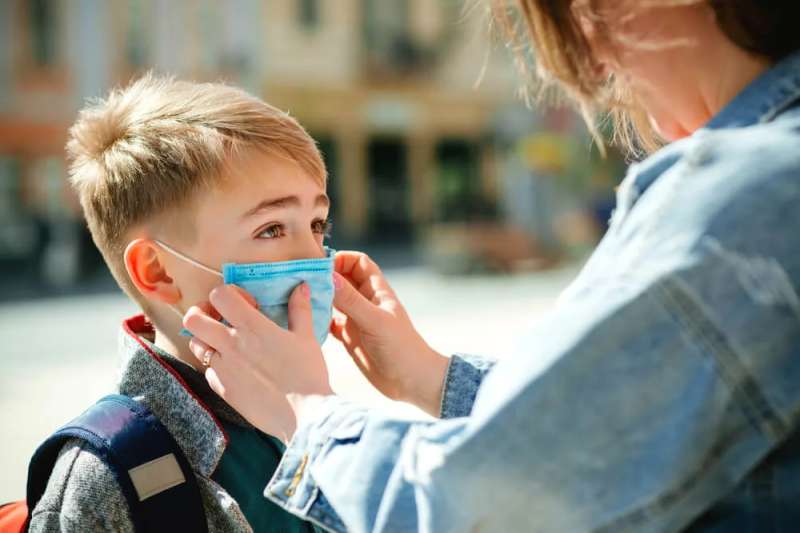
Education experts say virtual reopening might be necessary with virus still spreading, but warn that it won’t replace in-person learning.
Duke University scholars urged patience, realism and billions in additional funding to grapple with tens of millions of schoolchildren restarting remote learning in the coming weeks.
Their comments came with nearly half of NC’s public school districts now planning to begin the academic year with remote instruction only. Gov. Roy Cooper offered districts flexibility on how to reopen next month with the state’s coronavirus cases still on the rise.
Leaders say federal aid for the relaunching schools will be pivotal in the coming days and weeks, but lawmakers in the US Senate and US House of Representatives are bitterly at odds over how to appropriate funds.
US House Speaker Nancy Pelosi has reportedly indicated Democrats will be seeking more education funding after Senate Republicans released their own relief plan this week “narrowly tailored” to GOP priorities. Those priorities include tax cuts for businesses, but slash unemployment aid.
RELATED: From a Teacher: Stop Using Equity as a Prop for School Reopening, Sen. Berger
Leslie Babinski and Kenneth Dodge, two child psychologists at the Sanford School of Public Policy, joined Brian Cooper, director of educational innovation and online learning at the Duke Talent Identification Program, on a live-streamed panel discussion Wednesday morning.
However, Dodge, the founding director at the university’s Center for Child and Family Policy (CCFP), acknowledged online education, while necessary during the COVID-19 pandemic, will probably slow learning.
“Not being in person in the school building is likely to bring a loss,” he said. “I think we’re fooling ourselves if we think it’s going to compensate 100%. A year in the life of a 9-year-old child is a huge proportion of that child’s life.”
And that’s just for the students who are able to participate.
Dodge cited data from the American Community Survey showing that 4.5 million American children live where there’s no Internet access. Another 2 million don’t have a subscription, and 5 million lack a computer device. Overall 8.6 million don’t have what they need to participate in online learning.
“What that will do is to increase the disparities in educational outcomes,” he said. “They will only grow over time unless we do something.”
‘We Need a Public Response’
In April, the federal CARES Act included $14 billion for public education. But Dodge says schools need another estimated $4 billion to ensure that every American child has in-home access to broadband Internet service.
“It’s a lot of money no doubt, but not a lot of money compared to the trillion dollar economic-stimulus package being contemplated,” said Dodge. “Ninety percent of our students are in public schools and we need a public response.”
Babinski, director of the CCFP, added that funding itself is not enough.
“This is a whole new ball game,” she said. “This is really an unprecedented time. It really highlights the importance of public education and of keeping our economy running.”
In March, Babinski cut a research study into English as a Second Language (ESL) teaching short because of the coronavirus COVID-19 pandemic. She and her colleagues pivoted to look at how ESL families were adapting to online education.
She found that along with limited access to electronic devices and high-speed Internet, nearly half of the 81 students surveyed across 17 elementary schools didn’t have a parent home during the day to help with remote learning.
“Parents are overwhelmed as you’re trying to do anything else while you’re trying to support your kindergartener or first-grader in online learning,” she said. “Even with a device and access to the Internet, these young children and their parents really struggled. There were serious inequities.”
That’s why, even amidst priorities like take-home laptops and WiFi hotspots, Cooper urged collaborative solutions for childcare rather than just leaving families to fend for themselves.
“It gets to a fundamental problem around education in that to some extent it has become, maybe understandably so, a childcare vehicle,” he said. “Looking at community support is very important.”
Cooper suggested a “generosity of spirit” and assuming “positive intentions” as families and teachers need to anticipate having to learn new online platforms and not expect students simply to dive in.
“Every time you introduce a new tool, you’re introducing a new learning curve that requires mental and emotional energy,” he said. “Remote learning really requires students, teachers and parents to a certain degree to learn a whole new set of skills.
“Remote learning really is like playing a different game,” Cooper said. “It’s almost like students going back to kindergarten where they’re learning how to do school. It’s almost like teachers are becoming first-year teachers again, learning how to do things for the first time. Don’t expect it to be regular school because it won’t be.”