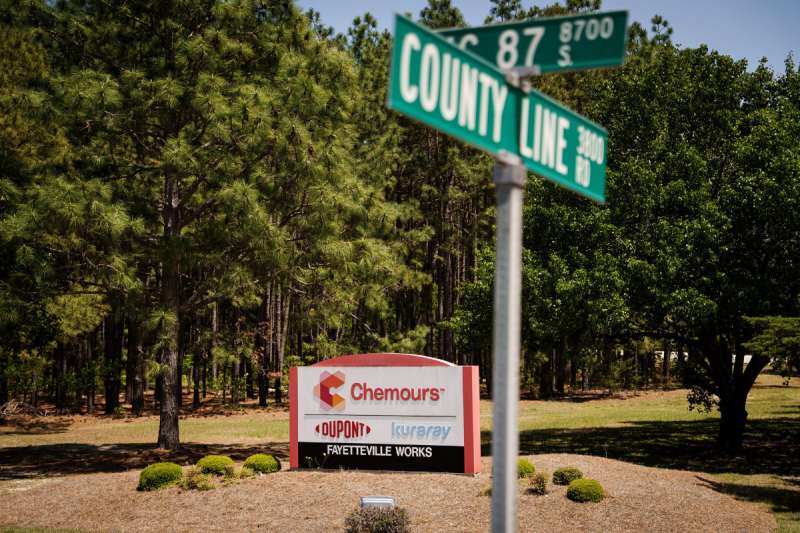
Cumberland County officials are asking the North Carolina Department of Environmental Quality to take enforcement action against a company responsible for leaking forever chemicals into residents’ drinking water.
The Chemours Fayetteville Public Works facility has been found responsible for releasing per- and polyfluoroalkyl substances, also known as PFAS or forever chemicals, into the air, groundwater and drinking supplies. The chemicals have contaminated private water wells and drinking water supplies across southeastern North Carolina, from the Gray’s Creek community in southern Cumberland County to Wilmington on the coast.
During the Board of Commissioners’ April 27 meeting, Gray’s Creek resident Mike Watters told commissioners that water filtration systems installed by Chemours aren’t being properly maintained, resulting in slime buildup in home appliances like his washing machine.
“Yes, they’re installing filtration systems,” Watters said. “There’s zero issue that they are blocking PFAS.”
The problem, he said, is that filters and lead tanks on the granular activated carbon systems must be replaced after 100,000 gallons of water or each year; otherwise, they’ll “get bacterial growth in them.”
Watters said the contractor that installed the systems used to change them out every six to eight weeks, but now it could be anywhere from two months to two years before they’re changed.
Watters told commissioners he paid $1,970 for eight biological activity reaction tests at his home and three of his neighbors’ homes.
The tests are designed to detect iron-related, sulfur-related and slime-forming bacteria.
He said the systems are becoming clogged, causing pressure to back up.
Watters said he recently changed an iron filter on his system, but his washing machine stopped working, and when he took the machine apart, he discovered “slime growth inside.”
“So, the problem is they’re not changing out water filters,” he said.
He further alleged that Chemours is not following a court-ordered drinking water compliance plan, which includes a requirement to maintain the filtration systems.
Chemours responds
In an April 29 statement to The Fayetteville Observer, a Chemours spokesperson said the company has consistently installed and maintained the granular activated carbon systems in accordance with the standards and protocols agreed upon with NCDEQ.
“This includes conducting quarterly monitoring and sampling of the GAC systems, and changing out GAC filters should sampling results for specific PFAS compounds meet or exceed the thresholds that have been established with NCDEQ,” spokesperson Jess Loizeaux said.
Loizeaux said bacteria and iron conditions are related to private wells and are not part of the PFAS drinking water compliance program that is designed to address PFAS contamination.
She said Cumberland County residents who have concerns about the system’s service and maintenance should call the Chemours Help Line at 910-678-1101.
County asks for state action
Watters is not the only resident with complaints.
At a work session before the April 27 meeting, Board Chairman Kirk deViere asked commissioners to approve a resolution that asks NCDEQ to enforce Chemours’ corrective action plan. DeViere is also sending a letter to NCDEQ Secretary Reid Wilson requesting the enforcement.
“These are not new items,” deViere said at an April 20 work session. “These have been well-documented, and I think this is our opportunity as a board to lift our voice as a board and stand up for our residents and ensure that we get answers and information to this.”
He said residents have told elected officials they’re having problems with the granular activated carbon systems.
According to the consent order that governs what Chemours must do about PFAS contamination from its plant, the systems are supposed to receive maintenance, deViere said.
The 2019 consent order requires Chemours to sample private wells for PFAS and provide replacement drinking water supplies to impacted residents
A draft of the letter that deViere sent to the NCDEQ states that protocols for maintaining the systems “exist for documented health and safety reasons, including the prevention of iron bacteria growth that degrades GAC media (carbon filter material) and creates conditions for the growth of coliform and other pathogens.”
DeViere further said at the April 20 meeting that in 2020, NCDEQ rejected Chemours’ corrective action plan to address off-site soil and groundwater contamination.
“More than six years later, there hasn’t been a revised plan submitted,” he said.
DeViere said not having an updated, approved plan violates the consent order.
Chemours has posted on its website the actions it has taken to comply with the consent order, such as water and soil testing.
Another matter that deViere said needs resolution is that the consent order required Chemours to pay $75,000 for water connection costs and pay up to to $75 per month toward water bills for impacted households for 20 years.
He said some residents are concerned that installing the granular activated carbon systems affects their ability to connect to public water.
Loizeaux, a Chemours spokesperson, said residents who opted for a public water connection but received a filtration system because hookups were not yet available will still retain their right to a Chemours-funded connection once it becomes available.
“There is no ambiguity here as claimed,” Loizeaux said. “We have, and continue to, connect these residences to public water as the option to do so becomes available and cover their monthly water bills up to $75 pursuant to the Consent Order.”
The county is moving forward with the installation of a water line in Gray’s Creek. Since March 2022, the county has also been in ongoing litigation with Chemours
In an earlier appeals filing on the case, the county alleged Chemours used Cumberland County as a toxic chemical dumping ground, releasing millions of pounds of PFAS into the air above its Fayetteville Works plant for nearly 40 years and contaminating the groundwater.
Chemours countered that the county had no standing to sue, that the state held that authority, and said only the N.C. Department of Environmental Quality or the attorney general could pursue remediation claims. A three-judge panel unanimously sided with the county, ruling the case must go to a jury trial, currently scheduled for Aug. 24.
What the county is asking the state to do
The resolution approved by the Board of Commissioners on April 27 asks NCDEQ:
• To issue a formal notice of violation to Chemours for failing to submit a revised corrective action plan to address offsite soil and groundwater contamination and require a plan to be submitted within 90 days;
• To conduct an audit of all granular activated carbon system maintenance logs for contracted maintenance installations in Cumberland County;
• To authorize affected residents to request independent water sampling to test for iron bacteria and other pathogens; and
• To issue a written determination that clarifies whether homes that have accepted the systems retain their rights to a public water connection funded by Chemours up to $75,000 and for Chemours to pay monthly water bills up to $75 for 20 years.
In deViere’s letter to the NCDEQ secretary, he said Cumberland County residents “deserve clarity, accountability, and action” and “many are elderly, on fixed incomes, and dependent on water systems that remain inadequately protected.”
“The people of this county are not asking for additional studies or additional timelines, but are asking that the regulatory framework already in place be enforced,” DeViere wrote.
Reporting by Rachael Riley, Fayetteville Observer / The Fayetteville Observer
USA TODAY Network via Reuters Connect