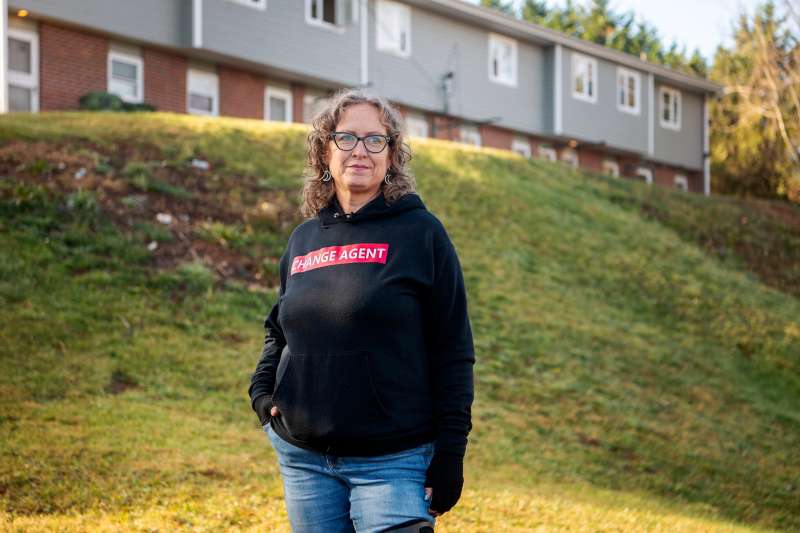
Asheville activists cheered the city’s Sept. 8 passage of “No Rent for Slumlords,” a legal measure meant to keep tenants from paying for unsafe living conditions. City Council unanimously backed the new ordinance, which forbids landlords from collecting rent on those properties until they bring conditions up to the minimum housing code.
City officials have since downplayed the rule’s importance, with Mayor Esther Manheimer telling BPR it was “more of a symbolic statement.” But according to organizers with the N.C. Tenants Union, a group that’s been pushing for similar language across the state, the ordinance gives tenants a real advantage in their dealings with landlords and the court system.
Read More: Conservationists in NC just saved 121 biodiverse acres next to Chimney Rock State Park
Jen Hampton, who helped found the NCTU and is the staff organizer for the Asheville Area Tenants Union, acknowledged that the rule doesn’t give tenants the right to withhold their rent from problem landlords. “What it does do is give you a legal route to get refunded your rent plus more,” she said.
Hampton is leading a workshop on how tenants can use the new ordinance at 6:30 p.m. Tuesday, Sept. 22, at the Trinity United Methodist Church in West Asheville. She spoke with the Citizen Times in advance of the event to walk through the process.
Document and file
The foundation of a successful complaint, Hampton said, is documentation. Tenants who are experiencing one of the 18 conditions that represent “a threat to life or property” — situations like lack of running water, the presence of raw sewage, or broken heating during the winter — should immediately take pictures capturing the problem and notify their landlord in writing.
Tenants should then also file a complaint with the city’s development services department. The city’s code enforcement officers accept complaints in three ways:
- Phone: 828-259-5764
- In-person: 161 S. Charlotte Street, Asheville
- Mail: P.O. Box 7148, Asheville, NC 28802.
Renters living outside of Asheville city limits should take their complaints to the Buncombe County Fire Marshal at 828-250-6620.
Get inspected
After a tenant files a complaint, the city will send an enforcement officer to investigate the situation. If the officer finds a violation of the minimum housing code, the case becomes active.
The city can then either immediately serve the landlord with a notice of violation, giving them a deadline to fix the problem, or schedule a mediation hearing no more than 30 days after the complaint was filed. According to city spokesperson Kim Miller, Asheville has addressed roughly 70 such cases since 2024, most for structural or water intrusion issues.
In Durham, where “No Rent for Slumlords” has been on the books since October, the act of filing the complaint has often been enough to generate change. C.R. Clarke, organizing coordinator for the NCTU, told the Citizen Times that the threat of the ordinance has made landlords more responsive.
“We’ve had some success in just pointing to the ordinance and reminding landlords, ‘Hey, you actually have to fix this, because it guarantees you will lose in court,’” Clarke said.
Escalate to the courts
If a landlord still won’t fix the problem, Hampton said the next step is a civil case at Buncombe County’s district court. She recommends that tenants contact Pisgah Legal Services for help filing and navigating legal matters.
But in theory, Hampton explained, a tenant can reference the ordinance in court to demand a refund of all rent paid during the time when their property was unsafe. And under the N.C. Unfair and Deceptive Trade Practices Act, she continued, the tenant would be entitled to “treble damages” — three times the value of the rent.
Organizers say that financial incentive is critical. “Without this ordinance, it’s really up to the magistrate on what the fine level is,” Clarke said. “Without this ordinance, it is really unattractive to bring abatement cases.”
Clarke said that legal argument hadn’t yet been tested in Durham’s courts but that Charlotte area tenants had succeeded in winning damages.
Reporting by Daniel Walton, Asheville Citizen Times / Asheville Citizen Times
USA TODAY Network via Reuters Connect