The governor can veto lots of bills. Why not this one?
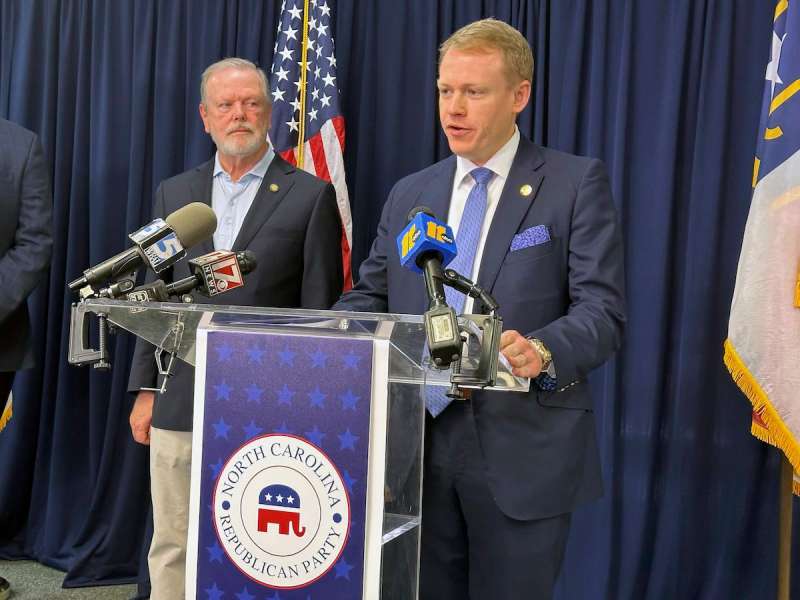
North Carolina’s most powerful state senator, Phil Berger, announced last week that he and state House Speaker Destin Hall would be calling the state legislature back into session this week to draw new congressional maps.
Along with Republican majorities in the legislature, North Carolina is expected to pass that plan. If you’re thinking back to fourth grade, you may remember that redistricting is only supposed to happen once a decade after the US Census releases new population numbers. However! The 2026 midterm elections will decide control of . Congress next year, and North Carolina has been caught in the wave of redistricting fights going on across the country.
GOP leaders in the General Assembly blame California Gov. Gavin Newsom for this, mostly ignoring the fact that he is simply responding to Texas’s mid-decade redistricting, which came about because President Donald Trump asked for it.
“We are doing everything we can to protect President Trump’s agenda, which means safeguarding Republican control of Congress,” said Berger in a statement.
In statewide elections, North Carolina’s status as a purple state is clear. In 2024, Democrats won races for governor, lieutenant governor, attorney general, secretary of state, and superintendent of public instruction, while Republicans were elected auditor, commissioner of labor, commissioner of agriculture, commissioner of insurance, and treasurer. By that logic, a fourth-grader might easily assume that there should be a lot of close elections for the General Assembly.
Nope! Since 2010, the GOP has had a stranglehold on the legislative branch thanks to voting maps they’ve drawn to rig voting districts in their favor.
Redistricting also affects both congressional and local races. A map that gave North Carolina a 7-7 split in Congress earlier this decade was allowed to be redrawn after the GOP also won control of the state Supreme Court, and the new maps (drawn in 2023—just years ago!) gave the GOP a 10-4 edge. And now they’re going to draw new maps again, potentially to give Republicans an 11-3 or even 12-2 advantage.
Wait, I thought the number of seats won was what elections and voters were for? Will of the people, things of that nature (I’ll go ahead and duck while you throw things at me, a naive person).
Alas, our governor has veto power! The governor right now is a Democrat. The GOP no longer has a veto-proof majority in the General Assembly! Democratic Gov. Josh Stein, you’d think, could just say no to this.
Except … he can’t. According to the state Constitution, the governor cannot veto redistricting bills.
So, um, why?
Consider this: North Carolina has traditionally had a very weak governor who, for most of our state’s history, did not have any veto power.
But after 1995 elections, a GOP that had been asking for gubernatorial veto power for YEARS took control of the House, and a young state senator, the was a new opening. That senator? A Democrat from Nash County named Roy Cooper, who would later, of course, become governor and likely wish he had been able to veto maps from the Republican legislature when he was in that job.
In 1995, the debate wasn’t so much about if the governor should have veto power. It was about how much power he should have.
So why, of all things, was redistricting exempted? The different versions of Senate Bill 3 don’t offer any insight. Cooper doesn’t seem to have talked about it in interviews, and newspaper articles from 1995 and 1996 barely mention it.
The only clues here come from context. From 1985 until 1993, North Carolina’s governor was James G. Martin, a Republican. And in 1989, when Democratic state senators first introduced a veto bill, they had already exempted redistricting from it.
The Republican minority leader at that time, Larry Cobb of Charlotte, wanted to allow governors to be able to veto new maps. So he introduced an amendment to do that. “Congressional districts are not something which should be decided exclusively by the representatives in the House and Senate in this body,” he said in an interview in March 1993.
Democratic Sen. Dennis Winner of Buncombe County noted that it wasn’t necessary for governors to have a veto since the federal government ultimately had oversight over the maps.
At the time, the Voting Rights Act and the courts had placed plenty of guardrails on redistricting, he argued. The bill passed the Senate 41-6 but died in the House.
After that, the fight over giving governors the power to veto political maps pretty much fizzled out. In 1996, when North Carolina finally became the last state to grant its governor veto power, Roy Cooper’s bill made sure that the chief executive had no power to stop political maps.
Cooper would go on to become governor himself, and had no recourse when the GOP redrew maps to put a stranglehold on the party’s hold on legislative districts. And in recent months, the Voting Rights Act has been weakened significantly by the US Supreme Court, with another major case expected to be decided in the coming days.
Months ago, I interviewed Western Carolina University political scientist Chris Cooper (no relation to Roy). He posed an interesting hypothetical.
“I wonder: Does Roy Cooper today look back at past Roy Cooper and say that ‘I could have made that veto just a little bit stronger.’ Could he have changed the state in ways that he would like to have them changed?” he asked. “It illustrates that the shoe is often on the other foot eventually, and that we oftentimes make policies for strategic reasons in the short run. We have an idea that things are never going to change. But inevitably, they always do.”
The original version of this column was published by NC Rabbit Hole, where Jeremy Markovich writes about North Carolina curiosities. Subscribe at NCRabbitHole.com. This column is syndicated by Beacon Media and can be republished anywhere online or in print for free under Beacon Media’s guidelines.