Six text messages and five telephone calls totaling 38 minutes — that’s all public records show of Tropical Storm Helene recovery czar Michael Whatley’s direct engagement with the senior state official helping coordinate regional recovery over the course of roughly one year.
Broader searches found no direct communications between Whatley and leaders at the Federal Emergency Management Agency (FEMA), North Carolina Emergency Management, the North Carolina Department of Commerce or leadership in any of the 12 counties the Asheville Citizen Times surveyed through public records requests.
Trump gave Whatley a sweeping mandate
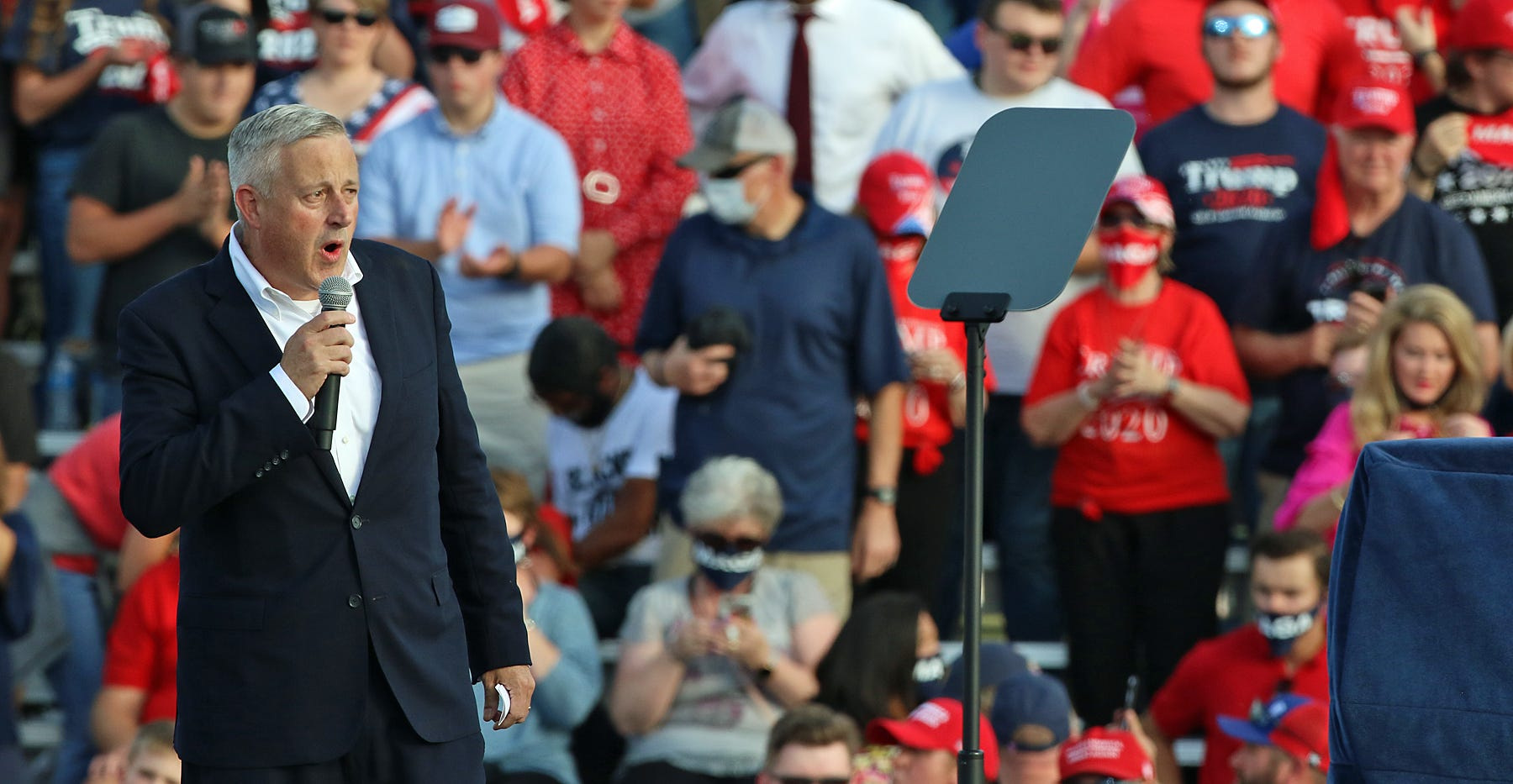
The findings emerge from the public records requests seeking emails, texts and call logs involving Whatley, the former state party and Republican National Committee chair, who President Donald Trump appointed during a Jan. 24, 2025, visit to the Asheville area to “(make) sure everything goes well” with Helene recovery.
Nearly four months earlier, Helene had caused $60 billion in damages across the state and killed more than 100 people. At least $8.3 billion in federal aid has been awarded to North Carolina for recovery, but the state had received only about $3.3 billion by late July — roughly 40% of the awarded amount but a mere fraction of the total damages. The Citizen Times around the second anniversary of Helene found that FEMA project closeout rates lingered around 14%.
Throughout his 2026 U.S. Senate campaign, Whatley has been criticized for “rarely, if ever” being seen working in the disaster zone. Whatley’s campaign did not respond to a request for comment on this story.
A broad search with unavoidable blind spots
The records do not capture every possible contact. Some counties said their systems could not search call logs by a telephone number alone, and the requests would not reveal communications through unidentified accounts or numbers. They also do not document in-person conversations.
Even with those limits, the searches were broad. They included multiple known Whatley email addresses, seven telephone numbers and, in some cases, any message merely containing his name. The requested periods began as early as Jan. 20, 2025, and extended into summer 2026.
The broadest federal search covered the inboxes and devices of 18 current and former FEMA and Department of Homeland Security officials. The list included senior administrators, regional leaders, recovery officials, advisers and then-Homeland Security Secretary Kristi Noem, covering Jan. 20, 2025, through Nov. 20, 2025.
FEMA’s final response was unequivocal.
“No responsive records were located using the search criteria provided,” the agency wrote June 2.
Across governments, searches came back empty
State agencies reported the same result. North Carolina Emergency Management searched once for communications involving Whatley’s known accounts and numbers and again for any message containing his name. Both searches came back empty.
In December 2025, Matt Calabria, director of the Governor’s Recovery Office for Western North Carolina, said he’d only spoken with Whatley once, around a year after Helene.
A subsequent Department of Public Safety search extending through March 2026 found no emails, texts, messages or phone communications involving Whatley. The Department of Commerce found none through its email, Microsoft Teams accounts or phone systems.
Further responses also reported no direct contacts with governments in Avery, Buncombe, Caldwell, Cleveland, Gaston, Haywood, Jackson, Madison, Polk, Rutherford or Yancey counties. Madison County summarized its search results in one sentence.
“After review, no records exist for this request,” the county responded March 31.
Those county results conflict with what Whatley told The Smoky Mountain News in February: that he’d been speaking with county-level administrators.
Lincoln County was the exception, but only in a technical sense. Its search produced mass messages sent to a bar association distribution list that included Whatley, who holds a law degree from the University of Notre Dame. The records show no reply from him and no recovery-related discussion.
One adviser carried the conversation
The only substantive communications in the public records came from Sharon Decker, former North Carolina commerce secretary and a senior advisor to the Governor’s Recovery Office for Western North Carolina.
Her records covered June 3, 2025, through June 3 of this year and showed six messages from Whatley — five of them about the region’s recovery.

Texts refer to a September 2025 meeting with Whatley and another conversation on June 1, 2026., with the thread beginning after the 2025 meeting in WNC. Decker asked Whatley to connect her with someone who could help create a path for special Opportunity Zones across the disaster region. She said she needed guidance on whether the proposal required legislation or executive action. Whatley answered five hours later.
“Thank you Sharon,” he wrote. “I will work on this and be back to you shortly.”
Public records show no written follow-up from Whatley for nearly five months.
His next message came Feb. 19, when he forwarded his own X post about the U.S. Department of the Treasury’s announcement that Asheville would host G20 Finance Track meetings in August.
Later that day, Decker told Whatley she was glad he was joining a World Military Games advisory board call, which was unrelated to Helene recovery. His entire response consisted of five words.
“I am here to help,” Whatley wrote.
On Feb. 27, Whatley texted a Department of Homeland Security announcement of $96.5 million for debris removal and road repairs to Decker.
Another message to Decker included the FEMA Review Council’s final report. Whatley served on the Trump-commissioned council, charged with making recommendations on FEMA reform. The council’s final report was released in May, more than five months late. Whatley co-chaired the subcommittee that prepared the council’s final recommendations. In July, a Citizen Times investigation revealed that Whatley could benefit financially from council recommendations he approved.
Recovery requests met with few replies
Conversely, Decker’s messages provided detailed proposals and status reports.
First, she sent Whatley the post-Katrina 2005 Gulf Opportunity Zone legislation as a model.
Then, she sent an analysis drafted by former Asheville-Buncombe County Economic Development Coalition leader Ben Teague, who now serves as vice president of strategic development at Biltmore Farms, where Jack Cecil, a member of the Governor’s Advisory Committee on Western North Carolina Recovery, is president and CEO.
Then, she sent a map showing that the existing Opportunity Zone excludes Canton’s former paper mill site. The mill closed in 2023 and is currently undergoing redevelopment.
Decker also raised the possibility of applying for federal grants, receiving a second recovery appropriation and delayed decisions affecting local governments.
On June 2, Decker told Whatley that the three federal actions could give the region what it needed to rebuild damaged infrastructure and attract private investment.
“Our Fed ask, with all of this, is still a fraction of the need,” Decker wrote.
The next day, she reported that $200 million for North Carolina remained at DHS awaiting approval. She also said Beech Mountain officials were waiting for FEMA to decide whether it would help fund an alternate water supply after the agency had visited the site and gathered the information it needed to make a determination.
The thread shows no response from Whatley to those June messages.
The six Whatley texts were not the entire record of her exchanges with Whatley. Decker thanked him for two meetings or conversations, and the phone records show calls on three dates. Nor do the records establish what Whatley may have done through channels outside the searches.
What they do establish, however, is that across the agencies directly responsible for approving, administering and carrying out recovery, those searches produced one narrow thread with a single state adviser. Most of it consisted of Decker sending Whatley requests and updates. Everywhere else, the response was the same — no records.
Canton Mayor Zeb Smathers, who with his governing board has been advocating for incentives to expedite redevelopment of the 185-acre mill site, had harsh criticism for Whatley after learning of the results of the Citizen Times investigation.
“I’m the first to thank anybody no matter their political beliefs, but based on this information, this is further proof that Whatley has been absent in our recovery,” Smathers told the Citizen Times Sept. 22. “Titles are not important. It’s the time you put in.”
Whatley is the Republican nominee for the U.S. Senate seat being vacated by Republican incumbent Thom Tillis, who is retiring.
“Senate? Absolutely not,” Smathers said of Whatley’s qualifications. “His record doesn’t show me he can deliver for the state of North Carolina.”
A spokesperson for Whatley’s Democratic opponent, former Gov. Roy Cooper, continued to paint Whatley, a former lobbyist, as a “DC insider” and said the records demonstrated Whatley’s failure as Helene recovery czar.
“Whatley has used his position to line his own pockets at the expense of Helene victims and refused to push for federal aid even when his fellow Republicans sounded the alarm,” the spokesperson said. “Roy Cooper will work with leaders in both parties to fast-track federal funding to ensure Western North Carolina gets every federal dollar it’s owed.”
Reporting by Cory Vaillancourt, Asheville Citizen Times / Asheville Citizen Times
USA TODAY Network via Reuters Connect