Jamie Ager, a first-time candidate, says he will focus on securing Hurricane Helene recovery funding and tackling the cost-of-living crisis.
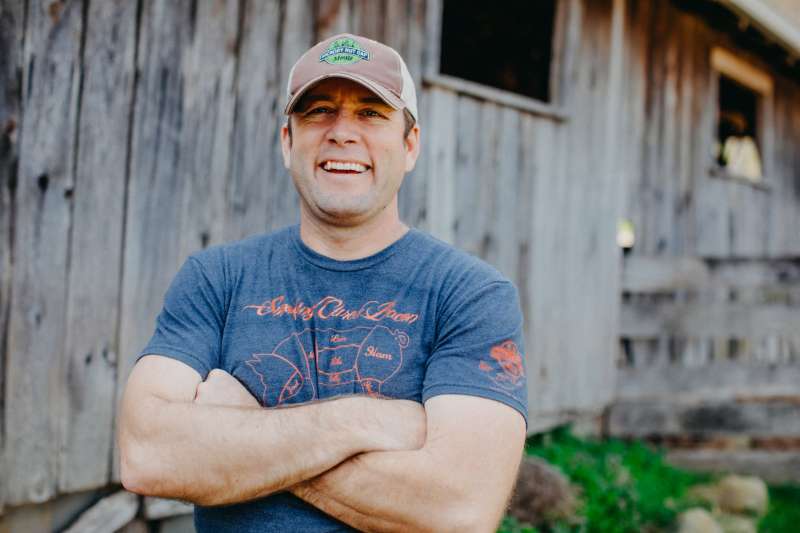
For 25 years, Jamie Ager has operated Hickory Nut Gap Farms, a family-owned business that provides meat and produce to the community and local businesses. The farm, located in Fairview and just 20 minutes west of downtown Asheville, has been in the family since 1916.
Ager, a graduate of nearby Warren Wilson College, has deep ties to the community and comes from a family with a history of public service in western North Carolina.
His grandfather, Jamie Clarke, served three nonconsecutive terms in Congress, while his father, John Ager, served in the North Carolina House. His brother, Eric Ager, currently represents part of Buncombe County in the state House.
Speaking with Cardinal & Pine on the farm, Ager says he never saw himself going into politics like many members of his family.
“I honestly thought I had avoided politics because my brother Eric got involved, and I said ‘Oh good. I can stay here on the farm and do all of this,’” he said.
Now, Ager hopes to be the first Democrat to represent the district since Heath Shuler left Congress in January 2013. He says Hurricane Helene’s aftermath and concerns about the rising cost of living are two issues he’s focused on as he challenges two-term Republican Rep. Chuck Edwards in North Carolina’s 11th Congressional District.
Boosting Hurricane Helene recovery efforts
On Sept. 27, 2024, Western North Carolina faced its darkest hour when Hurricane Helene ravaged communities across the region.
The storm claimed the lives of at least 107 people and inflicted around $60 billion of damage in North Carolina alone.
Ager says fighting for funds for his constituents would be the top priority.
“I would really focus on Helene recovery, number one. And make sure that we’ve got money coming into western North Carolina. Dot the i’s, cross the t’s, and make sure we got folks’ lives back into gear,” Ager said.
To date, the federal government has provided North Carolina with just 14% of the funds needed to recover from Helene. Ager says Edwards hasn’t done enough to advocate for recovery funds.
“When Hurricane Helene hit in 2024, our community got devastated. If there’s one job for a representative of western North Carolina after a storm like that, it’s to go fight for the money, and Chuck [Edwards] just evaporated,” he said.
The funds North Carolina has received from the federal government for Helene recovery were passed as part of a broader disaster relief package at the end of President Joe Biden’s term in December 2024.
Ager also criticized the priorities of the Trump Administration in not getting money to the region.
“That administration is building ballrooms in DC instead of building bridges here in western North Carolina, talking about Greenland instead of Newland right here in western North Carolina,” he said.
Helene damaged or destroyed around 70,000 homes. Nearly two years after the storm, Ager says he’s heard from people across the region that the promise to repair or rebuild those homes hasn’t been fulfilled.
“There’s a buyback program that was supposed to be in place, but folks are still kind of in limbo about what to do with these homes that are so wrecked they have a hard time knowing what to do with them,” he said.
“We still have roads that are out, we’ve got bridges that are out. We still have people living in campers or tents. I just hear over and over again how frustrated they are with the response.”
‘The price of everything’s gone up’
A Carolina Journal poll from May found inflation and cost of living was the most important issue in this year’s midterms for voters in North Carolina.
“The price of everything’s gone up. Obviously, groceries have gone up. Gasoline’s gone up here,” Ager said. “We’ve got folks here in Fairview, in western North Carolina, that are having their price of gas [doubled]. And when they’re living on a fixed income, that’s significant.”
Ager said that the increase in gas prices can be attributed to the US intervention in Iran that began on March 1 of this year.
“I think that [increased gas prices] can clearly be pointed to the activity over there in the Middle East,” he said.
According to AAA, the average price of regular gasoline in the Asheville area was $2.90 a year ago. In May, the average price peaked at around $4.20 per gallon, a 45% increase year-over-year.
North Carolina was also among the states hardest hit when Congress allowed federal subsidies for Affordable Care Act (ACA) plans to expire at the end of 2025.
The Assembly reports that North Carolina saw the largest drop in ACA enrollment, and all but two of the state’s 100 counties saw a drop in sign-ups.
“Folks’ insurance went up 300% in some cases. I hear about that over and over again,” Ager said.
Across the board, inflation continues to rise. The inflation rate is set to increase by 4.2% this year, up 1.5% percentage points from 2025.
“Both political parties bear some responsibility for this. I’m not going to partisan this thing. At the same time, one thing that certainly didn’t help in an inflationary environment is erratic tariffs that create chaos in the marketplace,” Ager said, referring to the tariff policy that began under President Trump last April.
He says that, as a result, businesses have had little choice but to raise prices when faced with higher costs.
“When your costs go up, I’m pretty sure you’ve got to raise prices. I don’t know how else you do that,” Ager said. “People said ‘you’ve got to pay the tariff and not raise your prices,’ but I’m not sure exactly how businesses can absorb that level of gross margin because these tariffs were significant.”
While he says tariffs haven’t impacted his farm, in his capacity as a farmer and small business owner, Ager has felt the impacts of rising inflation.
“We buy a lot of local cattle. We’ve seen tremendous impacts with inflation. The cattle price has gone up so much. We work with a lot of local farmers in our business and so the cost of the supply of cattle has gone up tremendously over the past two years,” he said.
How Ager would approach the role of Congressman
Ager says he doesn’t see himself as a partisan politician.
“I know a lot of folks that see me less in the context of partisan politics, and they see me more as a farmer, a business owner, as a dad, as a community member. And I see myself in that context. I really don’t like to see myself in the context of partisanship,” he said.
He believes his experience building a business has helped prepare him for the campaign.
“Business has taught me the humility of how hard it is to execute, and at the end of the day, building an organization that’s good for people is worthy. To me, those lessons go into politics too,” Ager said.
If elected, Ager says he is willing to work across the aisle with Republicans.
“People ask me, ‘which issue do you want to work with Republicans on’? And I say ‘all of them’. Because we need people who are willing to listen, people who are willing to engage, people who are willing to be creative to solve big, hard problems,” Ager said.