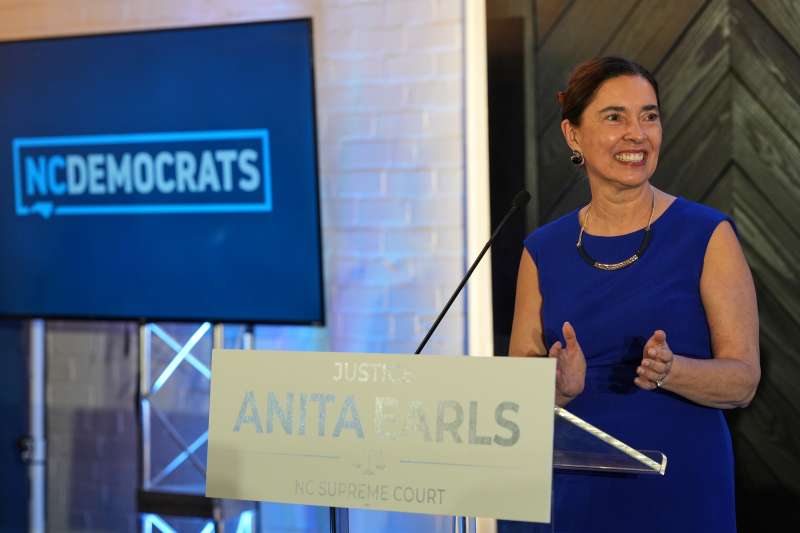
[Editor’s Note: The author’s new biography, Justice for the People, chronicles the life of NC Supreme Court Justice Anita Earls. This adapted chapter discusses Earls’ early legal career.]
When NC Supreme Court Justice Anita Earls became a lawyer in 1988, she moved to Charlotte to work at a firm founded by a civil rights icon—Julius Chambers—who had seen his home and law office bombed by white supremacists in the 1960s.
None of this deterred Chambers, who had graduated from an under-resourced, all-Black high school. After an internship with the NAACP Legal Defense Fund, Chambers broke new ground by launching a racially integrated, Black-led law firm.
A friendly man with glasses and a neat mustache, Chambers recruited partners Adam Stein, whose son Josh was elected governor of North Carolina in 2024, and James Ferguson. “Fergie,” as he was known to his friends, was a brilliant litigator who handled pivotal civil rights trials.
Everything you need to know about the 2026 elections in one place. Check out Cardinal & Pine’s 2026 Voter Hub.
Chambers traveled across North Carolina to empower Black communities to use the legal system as a tool for justice. His firm was crucial to the Fund’s effort to ensure that the Civil Rights Act of 1964 was effective in the South. They successfully challenged many of the old, deeply entrenched Jim Crow rules in place across North Carolina in restaurants, schools, and executive suites. And their work created new legal protections for workers across the country.
By the time Earls arrived in the early 1980s, there were about a dozen attorneys at the firm, and they were all helping in Chambers’ original mission —to make sure the laws of the Civil Rights era were used to ensure Black people and communities were treated fairly. Earls said their mission was to “serve anyone who came in the door… If someone came to you with a problem, in their view, it was your job to help them find a solution.”
Earls felt right at home and relished her work. She said their approach with new lawyers “was to throw you in at the deep end and either sink or swim.” Within weeks of being sworn in, she was in court representing defendants in misdemeanor cases.
The young attorney learned fast, with help from her older colleagues. Ferguson joked, years later, that there were times when Earls was so knowledgeable about the cases that he “felt unprepared” by comparison.
Never miss an update from Cardinal & Pine. Sign up for the free, award-winning newsletter that 100,000+ North Carolinians trust.
Earls remembered juggling a variety of cases, but “mostly it was wrongful death cases involving the police killing, almost without exception, people of color.” Lawyers at the firm witnessed systemic patterns of racial injustice in law enforcement.
She defended people accused of crimes and excelled in civil rights cases. When gay men in Charlotte were arrested for the crime of “sodomy,” Earls both represented them and called on the city to change the law.
“I’ve had a number of clients I respect a lot who have gone through real hell because of that law,” she said in a 1993 article in Q-Notes. “It is discriminatory, and I just feel strongly that if I am part of a system where discrimination causes suffering, I must stand up and do something about it.”
Though Chambers had left to run the NAACP Legal Defense Fund a few years earlier, Earls worked with him on voting rights cases, demanding election districts that gave Black voters the chance to exercise some political power. The legendary civil rights lawyer saw through the more sophisticated and insidious voter suppression measures, like unfair election districts, that replaced the Jim Crow system that he had grown up under.
“He was effective because he took the time to understand the other side’s arguments better than they did,” Earls reflected.
Earls also worked closely with attorney Leslie Winner in North Carolina to dismantle unfair local election systems. She said, “By the time I met her in 1988, [Winner] had been to nearly every county in the state with a significant Black population that did not already have African-American representation on their school boards and county commission.” Together, they reshaped local democracies.
“It felt like a couple of golden years of litigating voting rights cases,” Earls recalled years later. Local officials realized they couldn’t justify the systems that had kept Black people from exercising political power, leading to settlements and reforms without prolonged litigation.
Earls attended the annual Legal Defense Fund conference, where she encountered lawyers who had less success. “The employment discrimination attorneys would be so frustrated because the courts were rolling back those protections, same with the housing discrimination lawyers,” she said. “The school desegregation attorneys were just losing their cases.”
But when it came to election districts, Earls and her allies reshaped local politics across the South and made elections fairer. Together, they carved out victories for voters. “There were a few good years,” she reminisced. “But then the rollback started.”
That rollback continues today, and we’ve seen the impact on North Carolina voters. For the last eight years, Earls has fought that rollback on the state’s highest court. She’s engaged in the same struggle as Julius Chambers and her other heroes—the fight for a better democracy.
Find Justice for the People: The Anita Earls story on Amazon. Journalist Billy Corriher has covered North Carolina courts extensively since 2016. This column is syndicated by Beacon Media and is available to republish for free on all platforms under Beacon Media’s guidelines.