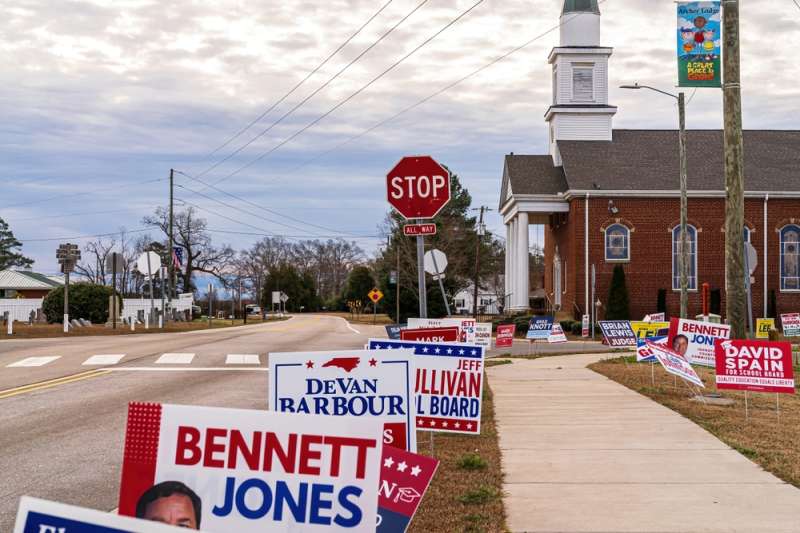
Editor’s Note: Paul “Skip” Stam is a former majority leader and Speaker Pro Tempore of the NC House. He served eight terms in the state legislature as a Republican.
Government should tax only to raise money for its essential functions. I support a thorough review of expenditures each year. A goal I share with proponents of this amendment is a mechanism that will restrain state government from overspending.
Read More: Why two NC constitutional amendments on the ballot could be devastating
Does this amendment actually restrain spending? Why is it a constitutional amendment?
Why would November 2026 voters think they have superior knowledge of government policy to voters in 2031 or beyond?
It seeks to remedy the spending problem by capping the state income tax rate at 3.5%. Currently, Article V of the North Carolina Constitution reads: “Sec. 2. State and local taxation… (6) Income tax. The rate of tax on incomes shall not in any case exceed seven percent, and there shall be allowed personal exemptions and deductions so that only net incomes are taxed.”
This amendment would lock in a future cap to the rate of 3.5% with which North Carolina has no experience. Since the personal income tax provides one half of the revenue for the general fund of the state, this is a risky bet.
The proposal assumes that the decrease in the rate would bring in more revenue just as revenue increased after the rate was decreased from 7.75% to 4.5%. This is an economic fallacy — the point of diminishing returns — and a logical fallacy — post hoc ergo propter hoc.
To change that maximum rate would take another constitutional amendment requiring 3/5 of the whole House, 72 votes and 30 votes in the Senate, plus a statewide referendum. Unlike a veto override, a constitutional amendment requires 72 positive votes, not 3/5 of those voting. Absences, vacancies or defections will make change impossible.
Why would November 2026 voters think they have superior knowledge of government policy to voters in 2031 or beyond?
This proposal makes no more sense than one that REQUIRED a minimum level of income taxation.
Particular problems with this amendment
It restricts increases only on income tax rates — not increases in overall state taxes. It almost requires increased rates on other taxes. It is no surprise that the Senate plan is to reduce income taxes to 2.5% while adding services subject to sales tax and adding sin taxes (alcohol, gambling, tobacco, marijuana) to fill the gap! Would the Senate be willing to tax prostitution in the future? Why not?
Since the personal income tax provides one half of the revenue for the general fund of the state, this is a risky bet.
There is a problem with squeezing income tax receipts into taxes on services. A tax on services is an income tax on gross income. Suppose the “sales tax” was extended to the services of a CPA. What is a sales tax on a service but an income tax on gross income? A CPA could refuse to pay the 6.75% “sales tax” claiming that it exceeded the 3.5% constitutional limit on taxation of income. The budget would be in chaos.
This amendment only restricts the rate of tax. A future General Assembly that wanted to spend more could decrease personal exemptions or eliminate popular deductions. That would be bad policy.
It would encourage more borrowing. Receipts from a bond would not count against the income tax limitation. Resulting spending could be counted over decades rather than the years the money is borrowed. It would have a negative effect on our AAA bond rating. Bond ratings themselves are just opinions. Bond ratings (opinions) matter — a lot. If we lose our AAA rating, the cost of borrowing increases. Bond rating agencies hate tax limitations that apply to the future.
The massive problem of government overspending is primarily at the federal level — not the state level. At the federal level, we are more than $40 trillion in debt.
Some day a responsible Congress will meet a responsible President and come to a “Grand Bargain” to reduce spending. Suppose that “Bargain” included a $1 trillion dollar yearly reduction in federal spending. $900 billion would not be spent at all. The other 10% ($100 billion) would be devolved to the states to cover functions that truly belong to states but have been hijacked by the feds. Conservatives would be in a state of delirious joy!!
That “Grand Bargain” would require a $3 billion increase in North Carolina state revenues. Taxpayers would be delighted because of the corresponding huge reduction in the federal tax and debt burden. But it would be virtually impossible for NC to take up this offer if this amendment passes. So many members have taken a “no tax increase” pledge that a future amendment would have to rely on others to vote “Aye.” They would impose unacceptable demands as ransom for the votes necessary to revise the Constitution.
I will vote NO on November 3, 2026.