By Anne Blythe, Michelle Crouch and Rose Hoban
Key Takeaways:
- Wake commissioners voted 5-2 to clear the way for Atrium and WakeMed to combine after months of debate and public opposition.
- The deal changed substantially in the final days, with better terms for Wake County. Some of the final contract language still has to be written.
- The final vote was delayed by repeated disruptions from opponents, prompting the chair to temporarily clear the chamber.
With key legal details of a “strategic combination” between WakeMed Health & Hospitals and Atrium Health yet to be finalized, the Wake County Board of Commissioners on Monday voted to move forward with one of the biggest and most contentious health care changes the county has faced in decades.
The 5-2 vote came after months of debate, almost two hours of public comment on Monday and a lengthy discussion with the county attorney over changes to the deal.
Read More: Michael Whatley holds thousands in companies with ties to housing market
“I believe this is one of the most important decisions we will make because this will shape health care for years to come,” said Commission Chair Don Mial, who voted ‘yes.’
“I believe that this action will make WakeMed stronger in the face of growing demands, workforce pressures, rising costs and the real headwinds facing health care today. It’s about making sure WakeMed has the resources and capabilities to meet what lies ahead.”
Many critics of the deal focused on what it could mean for health care prices. A substantial body of research has linked hospital consolidation to higher prices, and Brown University researchers found that after Atrium combined with Winston Salem-based Wake Forest Baptist in 2020, prices rose 28 percent.
Commissioners Safiyah Jackson, Cheryl Stallings, Susan Evans and Shinica Thomas also voted for the deal.
The vote came even though the commissioners have not yet seen the final contract language guaranteeing that Atrium will spend $2 billion on Wake County capital projects over 15 years using its own money, rather than WakeMed’s. Nor did they have the final terms of a promised five-year cap on price increases.
Commissioners Vickie Adamson and Tara Waters cast the two “no” votes, questioning the deal itself and also the process that left key changes out of public view until just before the vote. They also were skeptical about leaving language to be finalized by WakeMed and Atrium after, they said, the two health care systems made the deal sound more beneficial to the county than it initially was.
Adamson criticized the timing, saying she received the complicated legal documents only days before the vote. “This is not our normal process or how we do work,” Adamson said.
Waters agreed: “Quite frankly, the plot twists have been nonstop,” she said. “I do not believe this process has provided the level of clarity and reassurance that many of our residents deserve.”
Ardis Watkins, an attorney who’s head of the State Employees Association of North Carolina and a Wake County resident, said after the meeting that she was surprised by how many legal threads were still hanging.
“One of the more disturbing parts of this whole thing was that the county attorney’s staff did not appear able to answer some of the more serious questions about what is left — what it means legally,” Watkins said. “I was really concerned that we would have folks vote, then figure out later what the deal that they just agreed to means. I don’t think I’ve ever seen that.”
Last-minute changes
The deal gives Atrium Health, already the largest health care system in the state, significant control over WakeMed, a 973-bed community-focused system based in Raleigh. Atrium is part of Advocate Health, a $39 billion organization that is the nation’s third largest nonprofit hospital system. The combination still faces review from federal and state officials.
Because WakeMed was once a county hospital, the commissioners were required to approve changes to two documents — the hospital’s articles of incorporation and a transfer agreement — to clear the way for the combination.
A proposal to approve those documents first appeared publicly in May, tucked into the commissioners’ consent agenda, which is typically reserved for noncontroversial business items. After public backlash, the commissioners delayed the vote to allow time for public input. In the months since, hundreds of supporters and opponents turned out for community meetings, protests and public hearings.
State Health Plan officials released estimates late last week that premiums for the plan’s roughly 750,000 members would rise by $7-$11 a month — or $84-$132 a year — if WakeMed’s prices increase to the average rates Atrium charges the plan.
A revised version of the documents was released late Sept. 17, just a few days before the vote, once again prompting complaints that the public didn’t have enough time to review the changes and share feedback.
The amendments sweetened the deal for Wake County. They call for Atrium to pay Wake County $150 million over 10 years for public health initiatives, raise WakeMed’s indigent care commitment from 4.8 percent to 8 percent of adjusted annual revenue and add new county protections over certain governance changes.
Several commissioners said the changes made the agreement substantially stronger and addressed their concerns.
“I now feel confident that we have secured much stronger terms around governance and a significantly better level of financial investment for our community,” Evans said.
And Jackson said, “I believe we’ve negotiated a good and fair agreement that has protections and safeguards as well as community benefits.”
The day before the vote, Gov. Josh Stein’s office announced that Atrium had also agreed to cap price increases at WakeMed to no more than 1.5 times the annual increase in Medicare costs for the next five years. Atrium also agreed to fully fund $2 billion in promised capital projects out of its own pocket, rather than with money out of WakeMed’s coffers.
Final terms still being written
However, the promises negotiated by Stein were not part of the documents approved by the county commissioners Monday night. Instead, County Attorney Roger Askew told the board, they will be written into the private contract between the two health care systems.
Asked about the details of the price cap, he said, “The actual language has not been developed.” The health care systems are also developing the language for the $2 billion guarantee, he said.
The commissioners addressed that uncertainty by making their approval conditional on those commitments being added to the contract. Askew assured the commissioners he would review the language and if Atrium didn’t deliver on what had been promised, “We don’t have a deal.”
Adamson said her experience privately reviewing an earlier version of the deal between the hospitals made her nervous about relying on summaries and promises.
“The devil’s in the details. That’s what we learned from the first agreement,” she said. “When I finally threw a public fit and got to see it, I was shocked at the difference between that [and] what we had been told.”
For instance, one of the surprise revelations at the meeting was that Atrium, as WakeMed’s sole member, will have the power to remove WakeMed’s CEO with cause on its own, without agreement from the WakeMed board.
Disruptions clear the chamber
An hour and a half before the commissioners started their meeting Monday, The Patients Union, a health care consumer advocacy organization that’s gaining a foothold in North Carolina, rallied against the vote in Nash Square near the Wake County Justice Center, where the meeting took place.
Then, during a public comment period that lasted close to two hours, dozens of speakers made their case to county commissioners in two-minute increments.
Supporters, including several WakeMed board members and Atrium or WakeMed employees, said the combination would give WakeMed the resources to expand and update its facilities, expand care and strengthen WakeMed for the future.
“It means better health care. It means more charity care. It means significant investment in the whole health care of our county,” said Satish Garimella, a WakeMed board member.
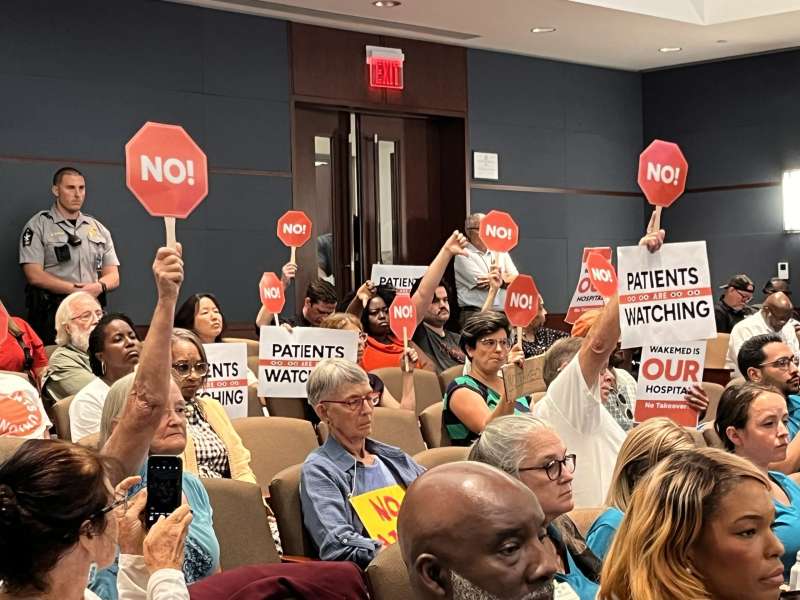
Opponents, meanwhile, recounted many of the arguments about the opaque process, loss of local control, concerns about price increases and reduced charity care. Wearing shirts that said “Save WakeMed” and carrying signs that read “No!” and “We will remember every November,” they asked why the board seemed to be in a rush to vote when changes were still being made to the proposal as recently as the day before.
“My number one question is: What’s the rush?” said Wake County resident Katherine Martin. “Wake Med is not hurting for cash, Wake Med does not need this decision this month or even this year. What is the rush? Why are we rushing into this decision when it doesn’t need to happen?”
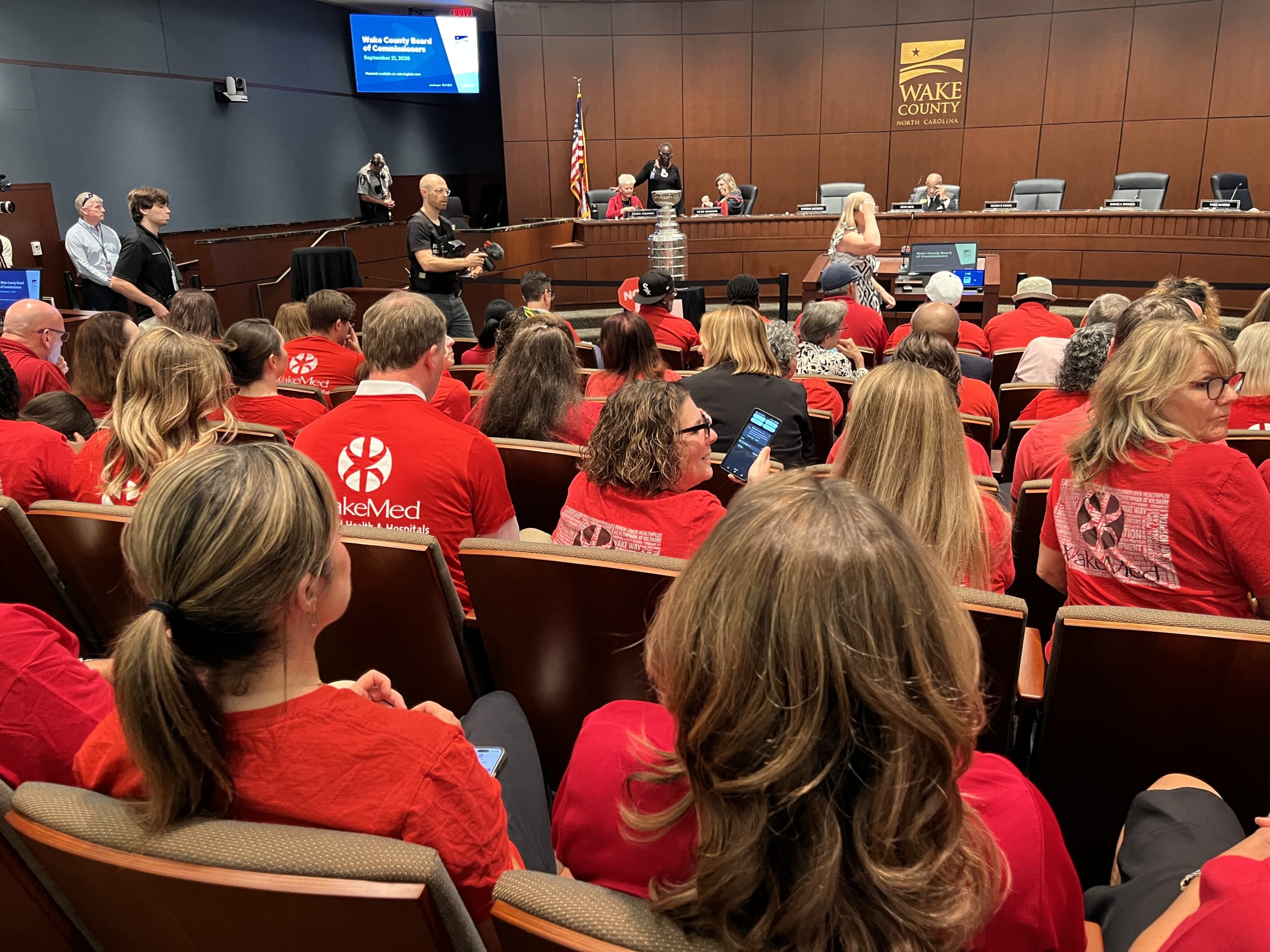
Once the vote was underway, several opponents voiced their final objections by standing one at a time to shout at the commissioners. Mial took the unusual step of temporarily clearing the room to stop the interruption. As people were being moved out, some chanted “shame, shame.”
Price concerns remain
Many critics of the deal focused on what it could mean for health care prices. A substantial body of research has linked hospital consolidation to higher prices, and Brown University researchers found that after Atrium combined with Winston Salem-based Wake Forest Baptist in 2020, prices rose 28 percent.
The Brown researchers updated their analysis on the day of the vote, after the changes to the deal were announced. “While the revised proposal alters a handful of provisions in the transfer of WakeMed to Atrium, it does not alleviate our central concerns regarding potential price increases, governance control and local accountability, workforce staffing, and indigent care,” the researchers wrote.
They listed problems with the pricing conditions announced by Stein, including the lack of a public binding contract and language in Atrium’s letter to Stein that suggests its agreement to the cap was conditioned on the governor’s support for the combination.
The researchers also emphasized that the price cap that Atrium agreed to — no more than 1.5 times the annual increase in Medicare costs for the next five years — is not a hard ceiling but merely a limit on increases.
Because the increases would compound from year to year, prices could still rise substantially over the next five years. For example, if Medicare costs rise 3 percent every year, WakeMed could increase prices by as much as 4.5 percent annually. If they do that each year, WakeMed prices would be 25 percent higher after five years.
“The price-cap agreement is temporary — only five years — while the transfer of the hospital to Atrium is permanent,” the researchers wrote.
State Health Plan officials released estimates late last week that premiums for the plan’s roughly 750,000 members would rise by $7-$11 a month — or $84-$132 a year — if WakeMed’s prices increase to the average rates Atrium charges the plan.
“Wake County is the heart of state government,” Watkins said in her public comments to the commissioners. “Your constituents, in all likelihood, a lot of them are state employees or retirees. They’re watching what is happening here.”
This article first appeared on North Carolina Health News and is republished here under a Creative Commons Attribution-NoDerivatives 4.0 International License.