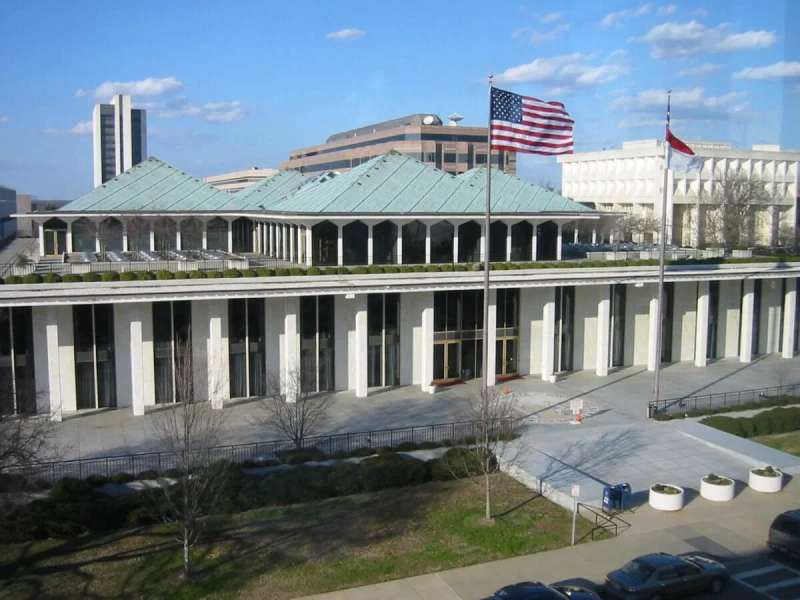
Lawmakers are expected to vote Saturday on their coronavirus relief package, including funding for schools, small businesses and more.
NC House and Senate leaders have been working to resolve a more than $300 million gap between their respective COVID-19 spending proposals. They are poised to vote on a $1.5 billion plan on Saturday.
But lost in the debate over the NC General Assembly’s dueling plans is how differently North Carolina’s legislative chambers arrived at their plans for coronavirus relief.
Members of a House Select Committee on COVID-19 and its four specialized working groups started meeting as early as March 25, taking public comments and airing their deliberations via live-stream.
“Our working group has really worked in the way that we’re supposed to work in a democracy. It’s really been an example of how things should be working all the time,” Rep. Ashton Wheeler Clemmons, a Democrat from Greensboro and co-chair of a House COVID-19 working group on education, told Cardinal & Pine. “I am very proud that in the House we had open meetings and had constant feedback.”
By contrast, the state’s legislative calendar doesn’t list a single Senate committee or work group meeting from mid-March until the General Assembly reconvened on Tuesday.
The Senate Appropriations Committee didn’t hold public meetings or publish documents related to COVID-19 until this week. But by Wednesday evening, Senate Republicans and Democrats had agreed to a spending bill worth nearly $1.4 billion. On Thursday, the House passed a $1.7 billion plan. By Friday afternoon, they had split the difference in terms of the dollar amount but were still working out specific priorities.
The process in the Senate leading up to this week shows a lack of transparency, longtime government watchdog Bob Hall, former director of Democracy NC, told Cardinal & Pine.
“It’s pretty clear that the House Republican leadership is acting in a more collegial way with the Democrats and with the public at large,” said Hall. “They’re providing more access to their meetings and allowing people to follow along as they develop the legislation rather than just drop it in one big bill shortly before there’s a big vote on it.”
The chamber’s Democratic leader, Sen. Dan Blue, said Senate President Pro Tempore Phil Berger tasked Republicans chairing the various Joint Legislative Oversight committees to take input from state agencies and other legislators but not in public meetings.
“The Senate maybe was somewhat behind the House in learning how to operate these virtual platforms,” Blue said. “For many of them, Tuesday was the first time that they had done virtual communications, certainly the first time we had done a virtual committee meeting. Everybody was trying to adapt to the new normal.”

“That’s how Sen. Berger chose to do it,” added Blue. “He decided not to replicate what the House had done. There are some ways that it could have been formulated differently, but I think it worked out just fine.”
Senate budget leaders did communicate publicly in a letter to Gov. Roy Cooper last week, asking his administration to cut $250 million from its budget ending in June 2021. House Speaker Tim Moore, a Cleveland County Republican, told reporters Friday the state expects a budget deficit of $4 billion by next June. Moore said the joint legislative budget would be dispersed on top of another $2 billion in federal money to state agencies, the Havelock News reported.
Blue said the Senate Democratic Caucus convened working groups to gather input from state agencies and to advise the Senate’s oversight chairs over the course of April, but their private deliberations didn’t have authority to enact any legislation.
“Certainly we could have replicated the House’s way of doing things,” said Blue. “I’m a firm believer in transparency at all levels, but looking at the final product, it ended up in the same place.”
Blue said the dollar figures and priorities just about matched up among the House, Senate and governor’s proposals, reflecting a “true consensus.”
But the House COVID appropriations plan is about 25% larger than the Senate’s, forcing negotiations late this week.
More than half of the overall gap lays in how each chamber would fund public schools and higher education. The House plan pegs more than $290 million for the Department of Public Instruction and its nearly 2,600 public schools across the state, whereas the Senate plans offers less than $130 million.
“I hope that we can get a budget that’s much more aligned to the House budget, supportive of our K-12 schools and our colleges and universities,” said Rep. Clemmons.
“We prefer many of the House’s K-12 funding levels and flexibility, and hope to ensure sufficient funds for connectivity, equipment needs, and exceptional children,” agreed Sen. Don Davis, an education committee member and Democrat representing Greene and Pitt counties.
“We are in uncharted territory and must take what is best from both spending plans to help our students and the residents of our state during this extremely trying time.”
Although the two chambers agree on much, the House prioritized education and healthcare, whereas the Senate budget favors small-business relief, with an additional $9 million to support rural broadband and $125 million in COVID-19 bridge loans through the Golden Leaf Foundation, a sum $50 million higher than in the House budget. These are matters of emphasis rather than strong disagreement.
“House Democrats support this bill to help small businesses, help workers who have lost jobs, paychecks, and health insurance,” said Democratic Leader, Rep. Darren Jackson of Wake County, in a written statement. “We look forward to continuing to expand Medicaid, strengthen the unemployment system for workers, and improve family leave policies.”
Expanding Medicaid coverage for testing and treatment of COVID-19 is a particular sticking point.
The House would allocate $40 million to cover COVID patients under Medicaid plus another $75 million to support rural hospitals, whereas the Senate allots $15 million for free community health clinics.
Berger’s spokeswoman Lauren Horsch said the federal government will end up covering individuals’ COVID-related costs and he wants the state to direct funding toward free clinics and health clinics. “They’re local and the core of their mission is caring for uninsured patients,” Horsch told The News & Observer.
Sen. Blue affirmed this, saying state health officials told senators they had other sources of federal funding to cover COVID testing and treatment. Blue said he had spent Thursday trying to understand the differences between the House and Senate bills.
“Certainly, they’re not insurmountable,” he said. “It shouldn’t be very difficult to bridge the chasm.”
Both chambers budgeted $50 million to the Department of Health and Human Services for COVID safety, sanitation and treatment gear like personal protective equipment, but the House bill would add another $270 million to DHHS, for priorities like behavioral health, child welfare, nursing homes, more COVID testing and contact-tracing.
GOP leaders worked Thursday and Friday to reconcile the two bills. Rep. Donny Lambeth, a GOP co-chair of the House’s healthcare work group, said he was in negotiations with Senate lawmakers, but declined to discuss the differences with C&P this week.