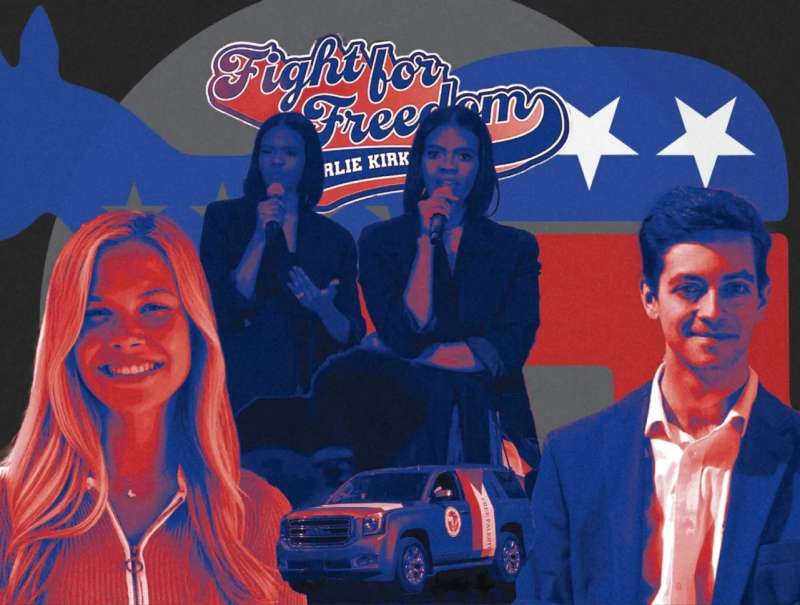
Following conservative commentator Candace Owens’ March 6 visit to UNC, student journalists dig into how college campuses tackle the “culture wars.”
When conservative political commentator Candace Owens visited UNC-Chapel Hill on March 6, the building was filled to capacity as soon as students were let into the building.
One student received compliments and approving glances as she repped her Ronald Reagan shirt. Another student proudly wore his “Second Amendment: God x Guns” baseball cap. Posters with “My Pronoun: Patriot” and “Be a rebel on campus. Fight for freedom,” were placed around the auditorium.
Before Owens’ appearance, event contributor and Daily Caller Live host Jobob Talefi opened the event and introduced himself as a comedian who “got wrapped up in the culture wars” — a term that has gained popularity in political discourse, especially on college campuses.
For more NC news, views, and culture, sign up for Cardinal & Pine’s free, award-winning newsletter
“‘Culture war,’ it’s not a term of art; it gets thrown around a lot,” Kathleen Culver, the director of the School of Journalism and Mass Communication at the University of Wisconsin-Madison, said. “When we use it, we mean the public battles over what should and should not be accepted practices in the country.”
In some cases, the consequences of these public battles can reach the top tiers of university leadership: In December, pressure from conservatives influenced the ousting of the presidents of Harvard University, the University of Pennsylvania and Massachusetts Institute of Technology after leaders testifying in a congressional hearing were unable to provide a clear response on whether calls for the genocide of Jews violated school conduct.
When both Harvard and Penn’s leaders resigned, conservative publications posted articles touting a victory against a culture war battle in higher education.
Universities have an obligation to create environments where everyone feels safe to explore views and ideas, according to Jason Shepard, media law professor and chair of the Department of Communications at California State University, Fullerton.
“And universities have to walk a line, university leaders in particular, have to walk a line between supporting the principle of free speech and sometimes condemning extremist views, racist views, hate-filled views, or conspiracies and lies. And that is not always an easy line to walk for university leaders,” Shepard said.
The impact on students
Higher education has become one of the culture war’s key battlegrounds, where opinions clash on free speech, affirmative action and other issues.
When one student at the Owens event brought up the culture war in a classroom setting and said she believed that she receives lower grades because she does not agree with her professors’ political views, the room erupted in supportive cheers.
In response, Owens suggested that students “raise hell” against professors and universities.
To her audience of college students, Owens continued to counter the broader culture war themes such as LGBTQ+ and transgender rights, planned parenthood and climate change and promoted “faith and family.”
Culver said that these culture wars generally paint only two sides of an issue – the left and the right – when the opinions of most citizens are more nuanced.
Another problem with the culture wars, she added, is that most of the time, the topics don’t necessarily have that much to do with students. “I am concerned that one of the implications of people outside of campus using campus as a place to have their battles unnecessarily polarizes our students and drives them apart,” she said.
UNC Young Democrats President Sloan Duvall said the culture war platform based on banning books or debating transgender athletes’ participation in sports is mostly a fearmongering tactic from conservatives. Students want to instead participate in substantive issues that impact them more directly, such as student loan debt or voting rights, she said.
“It’s really coming from the top down,” said Duvall, a senior political science major. “We have a Republican Party of North Carolina (whose) platform is built around culture wars. If you look at what they’re running on in 2024, it’s the issues that students really don’t care at all about.”
When former Republican Vice President Mike Pence spoke on UNC-CH’s campus last year at an event titled “Saving America from the Woke Left,” Young Democrats and a coalition of other groups organized a counterprotest called “Saving America With the Woke Left” in response.
Duvall said conservative speakers such as Pence and Owens exemplify the presence of culture wars on campus.
But so do counterprotests, said junior political science major Colby Kelley. An officer of UNC-CH’s Turning Point USA, an organization that advocates for conservative politics, Kelley said that when conservative speakers come to campus, those events especially help “hidden conservatives” find others with whom they share ideological views.
“Across generations, you’ve seen tons of different speakers come to college campuses; it’s a large place of learning and ideas,” Kelley said.
Daniel Klasik, UNC-CH professor of education, said it is tough to distinguish between which battles colleges should take a stance on and which they should not. But since university campuses are one of the few places in society that force people together, college is a unique place to see different dimensions of culture wars play out, he said.
An ideological divide
Americans are divided on how they view higher education. In a Pew Research study from January 2024, 53% of those surveyed said colleges and universities have a positive impact, and 45% said they have a negative impact.
The study found a significant difference in those opinions based on respondents’ political perspectives: Democrats were about twice as likely as Republicans to view higher education positively. About three-quarters, 74%, of Democrats and Democratic-leaning independents say colleges have a positive impact on the country. Out of Republicans and Republican-leaning independents, 31% see a positive impact.
Klasik said universities have been criticized for being too liberal for almost as long as they’ve existed, but there’s only so much influence that they have. Public flagship colleges, like UNC-CH, try not to take cultural or political stances because campus should feel like a place for everyone, he said.
“UNC prides itself on drawing students from every county in the state to the extent that it can,” he said. “That representation is important to be a place to educate the people of North Carolina.”
Universities also have an important role to play in encouraging discussions of important issues, Shepard said.
“Universities have to help students engage better with the marketplace of ideas because if we don’t, we’re going to just further go into our echo chambers. We will further enhance our own confirmation biases, where we only listen to and believe those with whom we’re predisposed to believe,” Shepard said.
Luke Harris, a junior political science major, was born and raised conservative in the South and said one reason he transferred to UNC-CH from a majority-conservative university in South Carolina was to challenge his ideological comfort zone.
“It’s encouraged me a little bit more because you have to do things that are hard and go outside your comfort zone and it may be stuff that you don’t want in order to grow,” Harris said. “So it didn’t really discourage me, it encouraged me because it does help to be open to more beliefs and more things that I wouldn’t be if I was still in a bubble.”
He said he interacts with students who are open to hearing other views, while others are intolerant to any opinion outside of their own.
“I think students have been told that they can have free expression on campus, or they can have an inclusive place where people feel a sense of belonging, but they can’t have both,” Culver said. “And that’s baloney. That’s not true. We can have both.”
While college students are still growing and developing, Culver said, this doesn’t mean they should get an age-based “Get Out of Jail Free” card that excuses anything they say. Instead, students should deliberate across their differences and engage with each other to find solutions for the monumental problems ahead.
“If you say something that offends someone, you need to know that it was offensive, and you need to know why,” Culver said. “We all have to play a role in helping students grow.”
This article was originally published by UNC Media Hub, a ongoing collection of state, regional, and national stories created by student journalists at UNC-Chapel Hill. For more info on the Hub, go here.