In an election year where abortion is set to loom large, Down Home NC is organizing and knocking on doors in rural North Carolina with in-depth conversations focused on issues rather than candidates.
Originally published by The 19th
BURLINGTON, NORTH CAROLINA — What keeps you up at night?
When field organizers with Down Home North Carolina knock on a door in rural North Carolina, that’s the first question they ask. Health care comes up a lot. So does housing. And recently, abortion rights.
North Carolina has the second-highest rural population of any state after Texas and the highest of all the 2024 battleground states, meaning it’s stubbornly hard for Democrats to crack 50 percent of the vote. Candidates’ paths to victory run through the large rural swaths of the state, which is set to see a large amount of attention and spending this election cycle. For progressive organizers who work year-round, the path to building long-term political power lies with uniting the working class in the state’s rural areas — especially women and LGBTQ+ people.
Republicans have controlled the state’s legislature for 13 years, passing a rash of abortion restrictions and policies targeting the LGBTQ+ community.
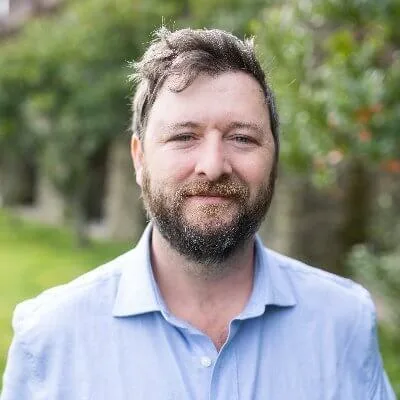
“There’s a sense of hopelessness that folks feel when they see government making moves that feel damaging and hurtful and not listening to the vast majority,” said Gwen Frisbie-Fulton, who works as a strategist and communicator at Down Home NC. “And that’s why organizing is where we find our hope.”
Over the past 15 years, Republicans have drawn legislative districts to favor their party, a practice known as gerrymandering, to secure a majority in the state legislature. The result is a supermajority passing laws that, in many cases, are out of step with an electorate that is closely politically divided at the state level. After the Supreme Court overturned Roe v. Wade in 2022, a state lawmaker switching parties last year gave Republicans a veto-proof supermajority and paved the way for a ban on abortion after 12 weeks.
In an election year where abortion is set to loom large, Down Home is focused on boots-on-the-ground organizing aimed at informing people on the political stakes in their communities and engaging them on the issues.
Frisbie-Fulton, who is raising her son in nearby Guilford County, comes from a family of coal miners whose guiding principle was never to leave anyone behind.
“Hopefully, our elected officials are remembering that rural communities and people really matter not just because we’re humans…but also because in a place like North Carolina, you can’t leave 80 percent of your counties behind,” she said. “You have to bring people along.”
Frisbie-Fulton, who says she’s been working-class her whole life, joined Down Home NC to “try to speed things up” for the next generation and fight “for other poor single moms.” Her work aims to unite people across racial lines in the state, which is fast-growing and getting more diverse not only in major cities but also in rural areas.
“The political project of North Carolina has been to divide working-class people along lines of race, and that was a project that was implemented in 1865,” she said. “There have been movements historically, in North Carolina, that have been multiracial with big wins, but they’ve been suppressed really significantly. And we just know that we have to organize around class in order to pull together people who have shared interests.”
Down Home NC, a nonprofit organization founded in 2017, has championed a model of organizing year-round in rural communities not tied to the ebb and flow of campaigns and election cycles. Members of the group’s political arm do endorse predominately progressive candidates, which include the Democratic nominees for governor and a key statewide education post in 2024. But the heart of its work is knocking on doors and engaging in in-depth conversations — what the organization calls “deep canvassing.” The group’s key policy planks, shaped by its members, center on ensuring access to health care, housing and education for all.
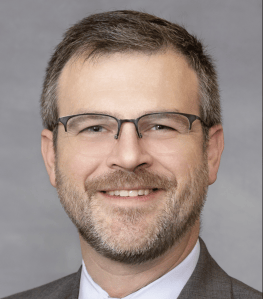
“The solutions are simple, and we’re missing the point right now while we’re focusing on being able to point fingers and argue about whose golf handicap is better,” said Taí Coates-Wedde, Down Home’s communications director, referring to the first debate between President Joe Biden and former President Donald Trump. “I really think that we’re in a communications crisis right now and that it does start with being able to connect with people.”
This year, Down Home is organizing on abortion rights in rural areas. Two-thirds of North Carolinians, 66 percent, support abortion being legal in all or most cases while 9 percent believe it should be illegal in all cases, according to polling from the nonpartisan Public Religion Research Institute.
“It’s very brave to go out into rural North Carolina, knock on the doors, and engage in one of the most hot-button issues of the cycle that has been so politicized,” Frisbie-Fulton said. “But what we find is that once those doors are opened, people are very eager and willing to talk.”
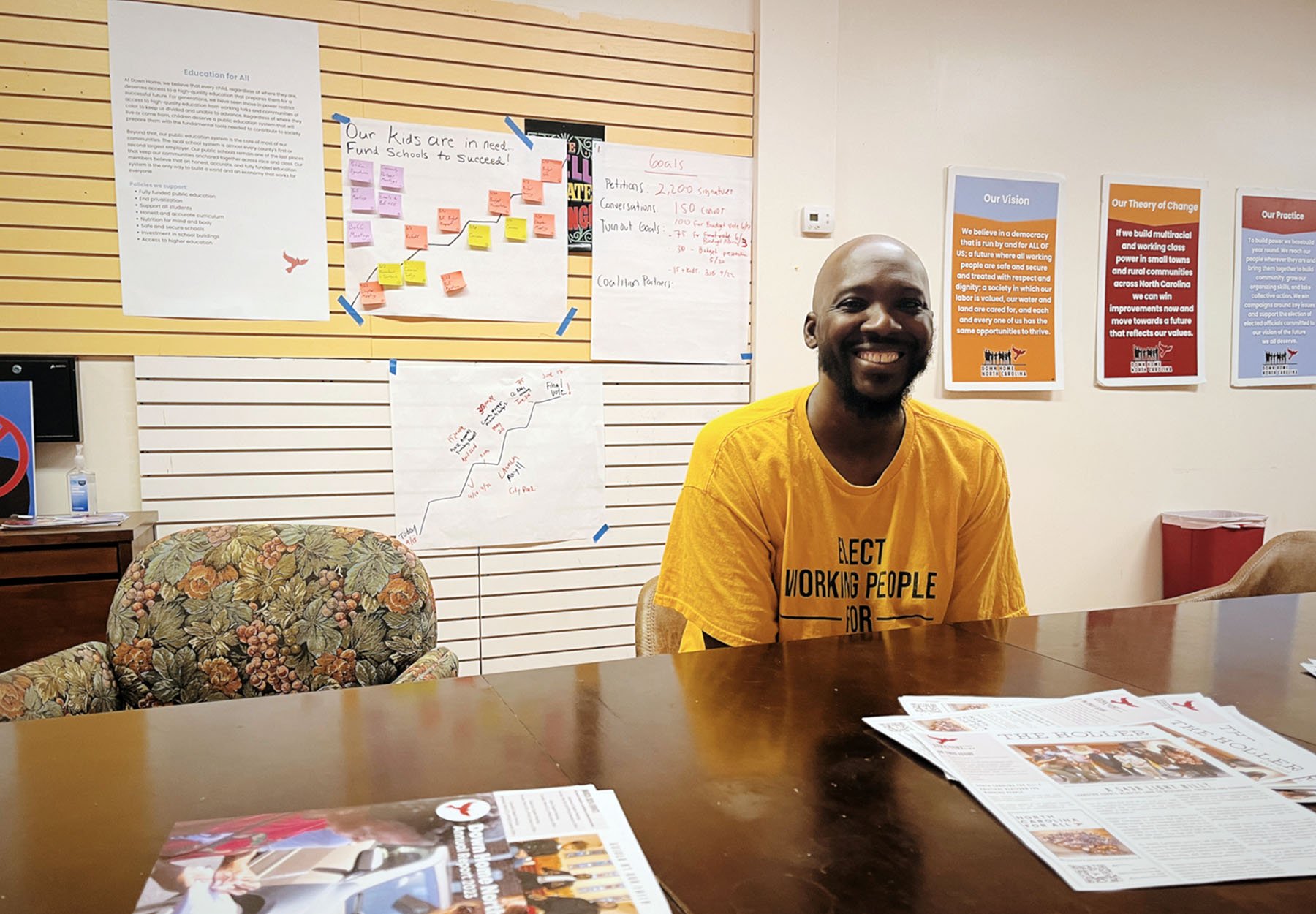
Bryant Crisp, a regional organizer who is also a local elected official, has had many of those conversations over the past few months. And while door-knocking on abortion has been a “mixed bag,” he says, it’s been more positive than he would have expected in the rural, conservative areas where he’s been organizing.
(Grace Panetta for The 19th)
“Our job is not to change anyone’s mind about anything, because you have some people who are just set in their ways,” said Crisp, who was raised in and now organizes in Alamance County, partway between the Raleigh-Durham metro area and Greensboro.
“But if we can just plant this seed and say, ‘Hey, don’t take my word for it, go do some research on your own, and make your own judgment,’ and we get that to that point, we count it as a win. That seed is planted that may not have been otherwise.”
Some people are firm in their beliefs opposing abortion. Others aren’t ready or comfortable talking about it. But many people support abortion access — and have opened up about their own stories.
“I’ve been surprised at the number of people, especially women, that have kept that weight on themselves,” he said. They’ve included a woman in her 80s who had an abortion pre-Roe and others who chose to have abortions decades ago and hadn’t told their families.
“I’ve been literally on someone’s doorstep that I’d never met before, I have a 20-minute conversation and by the end of it, we’re both in tears,” Crisp said. “And they let that out. And they haven’t told their husbands. They haven’t told their brothers, sisters, their closest people, and they will open up to a stranger.”
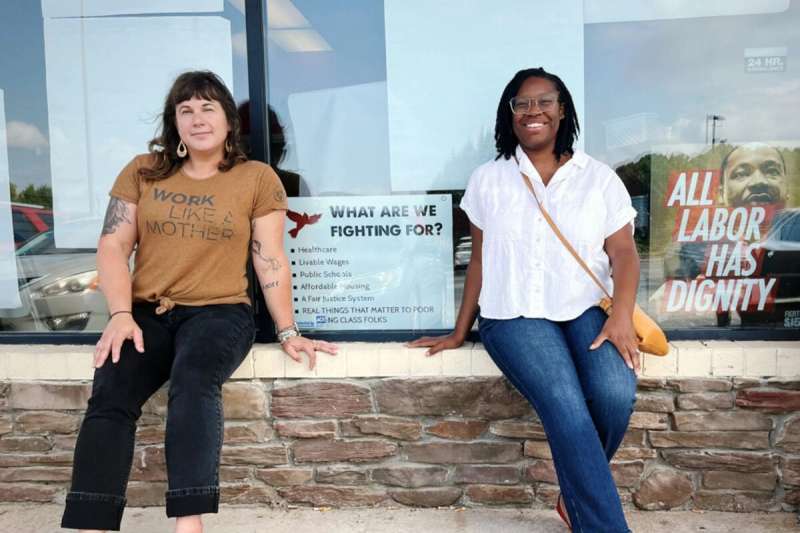
On a Saturday morning, volunteers and canvassers cycled in and out of the Burlington office, which was formerly home to a Confederate memorabilia store in a strip mall off the highway.
When Down Home NC organizers knock on a door, they don’t open with a prepared elevator pitch for a candidate or spiel for an issue. They come with questions and the hopes of engaging in an open-ended conversation. The organization’s agenda and platform are shaped by its members and the people it hears from at the doors. “That’s how abortion and reproductive rights ended up on our conversation list to begin with,” Frisbie-Fulton said.
“When things like the reversal of Roe occurred, I was already in this role, and I was already doing this work, but I was deeply reminded why working-class people need to organize together,” she said. “Because we can’t take for granted that other people will look out for us. We’re the folks who need to organize and take care of ourselves.”
Frisbie-Fulton credits the group’s members for their work toward the decade-long effort to expand Medicaid in the state, which the state legislature finally passed on a bipartisan basis in 2023. Rural areas have borne the brunt of hospital closures and reduced access to health care. Organizers, she said, made the issue “inescapable” for state lawmakers when they returned to their districts.
“People feel disengaged because maybe politicians drop in during the election season and ask for their vote,” Frisbie-Fulton said. “And it feels very extractive, versus organizing around issues that really matter to us on a daily basis.”
At the local level, Down Home NC members have secured more funding for affordable housing in Cabarrus County and a larger budget for education in Johnston County. In Granville County, members led a successful effort to get the city of Oxford to reopen and revitalize a park and basketball court that served as an essential fixture for the area’s Black community but had fallen into disrepair.
“It might just be a park, but that win gave people a taste of what their organizing can do, and then that town got hungry for it,” she said.
The 2024 governor’s race in North Carolina is poised to be one of the most competitive. The Republican gubernatorial nominee, Lt. Gov. Mark Robinson, is ardently anti-abortion and has a long history of making sexist and anti-LGBTQ+ comments, keeping abortion front and center in the contest.
He’s facing Democratic Attorney General Josh Stein in the race to succeed Democratic Gov. Roy Cooper, whose veto was the sole check on the legislature before Republicans gained a supermajority to override it. Implementing year-round grassroots organizing in rural areas was also a top priority of state Democratic Party chair Anderson Clayton, who came to the job from rural Person County, when she started leading the party in early 2023.
What keeps Frisbie-Fulton up at night is “the tendency to see politics become a circus” as her neighbors struggle to make ends meet and face eviction. But for her, all the small wins amount to something bigger — a long-game strategy for winning North Carolina driven by local communities.
“Not all politics is electoral, and not all hope needs to be,” she said.