As voters in North Carolina and across the nation head to the polls, the rising cost of seemingly everything is dominating much of the political discourse.
While fuel prices get a lot of the attention, other products in North Carolina also are seeing price increases that are hitting consumers in the pocketbook. A brewing trade war with Canada also is hurting some Tar Heel businesses as that market for their products gets more challenging.
Read More: The key role of soybeans in the race between NC congressional candidates Don Davis, Laurie Buckhout
Economists say several factors are at play for the increasing sticker shock, and most are out of the hands of consumers and companies.
While inflation − the Federal Reserve said the U.S. annual inflation rate in September 2026 was 3.7% − is fueling price hikes across the board, tariffs are helping heat up costs on certain products in the grocery aisle and even big-ticket items like new homes.
Key to the rising costs in certain North Carolina sectors is the growing trade war with Canada that hit high gear in late August when President Trump imposed 50% tariffs on roughly $20 billion worth of Canadian imports. Canada responded in kind, with its tariffs on $20 billion of American imports coming into effect in early September.
Canada is North Carolina’s largest export partner, representing 20.2%, or $8.7 billion worth of exports in 2024, according to the N.C. Department of Commerce. Pharmaceuticals, industrial machinery and vehicles were the top three commodities.
Dr. Mike Walden, an economist at N.C. State University, said tariffs create additional costs for companies that they can either absorb or pass on to consumers.
“Hence, North Carolina firms will be less willing to buy Canadian products, and will look for substitutes,” he said. “Likewise, Canadian firms will be likely to reduce purchases from the U.S., including from North Carolina, which include pharmaceuticals, tech products, and some agricultural products, to name a few.
“Tariffs are a factor behind the higher inflation rate U.S. households have experienced in 2026.”
Could rising fiber costs hit toilet paper?
On both sides of the border forest products, which can be especially important economic engines in rural areas, have found themselves targeted by tariffs. According to the N.C. Forestry Association, the hardwood industry in North Carolina and other parts of the country have been hit hard by the trade spat.
But a fear that consumers could see more of their savings flushed away due to the rising cost of toilet paper and paper towels hasn’t materialized, at least in the first few weeks of the North American trade war.

Experts were worried that prices for the paper products could increase because the U.S. placed a 50% tariff on chemical bleached softwood pulp, technically known as Northern Bleaches Softwood Kraft, or NBSK, imported from Canada. While most toilet paper and tissue products are produced in the U.S., the pulp product is an important raw material in the fiber blend in premium paper products that makes them softer and stronger. The rest of the fiber in the products is generally Brazilian eucalyptus.
Dr. Ronalds Gonzalez, an associate professor in the Department of Forest Biomaterials at N.C. State, said while the cost of toilet paper and other paper products has increased like almost everything else, the price hike isn’t just due to the tariffs.
“Is there some effect on pricing? I would say yes,” he said. “Is that due to the tariffs? I don’t think that’s the only reason.”
Gonzalez said manufacturing costs have likely increased more due to higher energy and transportation costs tied to rising fuel prices along with the increasing costs of commodities and other inputs in general.
Are higher new housing prices coming?
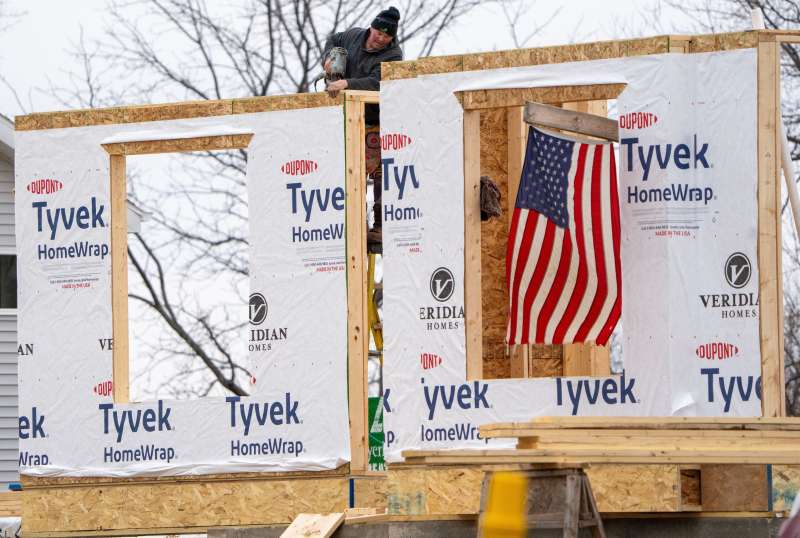
Another sector that could see a prolonged financial hangover from the U.S.-Canada trade war is North Carolina’s housing market.
North Carolina is adding roughly 400 new residents a day, according to the N.C. Office of State Budget and Management, with the Wilmington area not only one of the fastest-growing metros in the Tar Heel State, but in the U.S. as a whole.
A lot of those new residents want a new house, and that makes new housing construction big business in North Carolina.
But the sector hasn’t been immune to the factors hitting other sectors of the economy.
According to the National Association of Home Builders, residential building material prices in September were up 9.7% from last year, the highest yearly increase since 2022. The price of softwood lumber, which is the primary building material in wood-frame homes, is up 15.5% compared to last year, with Canada supplying about 1/4 of the U.S. supply of softwood lumber. But the impact of the tariff war on prices could be getting slightly muted by a slowing housing market in general, with total U.S. imports of softwood lumber for 2026 through August at 7.7 billion board feet − the lowest level since 2014.
Still, there’s a question if and potentially for how long builders can afford to absorb increasing costs without passing some of the higher prices onto consumers in the form of higher housing prices, said Dr. Matthew Metzgar, an economist at the University of North Carolina Charlotte.
“But that may take six months, a year down the line,” he said, noting it can take time for cost increases to ripple through the economy. “No one can really predict how this is going to play out.”
Reporting by Gareth McGrath, USA TODAY NETWORK / Wilmington StarNews
USA TODAY Network via Reuters Connect