The city’s lawyer told the City Council at its meeting April 27 that a moratorium, i.e., a legal pause, would be the only way to stop a data center from locating in Fayetteville.
“The only way to pause data center development is through a moratorium,” Lachelle Pulliam said.
I thought, “There it is.”
The attorney, who has no dog in this fight, had nonetheless thrown council members the equivalent of an alley-oop pass in basketball. The council is right there under the goal — just dunk it in, and pass a moratorium.
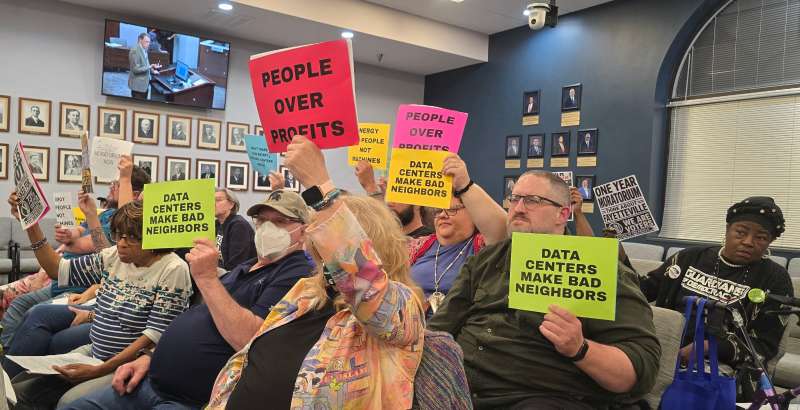
Protesters in the council chamber carrying signs that said things like “People over profits” and “Data Centers Make Bad Neighbors” might have expected a slam dunk, too.
The stakes are high because of the massive pressure large data centers can put on utilities and water and their contribution to noise pollution, while delivering a relatively low number of long-term jobs.
Instead, the council voted to gather research for four more months, which may or may not include some council members personally visiting data center sites and could include talking to the county about what it’s doing. And what the Cumberland County commissioners have done is schedule a public hearing this month on a moratorium, the major step before it can vote on one.
The city, on its current pace, would not be at that kind of step until late summer. A data center that meets current zoning standards could potentially be approved — to heck with the community and what it wants. At any rate, the staff and council would have to make the kind of ad hoc decisions on data centers that its planning and zoning staff had warned could be a result of the council passing no code changes.
Voting for the pause were Mayor Mitch Colvin, Mayor Pro Tem Derrick Thompson and Council members Malik Davis, Stephon Ferguson, Deno Hondros and Brenda McNair. Council Members Lynne Greene, Antonio Jones and Shaun McMillan voted against the pause. Council Member DJ Haire was not present at Monday’s meeting.
Fayetteville council members know that the city is exposed because staff told them
I get that council members want more discussion on data centers. Even though they have been discussing them in a series of meetings, both regular and dinner meetings, for a couple of months, and the staff and the Planning Commission were discussing data centers well before then. That said, council members should want to know more; that is due diligence and is proper.
But moratoria are legally allowed by the state for precisely that reason, so that municipalities can research and have discussions on how to prepare for and regulate the projects. The stakes are high because of the massive pressure large data centers can put on utilities and water and their contribution to noise pollution, while delivering a relatively low number of long-term jobs.
It was the council’s own city staff at the April 13 meeting that impressed upon us, in no uncertain terms, that the city is unprotected currently in terms of zoning when it comes to data centers, as they are a new kind of entity for which the city does not yet have a specific set of rules.
Council members lean toward a pause button, with legal backing
Victoria Curtis, assistant city attorney, said in a presentation to the council on Monday that a formal moratorium must be adopted by ordinance and include specific findings as to why it’s needed and its scope and duration under state law. It would not stop all projects and must follow public hearing procedures.
Her presentation was scheduled because of a 5-4 vote taken April 13 that the council should at least hear how a moratorium could work. Voting against this additional consideration were Colvin, Thompson, Hondros and McNair.
Curtis said that a moratorium “functions as a pause button, allowing both the government time to study issues and consider regulatory action before future development occurs.”
Afterward, Council Member Jones double- and triple-emphasized that he supports economic growth but is in favor of a moratorium, which he says is also favored by his District 3 constituents.
“For me, I’m pro-advancement. I’m pro-economic development,” he said. “I’m pro-housing. I’m pro all of those things,” Jones said. “So just because if I support a moratorium does not mean that I don’t support that.”
Greene, echoing Jones’ support for economic development, said she was also leaning toward a moratorium. Among the questions she asked was whether a public hearing would be included in the pause, to which she received no clear answer.
She asked if the motion for the 120-day pause would block data centers, that “there would be no applications allowed for a data center … and no approval of a data center of any type during that period.”
It was three minutes after Greene’s very sound questions when the city attorney tossed the alley-oop.
Fayetteville mayor: Other counties are fine with data centers
Ferguson said people opposed to data centers seemed to have four main concerns: Water, electricity, noise and air.
Ferguson said, in a question apparently directed at the group of regular protesters who have shown up, “If we addressed all of those issues, would you still be in favor” of a moratorium? He added: “I hope that we could take a balanced approach.”
Curtis said that a moratorium “functions as a pause button, allowing both the government time to study issues and consider regulatory action before future development occurs.”
Mayor Colvin continued to be a vocal and consistent supporter of data center investment.
“What’s unique about this community is … we are a Tier 1 urban county, which doesn’t exist in North Carolina except here,” Colvin said. “That means that our wages are low. That means our tax base is lower. That means that our … unemployment rate is higher.”
He said that Wake County, Guilford County and Mecklenburg County all have data centers.
The mayor made the point, as in previous meetings, that power companies like Duke Energy could pass along utility costs to all by petitioning the utilities commission.
“Duke Energy can pass along those costs whether we invest or not,” he said, drawing a comparison to how all Duke customers got stuck with the bill for Duke’s industrial coal ash.
Other cities, undeterred, are voting for a (real) pause
There are other communities one could hold up as being more cautious than the ones Colvin named. Durham, a peer city whose policies sometimes inform Fayetteville’s, is looking at a two-year moratorium on data centers and would also temporarily ban crypto mining.
McMillan, who argued against the pause, said he was prepared to put a motion on the floor Monday for a formal moratorium.
“The moratorium could incorporate everything that you just said,” he told Thompson, who had made the motion for the pause. “The first 120 days, if you want, could be included in a moratorium.”
He said that doing such “is not hard for us.
“About five different municipalities have done it in North Carolina in the last 75 days. Apex just voted to do this by unanimous vote.”
Fundamentally, he is right.
The council can do everything in terms of fact-finding — every bit of it — and take its time if it wishes, whilst a temporary moratorium holds off a project with a potential for generational impact.
I say come on, council: Let’s go ahead and take this one to the hoop.
Reporting by Myron B. Pitts, Fayetteville Observer / The Fayetteville Observer
USA TODAY Network via Reuters Connect