by Rose Hoban, North Carolina Health News
October 14, 2026
By Rose Hoban
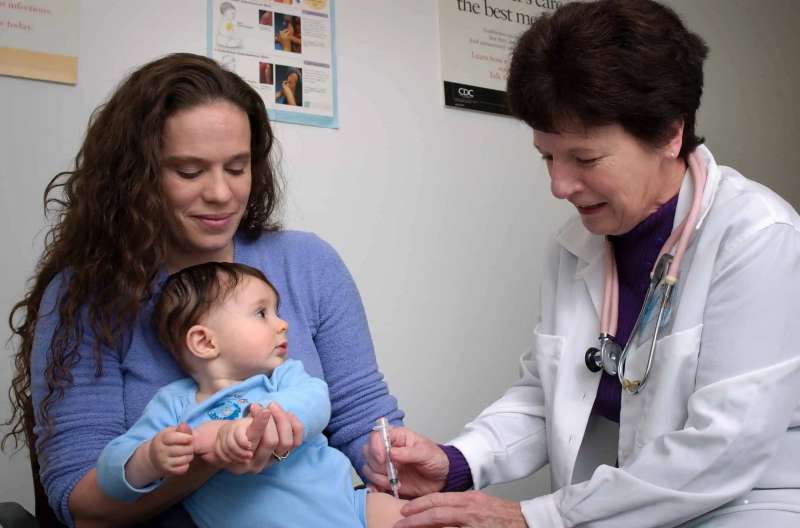
Fall leaves are starting to turn, and school is in full swing. That means respiratory infections are about to tick up, and it’s the time of year when health care providers talk to their patients about vaccinations.
This year, though, the topic seems even more fraught. A lot of mixed messaging is circulating around vaccines, often from the top of the nation’s federal health care infrastructure.
People are genuinely confused.
Sign up here for the free, award-winning newsletter that 100,000+ North Carolinians trust
“Parents are utterly terrified of doing the wrong thing. Of harming their child when all they want to do is protect them,” longtime health reporter Tara Haelle told a TedX crowd. She has written extensively on vaccine hesitancy and notes it has been around for centuries, since the advent of inoculation against smallpox, a procedure that, in itself, carried a risk of death.
“If we’re going to address vaccine hesitancy, we have to address the underlying processes that lead people to believe in fears lacking any scientific basis,” Haelle said.
Rumors circulate and go… viral
Anthropologist Heidi Larson notes in her book Stuck: How Vaccine Rumors Start — and Why They Don’t Go Away that vaccine hesitancy starts with rumors that can take off when people feel like decisions about their and their families’ health have become out of their control.
“Managing rumors is about understanding and managing the emotions which drive them, not attempting to judge whether they are true or false,” she wrote.
Learn More
Research shows that people appreciate having one place to find comprehensive information. The American Academy of Pediatrics has multiple resources:
- Schedule of well-child visits, which details what should happen at each visit, one month through 17 years, including which vaccines should be offered at those visits.
- HealthyChildren.org, which is powered by the AAP and provides news and advice. Readers can sign up for a newsletter, and they’ve developed an app to monitor children’s milestones. By offering this resource, pediatrics offices would provide trusted information that could keep people from being led down a conspiracy rabbit hole.
Other resources include:
- Vaccine Information Center, from the Children’s Hospital of Philadelphia. The VIC has vetted vaccine safety and scheduling information, as well as videos on “Why separating and spacing out vaccines is bad advice.”
- Voices for Vaccines, which presents credible, well-researched information written in plain English on the science behind and benefits of vaccines.
- Vaccinate your Family, a group that’s spent 35 years educating people about vaccines and supporting initiatives to make that happen.
Countering the confusion
In North Carolina, health officials have seen the rate of pre-kindergarten vaccination drift downward from a high of 95.5 percent in the 2021-22 school year to 92.6 percent in the 2025-26 school year.
NC Health News spoke to pediatrician David Tayloe III from Goldsboro Pediatrics, who said that at his practice they are “probably hearing a few more questions… I think there is a bit more confusion that is coming out from certain sources and authority figures.”
We started our conversation by asking whether he’s hearing confusion from patients.
The rest of this conversation, which took place on Oct. 1, is lightly edited for length and clarity.
Tayloe: “I think some parents are more confused than they were, but I do think that by and large — I’m in a rural to semi-rural community in eastern North Carolina — what we experience is the the vast majority of our patients do believe that vaccines are safe and effective, and they generally get the vaccines that are recommended at their visits, which is a good thing.
There’s definitely a little bit more confusion, and so we are having more families who are asking questions about vaccines and do have some doubts about getting some or all of the vaccines.”
NC Health News: When you have folks with some of those doubts, how do those conversations play out?
Tayloe: In an ideal world, things are not always ideal. It’s a conversation where each side is listening because listening is very important. Each side is sharing views, but I think one of the most important things, first of all, is in a nonconfrontational, friendly and empathetic manner to just ask parents kind of what concerns they have and find out exactly what it is. Because it may be something that’s easily discussed, and easily explained, and easily resolved.
Being empathetic, not putting parents and families on the defensive about having questions about vaccines, and then just having a conversation about it. It’s about, you know, “I understand you have some doubts about the hepatitis B vaccine. Tell me a little bit more about that,” and then providing evidence-based information where it is indicated. And then trying to work together to come up with a plan.
NCHN: When that’s someone’s attitude, do you feel like after that conversation people are eventually willing to say, “Okay, I’ll give Janie her vaccine today”? Or does it sometimes take a couple visits?
Tayloe: It just depends on the family. Some people say they’re on the fence, and some folks will call these folks the “movable middle.” So they’re having some doubts, but overall, they’re not a definite no. Sometimes you can talk to them and discuss vaccines, answer questions to their satisfaction, and of course make a strong recommendation for the vaccines that are recommended for that visit or that time. And then a lot of times they will get the vaccine.
Sometimes they may get the vaccine at a later date, and sometimes they will never get the vaccine. It all depends. A lot of it depends on where they are in the beginning. Are they more towards the middle? Kind of sitting on the fence, or are they kind of “I’m a hard no” for everything. It just depends.
NCHN: What doubts are people expressing? What do they say led them to have doubts?
Tayloe: In our clinic, we do not hear quite as much about the ingredients of vaccines. That is not a huge concern of a lot of our parents. I think that some parents are worried that they’re getting vaccines so early. The hepatitis B vaccine is recommended soon after birth — that’s for good reason. Just because that is a risky time period for babies, and there’s a window for protection. I think sometimes they feel like it’s too early.
Sometimes … parents feel like there are too many vaccines in one day, and their child’s immune system may not handle it well. I think some parents don’t always believe that vaccines are necessarily as helpful as we would like them to be, or don’t think that the disease that the vaccine is protecting against is a true risk for their child.
There are a lot of different reasons.
NCHN: What resources are you sharing with parents? Do you have different resources for the folks who come in expressing hesitance?
Tayloe: Far and away our most valuable resource would be the American Academy of Pediatrics. The AAP has done some amazing work on vaccines, vaccine hesitancy and vaccine advocacy, and so they have just a wealth of information for pediatricians, for parents, for families. So we definitely use some of their handouts.
They do have handouts on all of the vaccines with a QR code for additional information on many of these. And then they have tool kits for providers for vaccines, and then they have healthychildren.org, which is a website and a resource that’s really helpful for both health care providers and families, which provide some more information on vaccines.
We were just in our clinic yesterday. We were making copies about some of these — information and fact sheets on these vaccines — because today is the first day we can start giving the immunization for RSV, the monoclonal antibody that helps protect infants against RSV. We were making those information sheets and some other information sheets. They’re awesome.
NCHN: So you said that some folks are going to always be a no, but you don’t “fire” patients who decline vaccines?
Tayloe: In order to prevent the spread of disease, many clinics do have that vaccine policy, where they will have vaccines that patients and families will need to get if they’re going to remain with that practice. Generally those are the vaccines for things like meningitis, polio, measles and chickenpox, things that could be super dangerous to their child or anyone the child comes into contact with who may be immunocompromised.
NCHN: I have been fascinated by the new research coming out that looks at varicella [chickenpox] and the relationship between varicella and dementia in old age: that people who’ve had the shingles vaccine, they’re less likely to develop dementia. Then there’s also evidence around the HPV vaccine preventing cervical cancer and throat cancer.
Given that this kind of stuff is starting to happen, is your messaging changing at all? For example, I was listening to a podcast the other day, and the guest said that in Japan, one of the ways they got around vaccine hesitancy with HPV was that they say to women, “Do you ever want to be a grandmother? You need to get your daughter the HPV vaccine.” And after that, everyone took the vaccine.
Are you changing the way you message?
Tayloe: I think we are, definitely. I think this is pretty common knowledge, but HPV is one of the vaccines about which we do see more hesitancy among parents, patients and families. So I do think reframing the conversation and refocusing the conversation, and having it focused on cancer prevention and not necessarily that HPV is traditionally a sexually transmitted infection. I think that’s been fairly helpful. I think there is an indication for prevention … of head, neck and throat cancers with the HPV vaccine now, so we try to focus more on cancer prevention overall with the HPV. So you definitely, kind of, change the dialog a little bit, right?
There are some folks who, well, that’s one [vaccine] that sometimes you kind of peck away. You talk about it at some of those visits where they can get it, but maybe they’re not ready to. Then you see them six to 12 months later, you talk about it again, and kind of eventually, many of them do get it. That’s one that you sometimes have to work for, but it’s worth it.
NCHN: Has dementia prevention entered the conversation yet when it comes to things like the chickenpox vaccine?
Tayloe: That’s not something we hear about a lot. We don’t have a lot of families who are declining or are super hesitant about the chickenpox vaccine, which is a good thing.
NCHN: Maybe I’m at the age where I’m more worried about dementia!
[Laughter]
NCHN: North Carolina’s starting to see vaccination numbers drift down a tiny bit. What’s the conversation within the North Carolina Pediatric Society?
Tayloe: We just had our North Carolina Pediatric Society annual meeting, and I think we had at least two to three talks around vaccines and vaccine misinformation.
I do think the most important thing is that pediatric and other primary care providers are trusted voices. Parents do trust their medical providers. They may not trust authority figures and all government figures and the heads of agencies, etc. They do trust their pediatricians and their doctors. So trying to have reasonable, calm, empathetic conversations, and continuing to provide strong recommendations for vaccines, I think that really goes a long way.
It’s important to remember that there has been an increase in vaccine hesitancy nationwide, but the vast majority of families still get the vaccines as recommended by the American Academy of Pediatrics and their providers.
One other thing that is important that seems to resonate: There are a lot of different strategies that medical providers can use to make vaccine delivery more effective. I mean, there are practice-wide initiatives, but it’s all in the way that you ask about vaccines. Instead of asking, “Do you want the flu vaccine today?” We recommend that you say, “Your child is due for their annual flu vaccine. We have the FluMist and the injection. Which one would you prefer?”
Lots of research shows that presumptive language works.
Some of the literature that I’ve read, and some of the resources, talk about how families like it when you let them know that you think that a vaccine is important for the health of their child. They may not be quite as interested to know that, you know, “getting this vaccine is for the betterment of mankind,” or kind of “the health of all children.”
NCHN: So really, just focus in? One of my old editors used to say, “Your audience doesn’t care unless it goes into their mouth or comes out of their pocket.”
Tayloe: Exactly.
This article first appeared on North Carolina Health News and is republished here under a Creative Commons Attribution-NoDerivatives 4.0 International License.