From murals to museums to merchandise, this month is all about ‘African Americans and the Arts.’
Most people know that February is Black History Month, but did you know that each year highlights a new theme for the federally recognized observance?
Established as Negro History Week in 1926 by Carter G. Woodson, known as “the Father of Black History,” President Gerald Ford signed a proclamation recognizing the entire month of February as Black History Month in 1976.
Read More: 10 events, 29 days—How to celebrate Black History Month in NC
Woodson originally chose the second week in February in recognition of two men who he said played pivotal roles in Black history: Frederick Douglass (Feb. 12) and Abraham Lincoln (Feb. 14). Once it was expanded 50 years later as part of the nation’s bicentennial celebrations, a theme was added to each year’s observance, chosen by the Association for the Study of African American Life and History.
This year’s theme is African Americans and the Arts, showcasing the rich history of Black artists ranging from well before the Harlem Renaissance, which was in full swing when Goodson first launched Negro History Week, to contemporary hip-hop artists.
Charlotte is home to talented Black artists of all mediums, from rappers and spoken-word performers to comedians and live theatre performers. For this list, we’ve selected 10 places where you can check out some of the best Black art Charlotte has to offer in the visual arts medium, spread through the different sections of the Queen City so an entertaining and educational experience is never far off.
Uptown
The Harvey B. Gantt Center for African-American Arts + Culture
551 S. Tryon St.
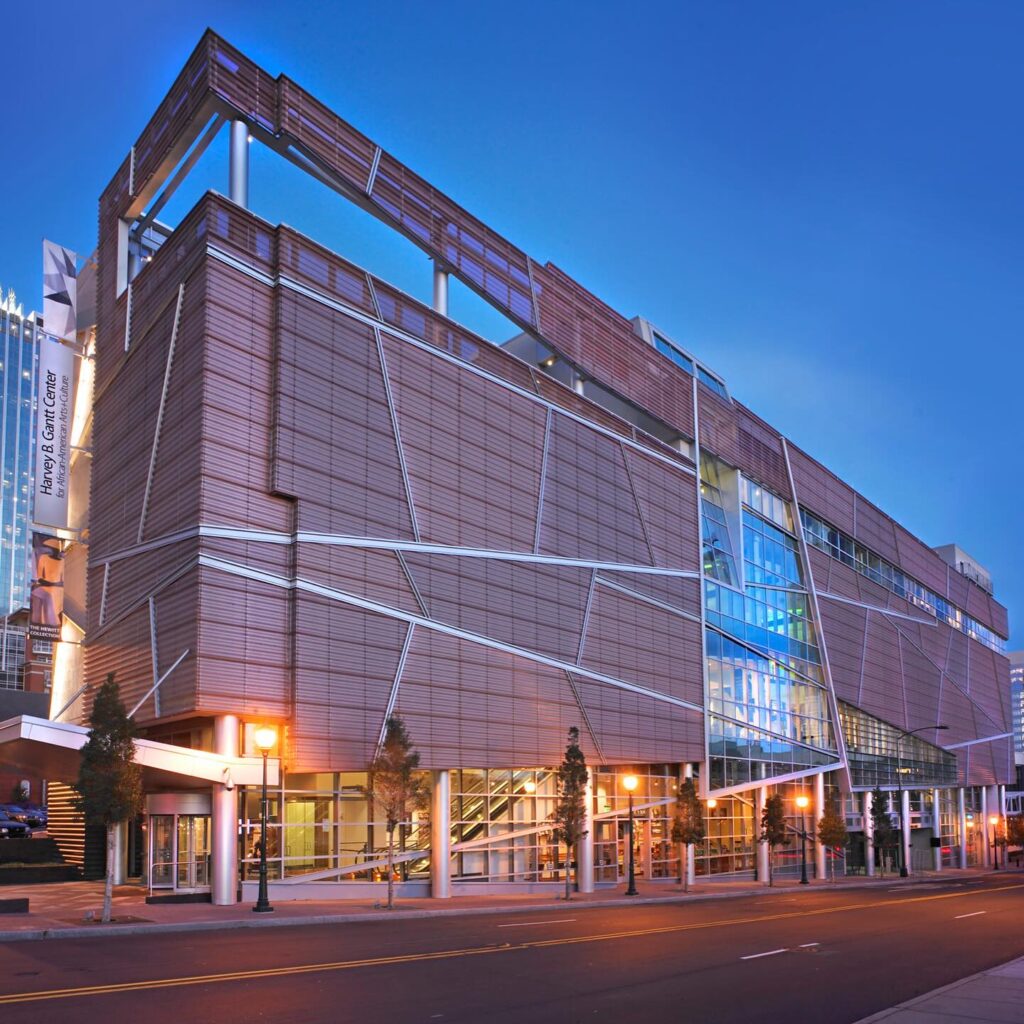
There is perhaps no institution in Charlotte more pivotal in representing Black history and culture than the Gantt Center. Founded in 1974 and launched as the Afro-American Cultural Center in a 600-square-foot space in Uptown’s Spirit Square in 1976, the 46,500-square-foot Gantt Center opened in 2009.
This February, as the Gantt kicks off its year-long celebration of 50 years in existence, the museum has special plans for Black History Month. On Feb. 2, the center hosted an opening celebration for its new exhibit by Christopher Myers titled Please Trouble, Carry Me, featuring works that showcase Myers’ interdisciplinary artistic range, including a breathtaking installation, “Let The Mermaids Flirt with Me,” which premiered at Art Basel Miami in 2022. The exhibit will show through July.
The Gantt Center also has plenty of other programming scheduled throughout the month, partnering with Blumenthal Arts to host the Dance Theatre of Harlem from Feb. 9-10, jumping to Wells Fargo Auditorium for the Big Read Kickoff Celebration on Feb. 23, and bringing things back home for Black Genealogy: Moving Beyond the 1870 Census on Feb. 24.
The Brooklyn Collective
229 S. Brevard St.
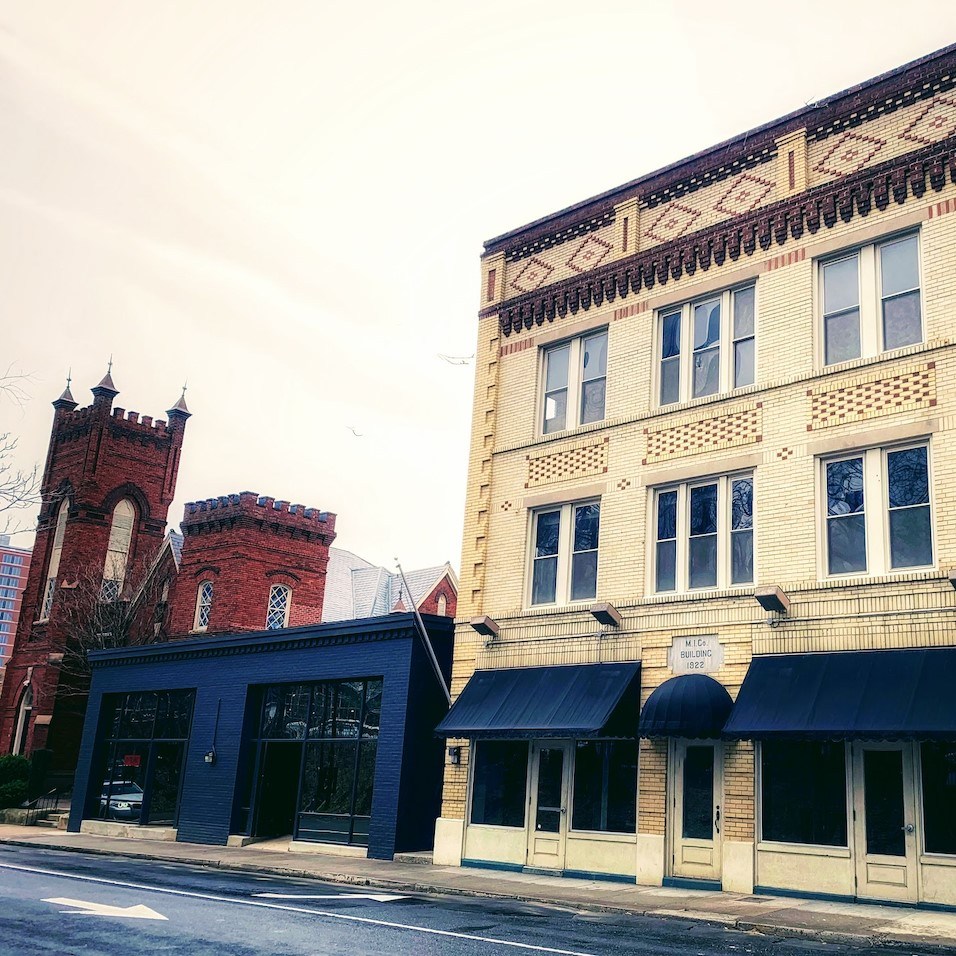
The Brooklyn Collective lives at the intersection of Black history and Black art in Charlotte. It’s located inside The Mecklenburg Investment Company (MIC) building, constructed in Charlotte’s Brooklyn neighborhood in 1922 and now one of the only buildings to survive the tragic razing of the historically Black neighborhood that took place during the 1960s. Nearly a century after The Mecklenburg Investment Co.’s founding, the MIC was resurrected in 2021 as the home of The Brooklyn Collective, leaders in Charlotte’s emerging art scene and incubators for nonprofits and small businesses.
“Our goal is to make sure that we are honoring the history of where we are, that we are the stewards of social consciousness and the programming, and things that we have here are all going towards enriching the community,” Monique Douglas of The Brooklyn Collective told Queen City Nerve shortly after the organization’s launch. “We celebrate the arts at The MIC. We provide our location as a space where local musical artists, as well as visual artists, can feel like they have a home or place where they can be showcased.”
On the first weekend of Black History Month, the Brooklyn Collective celebrated the opening of a new exhibit in its art gallery. Golden Galleries, the curators of the Black Fine Art Fair, have returned to the MIC building with Book Ends – Holding Up The Middle As They Should, featuring the work of six artists: James Denmark, Paul Goodnight, Najee Dorsey, Ametria Stamps, Kevin Nance West and Anthony Burks Sr. The gallery is open from 5-8 p.m. on Thursdays and Fridays and 10 a.m.-2 p.m. on Saturdays.
Mint Museum
500 S. Tryon St.
Just across the street from the Gantt Center, the Mint Museum will also be observing this year’s African Americans and the Arts theme by elevating Black art in our community, spotlighting Black artists and their work throughout the month.
The Mint’s calendar is chock full in February, so let’s focus in on just a few of the scheduled programs. On Feb. 10, you can meet the artist behind Constellation CLT series Sublimations of Spacetime. Ajané K. Williams is a Gen-Z Afrofuturist painter, performance DJ, and video artist whose work “provides a twilight zone of enigmas reimagined such as UFOs, ancestral spirits, wormholes, and landscapes of higher dimensions,” Mint’s website reads. On Feb. 23, join in a moment of artivism and remembrance centered on Láolú Senbanjo and Chris Carnabuci’s sculpture “Breonna Oya,” featuring music, singing, poetry, and tributes to Breonna Taylor and others who have tragically fallen at the hands of white supremacy.
West Charlotte
Archive CLT
2023 Beatties Ford Road, Suite D
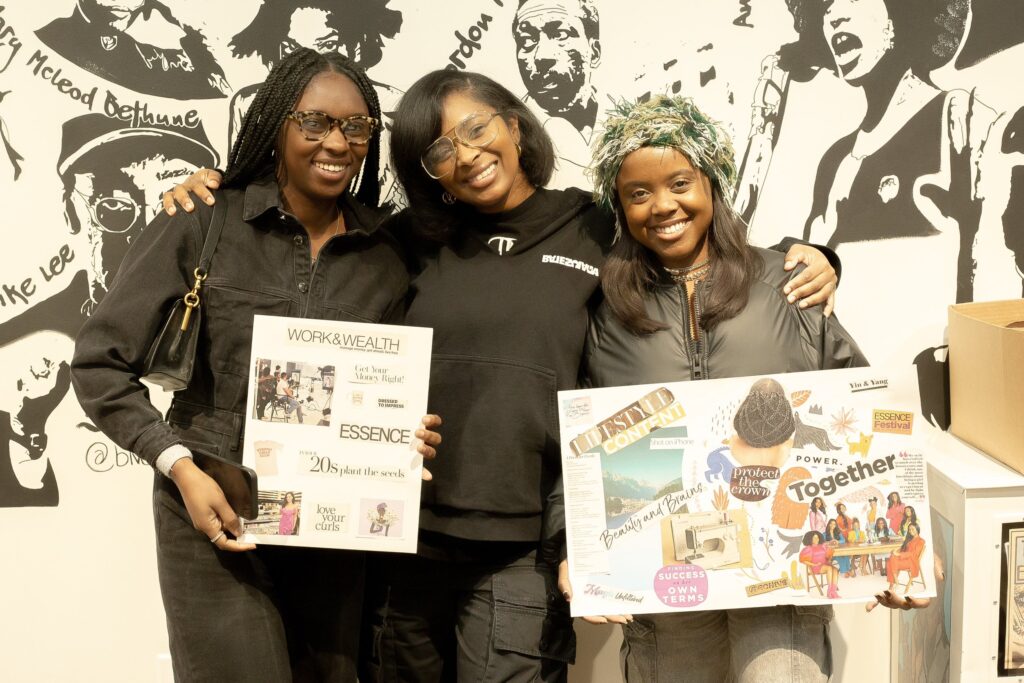
Located in a shopping center at the corner of LaSalle Street and Beatties Ford Road in the Historic West End, Archive CLT connects customers across generations with artifacts from Black history. By 2021, collector Cheryse Terry was ready to open her own brick-and-mortar shop filled with ephemera that captures the Black American experience.
The loss of her mother at age 24 and a devastating house fire shortly thereafter intensified Terry’s interest in collecting. The ephemera, especially old magazines, connected her to her past and helped her to find herself in the midst of loss. She focused on items from the 1970s, the era when her mother was in her twenties. A 1971 copy of Dick Gregory’s Ebony Magazine cover holds a particularly special place in her heart.
Today, Terry’s coffee shop is home to a one-of-a-kind collection of ephemera: a wall-spanning mural by local artist Sade Black depicting titans from Black cultural history ranging from Harriet Tubman to photographer Gordon Parks to OutKast emcee André 3000, and on the opposite wall, magazines, stickers, posters, art, books, etc. — including original copies of Malcolm X’s canonical autobiography, a rare Toni Morrison Newsweek cover, and stacks of Jet and Ebony magazines. Grab a coffee and a pastry and jump into the rabbit hole.
Historic West End Murals
Beatties Ford Road
The Five Points area just outside of Johnson C. Smith University in Charlotte’s Historic West End has a rich history that is not limited to — but certainly includes — the Excelsior Club just down the street.
In November 2022, local artist Georgie Nakima wrapped up a series of murals named Kindred that can be found in a few areas surrounding the newly renovated Five Points Plaza, including a large-scale mural that showcases her recognizable geometric, Afrofuturist style that looks down on the plaza. Across the street, local artist Lo’Vonia Parks’ mural on the side of Rita’s Ice pays homage to the rich Black history of the Biddleville neighborhood and features interactive elements.
Less than two miles north on Beatties Ford Road, Abel Jackson’s “River of Life” mural recognizes six icons of the Historic West End. Commissioned by West End Fresh Seafood Market owner Bernetta Powell, Jackson’s mural depicts six luminaries of the Beatties Ford Road corridor: Dr. Bertha Maxwell-Roddey, James Ferguson II, Julius Chambers, Hattie “Chatty Hatty” Leeper, Harvey Gantt, and Sarah Stevenson.
The title comes from an expression that appears to have been coined by Rev. Clifford Jones, pastor at Friendship Missionary Baptist Church, in a 1990 Charlotte Observer article about an attempt to rename a 3-mile stretch of Beatties Ford Road to Martin Luther King Drive. Jones is quoted as saying, “It’s the river of life for the black community,” referring to Beatties Ford Road. Powell, who attends Friendship Missionary, heard Jones use the same expression during a sermon there and it stuck with her, eventually inspiring the name of the artwork. Learn more about each of the six icons depicted in the mural in this article from Queen City Nerve.
North Charlotte
BlkMrktClt
Camp North End, 1824 Statesville Ave.
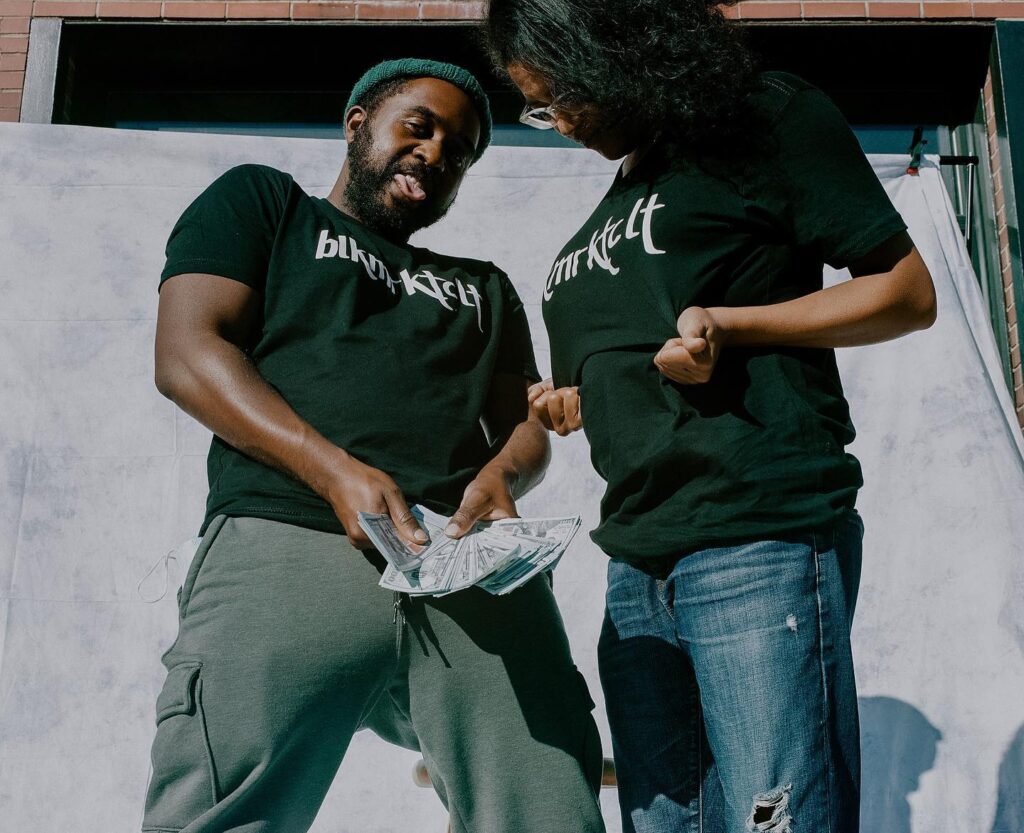
Founded by Jimi Thompson (aka Dammit Wesley) and Will Jenkins (aka Simplisticphobia), BlkMrktClt is a gallery and studio space based that provides a safe and supportive creative environment for local photographers and artists of color. “Our mission is to empower these artists by offering access to resources, connections, and guidance, and to promote their work through exhibitions and events,” the website reads.
While BlkMrktClt and neighboring DUPP&SWAT, owned by brother-and-sister duo Davita and Dion Galloway, both serve as incubators for local Black artists and are the best storefronts to visit to check out the work of such artists in Camp North End. Follow that up with a walk around the sprawling campus to see dozens if not hundreds of pieces of public art from local artists like Abel Jackson, Georgie Nakima, Makayla Binter, and more.
Real African Art
440 East Mccullough Drive, Suite A-111
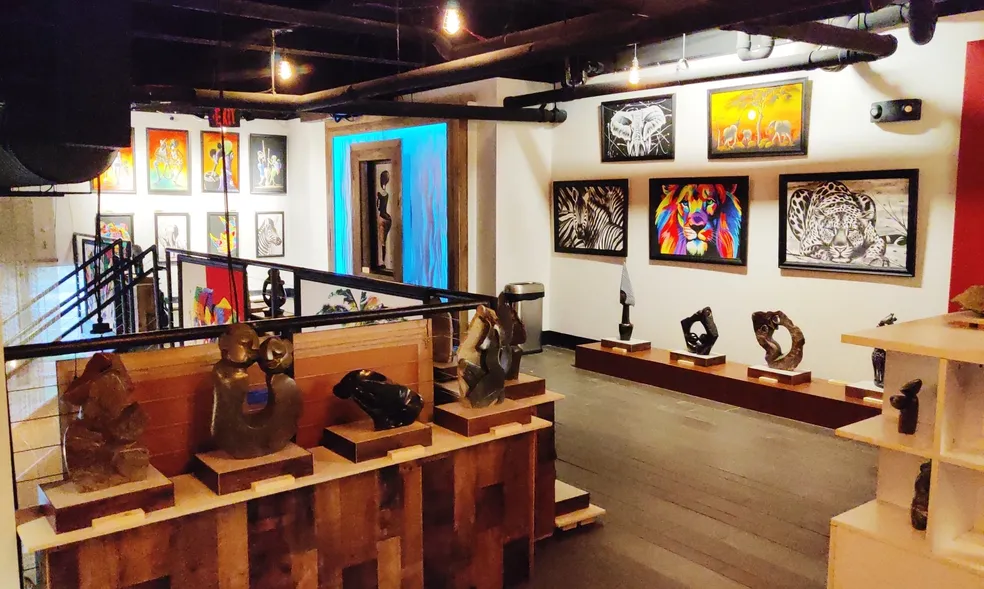
Located in the heart of University City, Real African Art describes itself as “a community-focused, socially conscientious arts entity that was started with the aspiration to improve the lives of Zimbabwean and African artists and provide them with opportunities and platforms to exhibit and market their creative art work in the United States and beyond.”
Owner Cal Ganda says he and his team are personally familiar with each artist they showcase in their store. “In some cases, we know their families, we know their entire stories. The objective is to take their hard work and bring it to the consumer directly,” Ganda says.
The website’s artist page allows you to become familiar with the artists, too, as Real African Art provides in-depth descriptions of each artist’s work, inspirations, and messaging. Most Fridays, the gallery hosts a Sip & See event that includes two glasses of wine for a $10 admission to peruse and discuss the art with other patrons.
East Charlotte
Charlotte Museum of History
3500 Shamrock Drive

The Charlotte Museum of History is gearing up for its biggest African American Heritage Festival yet in 2024. Scheduled for Feb. 22-24, this year’s festival kicks off with a documentary screening on Thursday, Feb. 22, followed by a somber discussion about enslavement on the historic Alexander Homesite, which is still located on the museum property and marks 250 years in 2024 — the oldest homesite in Charlotte.
Things get more festive on Friday night with the Charlotte Caribbean Carnival, featuring popular music from the Caribbean such as reggae, calypso, dancehall, soca, and merengue, plus beautifully exquisite costumes and traditional Caribbean dishes. While the film screening and Carnival celebration are ticketed — $10 and $20, respectively — the museum is offering free admission on Saturday to celebrate the finale of the festival with a slate of programming that includes an HBCU panel, a performance by SHAE Movement African Arts, a Slave Dwelling Project presentation, a Drums4Life performance, and other pop-ups and community tables. All exhibits on display at the museum will also be free to access that day.
House of Africa
1215 Thomas Ave.
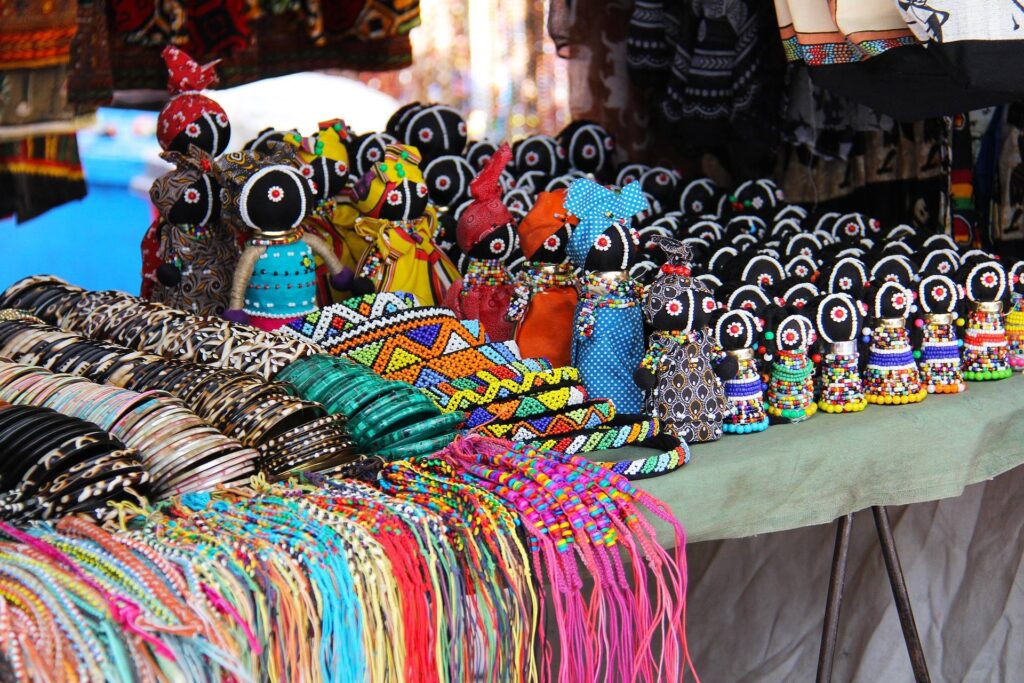
Known for hosting an annual Juneteenth festival, the House of Africa has been a staple of one of Charlotte’s hippest neighborhoods, Plaza Midwood, since the late 1990s — long before it was one of Charlotte’s hippest neighborhoods.
“We don’t just carve, it’s ceremonial,” Pape Ndiaye, House of Africa’s founder, told WCNC last June. “We have pieces that were carved last week or 20 years ago. We have pieces that are from the 17th century to the 20th century.”
But it’s not just Juneteenth that makes House of Africa an interesting and artistic place to visit, and they carry much more than carvings. The shop serves as an art gallery, retail store, community space, and Charlotte landmark carrying authentic handmade pieces shipped straight from Africa. The shop doesn’t keep up much of an online presence, so you’ll have to visit IRL for a look at how they’re observing Black History Month, but it’s guaranteed to be worth your time.
South Charlotte
Whitney Austin Gallery of Art
10720 S. Tryon St.
View this post on Instagram
In 2016, Charlotte artist Whitney Austin started her own business on the dining room floor, and within three months had moved into a two-bedroom apartment. Six months later, she opened her first art gallery. Since then, she has only continued to build her business, opening her second gallery in the Steele Creek area of southwest Charlotte in 2018, where she gives tours by appointment only.
The self-taught artist has become one of Charlotte’s most influential creatives, with nearly 300,000 followers on Instagram, thanks in part to her transparency and vulnerability in discussing her struggles with depression as a survivor of suicide. And if you can’t make it to her gallery, you can still interact with her art by picking up her Whitney Austin Coloring Book: Black Lives Matter edition, released in 2020 as a way to give everyone the opportunity to bring some of her favorite works back to life using their own creativity.
J. Stacy Utley, Rail Trail Lights
222 E. Bland St.
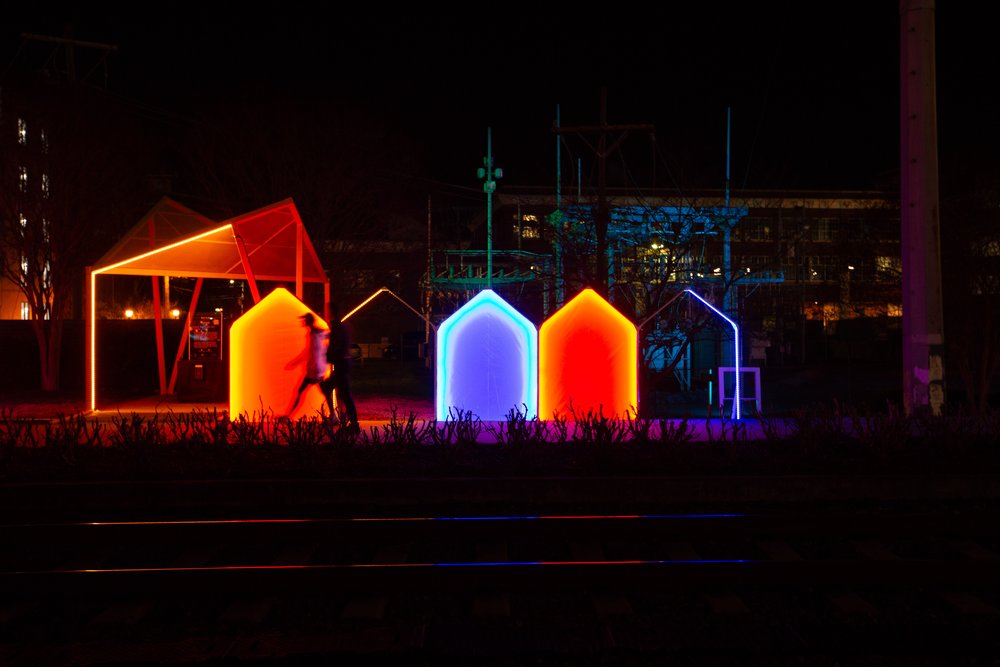
On Feb. 2, Charlotte Center City Partners “flipped the switch” to celebrate the fifth annual Rail Trail Lights, which illuminates the South End portion of the Charlotte Rail Trail with four original interactive art installations done by local artists. The outdoor art walk will remain in place through Feb. 18, and this year features one of Charlotte’s most talented Black installation artists.
J. Stacy Utley is a critically acclaimed artist whose work is grounded in the fundamental belief that public art should incite dialogue, evoke an emotion, and tell a narrative that reflects its cultural landscape and is curated with thoughtful design. Utley works in 2D and 3D mediums, addressing complex narratives found within the African American diaspora. Born in Suffolk, England, and raised in Raleigh, Utley has now lived in Charlotte for some years, working as an artist, lecturer, and educator. His iconic “Excelsior” installation paying homage to Charlotte’s Black history can be found at Five Points Plaza in the West End, mentioned earlier in this list.
His work for this year’s Rail Trail Lights was inspired by his recent series of paintings, In Transition, and carried out in collaboration with artists Dani Delrio and Karl Hoffman. Titled “Leave the Light On,” Utley’s installation addresses the impact of gentrification in communities and urban spaces, as well as the resulting effects on various demographics. Using a simple shape that represents a house, the work represents the homes and lives that have been affected by redevelopment. The LED lights, while perceived as colorful, are coded. In the 1950s and ’60s, redlining maps used the primary colors of red, yellow, and blue as indicator markings to distinguish desired areas from those in decline due to a lack of resources, which you’ll see reflected in the work located at The Pavilion across from Futo Buta.
This article first appeared on Good Info News Wire and is republished here under a Creative Commons license.