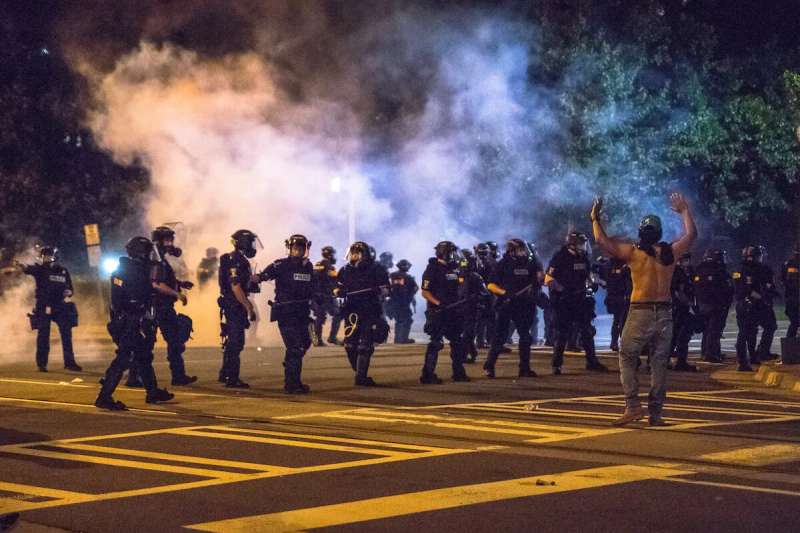
NC Sen. Jeff Jackson, whose district includes Charlotte, conducted a review of the police department’s June 2 use of tear gas on demonstrators.
When video surfaced of Charlotte police officers encircling a crowd of protestors on June 2, and attacking them with chemical weapons, State Sen. Jeff Jackson told his constituents that he would hold off on commenting until he had conducted a thorough investigation.
“It appears from the video that [the protestors] were being told to disperse but were essentially being blocked from doing so,” Jackson wrote in a June 3 post on his Facebook page. “The result was sheer panic.”
RELATED: After Police Clash With Demonstrators, Charlotte Cuts Tear Gas Funding
Jackson, a Democrat whose district includes the location of the kettling incident, is an attorney and a captain in the US Army Reserve, North Carolina National Guard.
On June 8, he shared his findings in a document containing embedded video and screen grabs, which found fault with the Charlotte Mecklenburg Police Department’s tactics.
In the document, after laying out the timeline that led to roughly 350 remaining protesters being flanked by two groups of police in riot gear, Jackson focused on a two-minute window in which the crowd was hit with tear gas, flash bangs and pepper balls.
Posting video of the clash as well as pictures taken at the location which show pepper ball impacts, Jackson concluded that, contrary to CMPD claims, pepper balls were fired from an elevated position.
“CMPD policy is to shoot at the ground or, if necessary, below the waist,” Jackson wrote. “But here, it is clear that they were not firing at the ground but at the protesters and that at least one officer fired a shot at eye-level and struck a protester in the face.”
Jackson then laid out a list of concerns:
The police state that they issued dispersal orders to the crowd before the incident, Jackson wrote, but such orders are not audible on the video and no participants he interviewed heard them.
“The use of tear gas on both sides of the street, essentially boxing in the protesters, was wrong,” Jackson wrote, adding that trapping protestors with chemical weapons served no tactical purpose, particularly if the intent was to disperse the crowd. “Doing so demonstrates a willingness to induce fear and panic for its own sake,” he added.
“Given that the tear gas had effectively immobilized the crowd, the firing of pepper balls was wrong,” Jackson continued. “All it could do was induce fear and panic and create a greater risk of injury.”
Jackson also wrote that firing pepper balls from an elevated position was particularly egregious.
“Imagine you’re surrounded by tear gas, you’re coughing, people around you are coughing, and then suddenly you realize people above you are firing down. Anyone would panic. Anyone would be terrified.”
Jackson concluded saying the police tactics created unnecessary risks, and that it was essential to see from body camera footage how the police leader on the ground reacted in real-time to the events.
“In the preliminary conversations I’ve had with CMPD leadership and other public statements I’ve heard them make recently, I have heard a lot of agreement with some of [my] points,” Jackson continued, citing CMPD leadership’s concern that the use of pepper balls in the situation was inappropriate.
At press time, Charlotte police had not responded publicly to Jackson’s assessment.
While acknowledging that formal reviews of the incident, including investigations by the State Bureau of Investigation and Center for Domestic Preparedness, the federal office under the Federal Emergency Management Agency (FEMA) that focuses on training and best practices, are far from complete, Jackson vowed that there would be change.
“There are going to be significant tactical reforms within CMPD as a result of this incident,” Jackson wrote.