Reporting by Christine Zhu, NC Newsline/Asheville Citizen Times
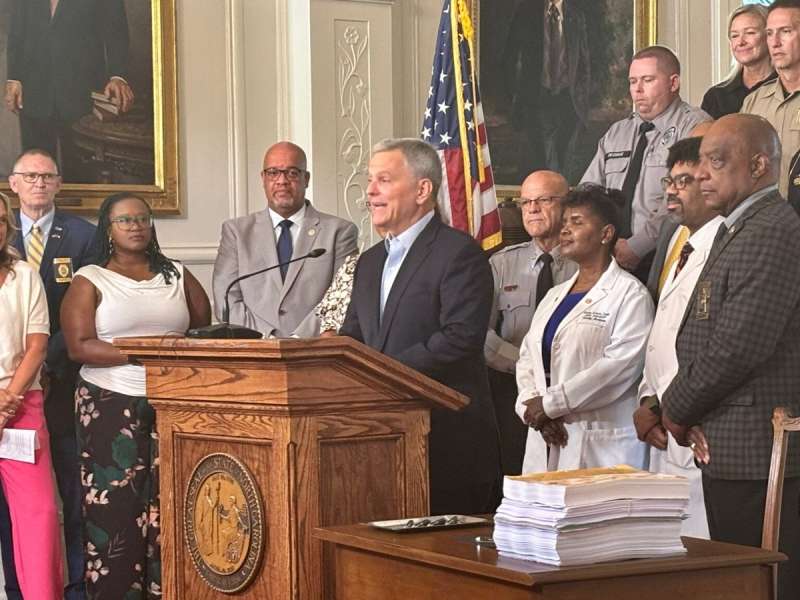
Gov. Josh Stein signed a historic $34 billion state budget Tuesday, enacting North Carolina’s first comprehensive spending plan since 2023.
Republican legislative leaders sent the long-overdue budget to Stein last week after more than a year of negotiations over items like income tax and teacher raises. The delay meant state agencies were running on budget levels approved nearly three years ago.
The 634-page budget includes a 3% raise for all state employees and lowers the personal income tax rate from 3.99% this year to 3.49% next year. It marks the largest starting teacher pay raise in nearly 50 years and the largest overall teacher pay raise in the past 15 years. The plan also fully funds Medicaid and appropriates $700 million towards Hurricane Helene relief in western North Carolina.
“The legislature has accepted many of my big-ticket budget recommendations, and having just celebrated America 250 this weekend, we remember that our democracy has always run on compromise for the common good,” Stein said.
However, the governor’s signature did not come without criticism.
The raises for most state employees don’t keep up with inflation, Stein said, and the budget’s “more meaningful” raises for law enforcement and corrections workers still leave North Carolina lagging behind its neighbors.
He called out the legislature for slashing more than 1,000 state government positions and eliminating the Office of Minority Health and Health Disparities, as well as the Office of Historically Underutilized Businesses.
“It’s full of unconstitutional and petty provisions that strip power from the executive branch, politicize state government, and undermine its efficiency,” Stein said.
While Stein could’ve vetoed the budget, enough Democrats in both chambers voted in support of it to make a veto override likely. The spending plan passed 88-21 in the House and 35-10 in the Senate.
Hannah Moon, a Wilmington English educator who was named the Southeast Region Teacher of the Year, said the budget is critical for classrooms and for retaining educators.
The pay increases show respect for the long hours and emotional weight that come with teaching, she said.
Still, there’s work to be done. Under the plan, teachers receive either $500 or $1,000 bonuses depending on their experience. But North Carolina educators spend an average of $1,632 out of their own pockets on their classrooms each year for classroom supplies like pencils, personal hygiene products, and winter jackets for students.
“Hope is what starts a teaching profession. Support sustains it,” Moon said. “Every day, we’re giving everything we’ve got, but quietly wondering how long we can afford to keep doing it.”
State Secretary of Public Safety Jeffrey Smythe said the budget’s provisions for law enforcement are essential.
The plan includes a 16.2% average pay raise for state law enforcement officers and an average of 15% for the state highway patrol.
“We must continue investing in officers’ mental health and supporting behavioral health investments that enable law enforcement officers to focus on keeping people safe,” Smythe said. “To do that, we should be incentivizing formal education and additional training.”
For the Department of Adult Correction, the budget plays a significant role in recruiting and retaining staff, said Secretary Leslie Dismukes.
It provides funds for vehicles, cameras, body scanners, ballistic vests, and body armor for correction staff. It also includes money for technology to increase staff efficiency and for replacing aging medical equipment.
Over the course of this budget cycle, the agency lost more correctional officers than it had hired, Dismukes said.
“If we cannot adequately staff our prisons for safety and security, we cannot run the programs that will ensure that those in our custody are released in good health and with educational and vocational training that will allow them to safely reintegrate into society,” she said.
Reactions
Lawmakers and political observers were quick to make their voices heard on Stein’s decision to approve the spending package.
House Speaker Destin Hall (R-Caldwell) called it the “best budget in decades.”
“There is something in this budget for every North Carolinian, and the meaningful investments we’ve made will deliver real results that strengthen our communities, put more money back in people’s pockets, and improve lives across our state,” Hall said in a statement.
North Carolina Democratic Party chair Anderson Clayton applauded the General Assembly for finally passing a budget. While it isn’t perfect, she said, it’s a step in the right direction.
Clayton pushed for additional investments in public education, funding for behavioral and mental healthcare, and making life more affordable.
“This November, North Carolinians across the state have the opportunity to elect leaders who will champion those priorities,” Clayton said. “After all, it’s the hard working people across our state that make us so great.
Christine Zhu covers state politics and government for NC Newsline. She is based in Raleigh. NC Newsline is part of States Newsroom, the nation’s largest state-focused nonprofit news organization.
This article originally appeared on Asheville Citizen Times.
Related: FEMA approves $197M more in Helene recovery funding. Here’s where it’s going