A new documentary follows three abortion clinic escorts as they walk patients through harassment, burnout, and backlash in post-Roe America.
The first time Kelsea McLain walked into an abortion clinic, it was for her own abortion. She’d planned to get her procedure done “secretly and quietly” then “move on with her life,” but the cost forced her to ask her mother and partner for help—a conversation that left them “almost kind of hurt” she hadn’t trusted them sooner.
What she couldn’t trust were the community members who’d lined up to shame her as she went inside.
“I remember getting in and just being really incensed and enraged that they had the audacity to come there and make the people that were there, on the same day as me and going through the same experience, feel so shi**y,” McLain said. “The spark was set.”
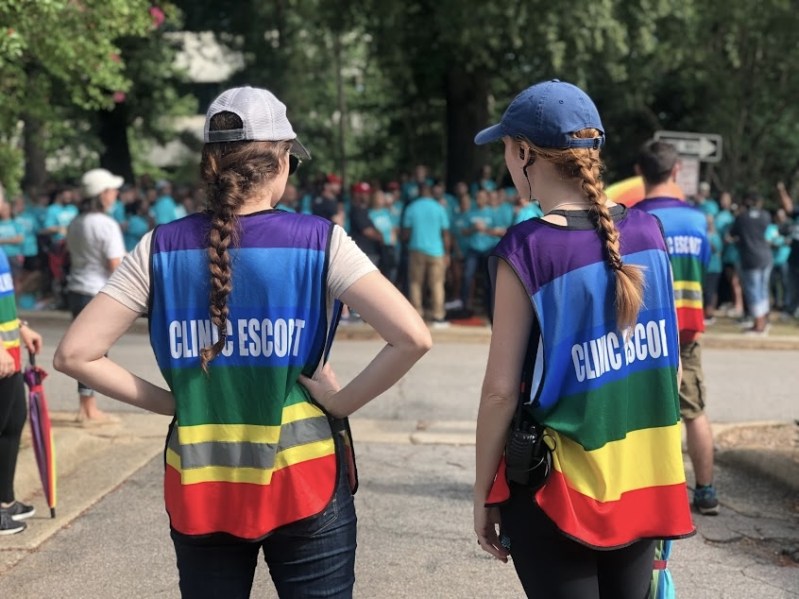
Years on, in a narrow driveway wrapped around a clinic in Raleigh North Carolina, that spark has ignited. McLain, one of many waiting at the curb wearing a rainbow-colored vest, is now a coordinator and the founder of the Triangle Abortion Access Coalition, and healthcare access director at Yellowhammer Fund, an abortion advocacy fund. She greets patients and provides them comfort—talking about the weather and traffic—and escorts them safely into the clinic while anti-abortion protesters swarm, scream “don’t kill your baby,” and threaten to tell patients’ families they were there.
RELATED: They’re not politicians, they’re OB-GYNs—and their podcast might change how you talk about abortion
McLain’s story is one thread in “Human Shield,” a new documentary from Director and Producer Erin Persley that follows clinic escorts in Raleigh, Ohio, and Maryland as they walk patients through the multitude of screaming, racialized harassment and sometimes stalking just to reach a clinic door. Filmed over eight years and including the fall of Roe v. Wade, the movie treats that short walk from car to entrance as a frontline of both abortion access and democracy, showing how much of the country’s “legal” right to abortion now rests on unpaid neighbors willing to put their bodies between patients and protesters.
While North Carolina has become both a refuge for out-of-state patients and a target for new restrictions, “Human Shield” asks what it would mean for more people to do what McLain does: “Be there unapologetically with no shame for others.”
How it started
Persley didn’t set out to make a film about policy. She set out to answer a question.
One night in 2018, scrolling through abortion coverage she thought she already understood, she came across a blog post by clinic escort and writer Lauren Rankin. Persley said Rankin described escorting as an act of compassion and psychological warfare, less about abortion itself than about stepping up and supporting others in a moment when they feel exposed.
“I thought I was pretty well-read in the reproductive rights space,” Persley said. “I’d seen a lot of abortion documentaries, I’d read a lot of stuff…and then I read this blog post, really on a whim. I was just blown away.”
She said she had never seen volunteers on the sidewalks treated as protagonists, and wanted to figure out why it wasn’t talked about more.
“It was like an invisible, unknown network—that was what was so interesting,” Persley said. But there’s such little talked about in terms of compassion, dignity, and care, especially in the media space. And so I just wanted to sort of open up that to a different point of view.”
So when television crews “came for a day” after a big court decision, she wanted to see what would happen if a camera just stayed. In Toledo, she films an escort watching Ohio’s Issue 1 ballot measure that ultimately enshrined abortion rights in the state constitution. In Maryland, she follows volunteers outside a clinic whose front door opens directly onto the public sidewalk, where protesters are able to block the threshold. In Raleigh, she and a local cinematographer spend dawns and weekends at A Woman’s Choice, one of just over a dozen abortion clinics in North Carolina, watching the driveway fill with patients arriving from across the South.
What a shift in Raleigh really looks like
Most people in North Carolina will never see what happens in the few dozen yards between a car door and that clinic entrance. As a clinic escort of over 10 years, McLain sees it every week.
“In the mornings, it can kind of start gently,” she said. “That’s when the quieter protesters come out…you’ll see some people praying a rosary in front of the clinic. You might see some posters that say, ‘We can offer you help,’ or ‘We can offer you resources.’”
The environment changes as the morning carries on.
“As the more hateful people stumble out of their bed, you start to hear it get louder outside of the clinic,” McLain said. “There’s lots of shouts. There’s lots of pleas for you to not kill your baby. There’s lots of proclamations about faith.”
READ MORE: ‘They knew I wanted an abortion’: What she got instead at a ‘crisis pregnancy center’ in NC
She added that there are lots of judgments passed about why a person may be there, and about who they are as a person.
Because many of the protesters belong to a church, especially a predominately Black church in the same community, McLain said, Black and other patients of color often get an extra layer of personalized harassment. McLain has seen protesters call out patients by name, threaten to tell their aunts or mothers they were there. During the Black Lives Matter movement in 2013, McLain said she had also seen protesters single out people wearing BLM shirts as committing “Black genocide.”
Cars, she said, can also quickly become flash points. For patients who might show hesitation or concern about the number of protesters near their car, McLain has watched protesters bang on car windows, shove anti-abortion literature in their vehicles, or refuse to move out of the way.
“If you ask them to move, it can look like you’re weak,” McLain added. “You try to talk to someone and convince them to leave you alone, and they will use what you say against you every time they see you walk in and out of that clinic. I’ve seen patients share that they were assaulted, like it wasn’t even their choice to be here. And I actually heard a protester say to a patient, ‘You know, an abortion won’t un-rape you.”
Dobbs led to more danger for patients
When the US Supreme Court overturned Roe v. Wade in 2022 with the Dobbs v. Jackson decision, McLain expected everything outside the clinic to get worse. The reality was stranger.
Before, a big political hit to abortion access brought what her organization would call “outrage donations and signups,” which was a rush of volunteers and money whenever abortion made national headlines. This time, the spike never came.
RELATED: ‘I’m afraid of no access’: Calls flood NC clinics as providers warn of a backdoor abortion ban
“Dobbs came and went, and it was barely a whisper,” McLain said. “We had a rally locally, and about the same number of people came the next year when we held our counterprotest of the March for Life. It was a struggle getting people to show up, sign up, to volunteer—it didn’t skyrocket like they usually do.”
McLain and other escorts felt a deep “burnout and fatigue,” and a sense that much of the public had “rolled over and taken what happened with Dobbs without much of a fight.”
At the same time, the dangers for escorts intensified. Shortly after Dobbs, McLain noticed familiar faces from the clinic driving past her home and taking pictures.
“I think that they kind of ratcheted up the direct, targeted harassment of myself and other volunteers because there was frustration that we didn’t leave the fight and that we were still in it,” she said.
Advocates in North Carolina have documented similar patterns at other clinics: protesters filming every car that enters, following staff and escorts and calling the police to escalate tensions outside facilities providing legal care, as Pro-Choice North Carolina states.
RELATED: ‘This will delay care’: NC doctor warns of harm after Trump’s rollback on emergency abortion rule
National data from the National Abortion Federation show that in 2022, reported incidents of stalking against providers and patients more than tripled from 28 cases in 2021 to 92, while reported burglaries of clinics rose from 13 to 43 and arson doubled from two to four. A follow-up report on 2023 to 2024 found “sustained and consistent” harassment and violence—including hundreds of death threats, assaults, and clinic obstructions—even as bans forced many high-volume clinics to close.
That’s why Persely tried to make sure her camera didn’t add to that harm. She filmed with a tiny crew, built “ongoing consent” into every shoot, blurred faces and house numbers, and showed early cuts to escorts like McLain so they could flag anything that felt too risky.
You can watch it for yourself
For the mental and emotional toll, McLain doesn’t think everyone needs to stand in that driveway. What she hopes, she said, is that North Carolinians who watch the documentary at least understand “what is happening in their state” and start planning for “if and when they themselves or someone they love needs an abortion.” She also hopes people understand that no one has to walk through those doors alone.
RELATED: NC canvassers brace for flood of anti-abortion messaging ahead of 2026 midterms
The documentary premiered exclusively in North Carolina at the RiverRun International Film Festival in person April 19 and 25. But “Human Shield” is still within reach. As part of the festival’s virtual program, the film is streaming statewide, available online to anyone in North Carolina at the price of $16 through Sunday, May 3.