The first cooler days are beginning to descend on Western North Carolina. Wondering what to do with those hummingbird feeders as temperatures drop?
North Carolina hummingbirds, particularly ruby-throated hummingbirds, which are the only species that breeds in the Tar Heel State, begin migrating from Mexico and Central America in late February to early March to find temporary homes in the eastern and southern regions of the U.S. for breeding.
The birds generally start their migration back south for the winter in the late summer and early fall months. However, this doesn’t mean that feeders should come down at around the same time ― in fact, N.C. State University says the exact opposite might be best for those hoping to help ruby-throated fall travelers.
Here’s what to know in the Tar Heel State as hummingbirds begin to head back south to settle in for the winter.
What types of hummingbirds live in North Carolina?
N.C. State University notes that, while around 11 species of hummingbirds can be found in the state over the course of the year, the ruby-throated hummingbird is the only species of hummingbird that breeds in the Tar Heel State. In fact, ruby-throated hummingbirds are the only species of hummingbird that regularly breeds anywhere in the eastern U.S. The school’s report adds that it is also the species “behind nearly every NC sighting from spring through fall,” plus through winter in coastal regions.
What do ruby-throated hummingbirds look like?
The N.C. Museum of Natural Sciences describes ruby-throated hummingbirds as being only about 3.5 inches in length and .13 ounces in weight on average, but notes that their wings move at an average of 52 beats per second.
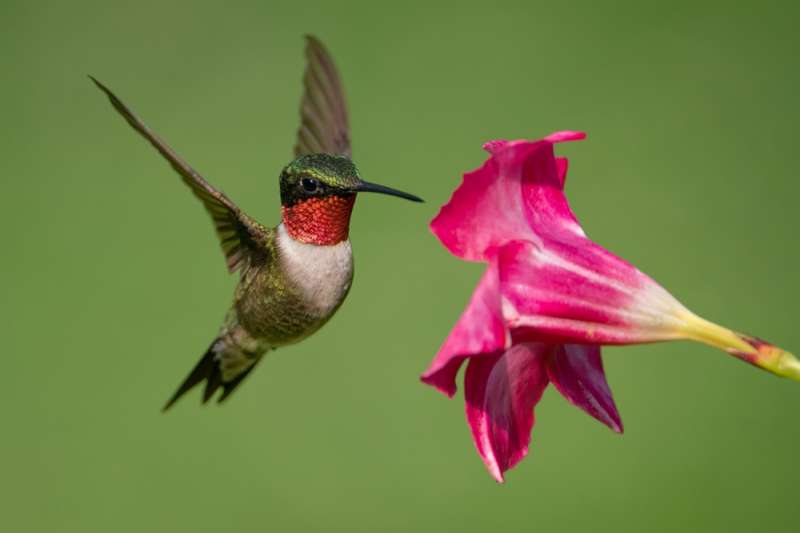
Adult birds have emerald green backs. Male birds have an iridescent ruby red throat that may appear black under some lighting conditions, gray flanks, and forked tails with no white, while females have a white throat and breast and a rounded tail with white tips. Females are larger than males, with longer bills.
When do hummingbirds leave North Carolina?
N.C. State University’s Cooperative Extension explains that hummingbirds, especially ruby-throated hummingbirds, will usually start their migration south for the winter in late August into September. The agency adds that this makes it “a great time of the year for feeders and plants as the birds will be feeding voraciously putting on necessary fat for the long transit.”
Ruby-throated hummingbirds begin migrating from Mexico and Central America in late February to early March to temporary homes in the eastern and southern U.S. for breeding.
When should you stop feeding hummingbirds in North Carolina?
Though hummingbirds begin to migrate in August through September, N.C. State University assures birders that migration is driven by factors like weather, sunlight patterns, changes in plants and insect populations and more. This means that leaving your hummingbird feeder out won’t delay or prevent hummingbirds from migrating.
The site mentions that it is also common for some hummingbirds to migrate later than others, remaining in the state late into the fall or beginning of winter.
How often should I clean and change nectar in hummingbird feeders?
How often hummingbird feeders need cleaning and fresh nectar varies by season and temperature, according to the National Audubon Society.
- In cooler months of fall and spring, clean and refill twice a week.
- In warmer months, clean and refill every day or two.
- If the nectar becomes cloudy, a change is overdue.
- Also clean and refill if you see mold, insect encroachment or if a sick bird uses a feeder.
When is the first day of fall 2026?
The fall equinox, which marks the first day of fall in the Northern Hemisphere, occurs Tuesday, Sept. 22, at 8:04 p.m.
When is the first day of winter 2026?
The winter solstice, which marks the first day of winter in the Northern Hemisphere, occurs Monday, Dec. 21, at 3:50 p.m.
Reporting by Iris Seaton, Asheville Citizen Times / Asheville Citizen Times
USA TODAY Network via Reuters Connect