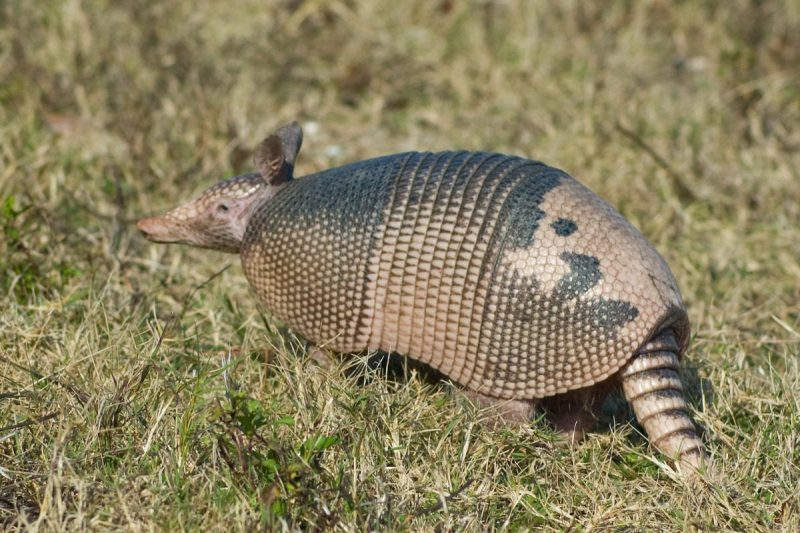
Drawn by a warming climate, lots of diggable land, and loads of fire ants, nine-banded armadillos are increasingly being spotted here in North Carolina.
They’re rolling in from South Carolina, Georgia and Tennessee, attracted by the promise of a temperate and warming climate, vast tracts of diggable land, room to expand, and a nearly endless supply of fire ants − a delicacy for these banded travelers.
But these new residents to North Carolina aren’t adding to the Tar Heel State’s traffic woes, rising home prices and urban sprawl.
https://new.cardinalpine.com/local/food-drink/these-are-ncs-10-best-food-halls-for-globally-inspired-eats//
They are nine-banded armadillos, and they’re becoming increasingly common across the state. But unlike the first European settlers that moved east to west across North Carolina, armadillos are moving the other way.
After first being spotted in Texas in 1849, the march of the armadillo across the United States has been relentless. The first animal was spotted in North Carolina, in Macon County in the far west of the state, in 2007. Since then, nine-banded armadillos have marched east, and there have been credible sightings in several N.C. coastal counties, including Brunswick.
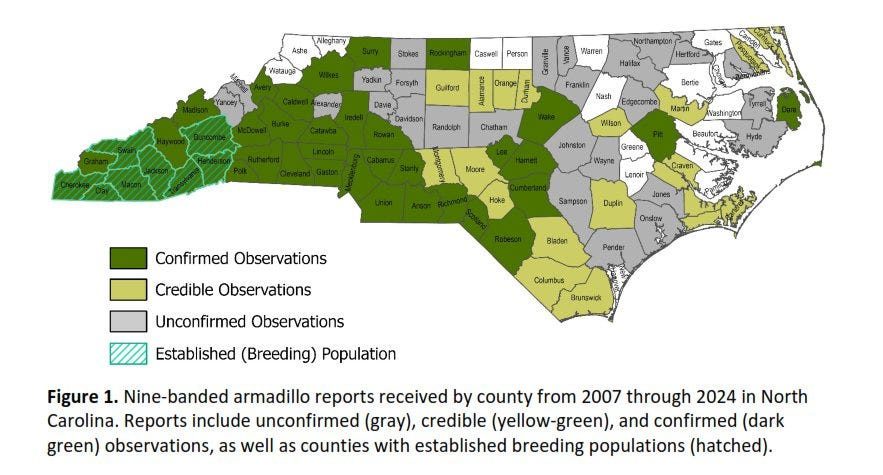
The NC Wildlife Resources Commission released a new map in October detailing where armadillos have been observed between 2007 and 2024.
Little armored ones
The nine-banded armadillo, so dubbed because of the bands around its midsection, is native to Central and South America, but has been expanding north for more than a century.
Named after a Spanish word that means “little armored ones,” armadillos are nocturnal animals that feed on insects and other invertebrates that they dig up and capture with their long, sticky tongue. And maybe a bit like the opossum, the armadillo isn’t the cutest of animals, equipped with long ears, a pig-like snout and a scaly tail. It also has poor eyesight, but a great sense of smell.
Unique among mammals, armadillos are famous for their distinctive shell − made of hardened skin plates − and propensity to roll into a ball when threatened, although it’s only the three-banded armadillo that does this.
Finding North Carolina very habitable
Like many new arrivals to North Carolina, armadillos are finding the Tar Heel State’s climate and environment suits its needs.
Biologists believe there are a number of factors driving the animal’s increase in N.C., including armadillo population growth in neighboring states forcing new animals to seek virgin pastures.
But one ingredient that is definitely working in the armadillos’ favor is North Carolina’s warming climate. Five of the state’s top six warmest years have happened since 2016, and each year in the past decade ranks among the top 22 warmest on record dating back to 1895, according to the N.C. State Climate Office.
While the arrival of a new house cat-sized mammal in their backyard or along local roads might startle some people, especially one that’s known to carry and transmit the bacteria that causes leprosy, biologists say they are largely harmless and shouldn’t have too much of an impact on North Carolina‘s environment.
Sure, they dig holes while searching for food that can be a nuisance for farmers, golf courses and homeowners. And their burrows can be a problem for those walking off the beaten path − although those very same burrows could prove useful for other animals. But armadillos are voracious eaters and could help control insect and grub numbers. That includes fire ants, an invasive species that’s also a fairly new arrival to N.C. and one that is also taking advantage of climate change to expand its range in North Carolina toward the mountains and the Virginia border.
According to the wildlife commission, nuisance armadillos can be trapped during the regulated trapping season from November through February, or taken with a depredation permit − although it is illegal to relocate the animals. Armadillos also can be hunted year-round, but non-lethal control methods are few and far between. The commission said there are no known effective repellents, and poisoning is illegal and could endanger other wild and domestic animals. Professional exterminators are another option for dealing with troublesome armadillos.
‘Rapidly expanding both north and eastward’
While most observations reported so far are from Western North Carolina, Eastern North Carolina‘s sandy soils and extensive pine forests are seen as prime armadillo habitat. And there have been reports of sightings in and around Wilmington.
In 2013, an armadillo was observed in The Cape neighborhood in Southern New Hanover County. The animal’s are surprisingly good swimmers, making the ponds and wetlands around golf courses and across much of the region prime armadillo habitat.
Recent social media posts also report sightings of dead armadillos along the sides of roads, since the animals often use highways and railroads as travel corridors.
According to the recent wildlife commission range map, armadillos have been spotted in Brunswick County, with “unconfirmed” observations of the animals in Pender and Onslow counties.
In a study published in February 2025 looking at the distribution of armadillos in a number of states, including N.C., researchers stated that the wildlife commission has collected roughly 900 reports of armadillos in 70 of North Carolina‘s 100 counties. The agency was then able to verify the sightings in 28 of the counties, and armadillos are now considered “established” in the western third of the state.
“Whereas North Carolina has only had armadillos for 17 years, and they appear to be rapidly expanding both north (even into Virginia) and eastward,” states the study. “While they may not yet be established throughout the entire state, there are increasing numbers of sightings across the entirety of the state in each county.”
Seen an armadillo in N.C.?
The wildlife commission is tracking sightings of armadillos in the state. The most reliable way to report a sighting is through INaturalist. You can create an account and report your sighting at: https://bit.ly/39ueS7G. You can also let the commission know via email at armadillo@ncwildlife.gov. Please include the following information: photo/video (if possible); location; date of observation; and whether the animal was dead or alive.
Reporter Gareth McGrath can be reached at GMcGrath@Gannett.com or @GarethMcGrathSN on X/Twitter. This story was produced with financial support from the Green South Foundation, the Prentice Foundation and the Z. Smith Reynolds Foundation. The USA TODAY Network maintains full editorial control of the work.
Reporting by Gareth McGrath, USA TODAY NETWORK / Wilmington StarNews