We won’t bury the lead: North Carolina very likely does not need to panic about the Texas screwworm outbreak, experts told Cardinal & Pine. But before we tell you why, you might want to put down any sandwiches or snacks.
“If this wasn’t being recorded, I would use way more colorful language,” Dr. Andy Moorhead, a veterinarian and parasitologist at North Carolina State, told Cardinal & Pine in a recent Zoom interview.
“Screwworm deserves colorful language,” he said.
Indeed it does.
Most maggots have a job to do, Moorhead said, helping to clean up carrion after an animal dies.
Screwworms are not most maggots.
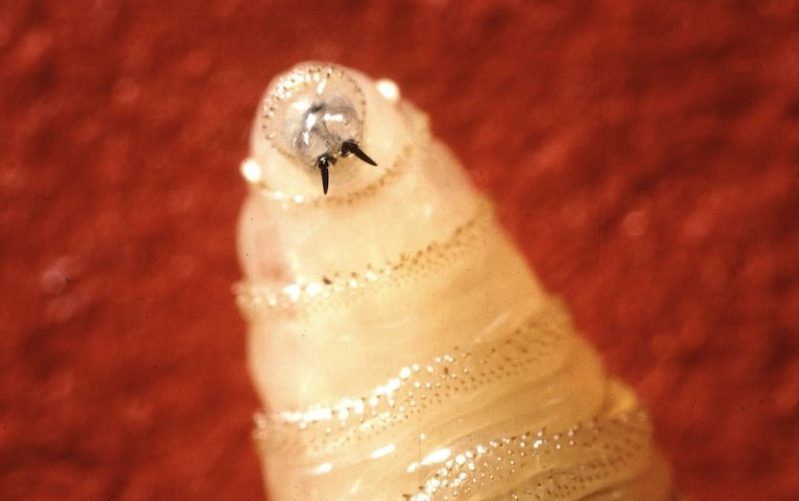
Screwworm flies lay their eggs in the open wounds of healthy animals, so that the maggots that emerge from those eggs can immediately begin to eat their living hosts.
A screwworm maggot, or larval stage if you prefer, has two sharp hooks at its mouth that it uses to burrow deeper inside the wound. The flies can lay up hundreds of eggs at a time.
“These guys, no other way to put it: total jerks,” Moorhead said.
And though screwworm poses a serious threat to cows, it is not a picky eater. Any warm blooded mammal is a potential host. And though human infections are rare, household pets are common targets.
The parasite has prompted news coverage and concern in the agricultural industry, because a widespread outbreak could devastate an already battered cattle industry in the United States and cause beef prices to soar. But so far, Moorhead and other North Carolina State experts say, it appears that aggressive quarantine and mitigation efforts at the state and federal levels, as well as some geographic luck, have a good chance at limiting the damage and avoiding worse case scenarios.
The first screwworm case in the United States was confirmed on June 3, and there have been 15 total cases confirmed in the last three weeks, according to the US Department of Agriculture’s tracker. Though North Carolina farmers and pet owners should be vigilant and educate themselves about the signs of screwworm, Moorhead said, there is no need to worry—yet.
‘They do not stop’
Screwworms are something out of a horror movie that lots of people might want to see in a theater, but zero people want to live through.
“They eat living flesh, and they do not stop,” Zach Raff, assistant professor in North Carolina State’s Department of Agricultural and Resource Economics, told Cardinal & Pine.
They are particularly fond of a newborn calf’s severed umbilical cord.
“That’s an open wound, so [screwworm] goes there and eats,” Raff said.
And the flies don’t need much to get started. They can lay their eggs in a wound the size of a tick bite, Moorhead said.
So the key to stopping the spread of the parasite is keeping a calm but watchful eye on your pets, Moorhead said.
“Dealing with an outbreak is very different than dealing with prevention, and that’s where we’re at,” Moorhead said.
In Texas, farmers and veterinarians are busy checking each cow, bull and calf, culling the sick animals form the herd and sticking to severe restrictions on transporting animals out of or into quarantine zones.
That is not North Carolina’s role. Right now, it’s time to read about the threat, learn as much as possible, and keep a calm, but watchful eye.
“An important part of this is the education piece, making sure that people know what to look for,” Moorhead said.
And if your pet has screwworm, you won’t have to look for long.
“You will know when an animal has been affected,” Raff said.
The good news
As grisly as screwworms are, there are several factors that count as tidbits of good news for North Carolina.
Routine care and upkeep is the best monitoring system for household pets, Moorhead said.
If your dog has an open wound, clean it and take them to a vet.
“At least in North Carolina, pet owners, livestock producers, and certainly veterinarians need to be aware that this disease is [in the US] and that we need to be vigilant for it,” he said.
He added: “If you see a wound and you see maggots, it doesn’t necessarily mean it’s screwworm, but what it does mean is you should take it to the veterinarian.”
The biggest risk for an outbreak in the state is an infected animal from Texas coming into the state, but the vigorous quarantines and travel restrictions in Texas and North Carolina have so far provided solid protection, Raff and Moorhead said.
“From everything that I’ve been following, there seems to be a robust response. So certainly there may be further spread, but … There are so many rules and regulations and quarantine zones, I think [North Carolina cases are] hopefully unlikely.’
Just don’t take your pet to Texas, for now, he added.
“If you were going to travel with your pet to Texas on vacation, I would maybe rethink that right now, ’cause there’s no reason to add fuel to the fire.”
North Carolina officials are taking this particular risk factor seriously, Raff said.
“In addition to the quarantine in Texas, the North Carolina Department of Agriculture has been very proactive, and we’re already not accepting animals,” he said.
An outbreak is not likely to tear through North Carolina’s hog farms because after feeding, the screwworm maggots drop off the animal and burrow into the ground to become flies that can move on to the next animal to lay eggs. Hog pens usually have wooden plank floors with manure beneath, Raff, said. Screwworms maggots are less likely to bloom into flies in a field of pig manure.
Screwworms do not spread as easily as measles or other contagious viruses. They do not cause a food safety issue and there is already a well-established toolkit for addressing an outbreak.
“The good news is there is a plan for screwworm because we’ve done it before. This is not a situation where we’re now dealing with some novel disease,” Moorhead said.
Federal officials are currently releasing millions of sterile male screwworm flies into Texas.
Female screwworms mate once in their life, Moorhead said, so if they mate with a sterile male, there will be no offspring, and the screwworms will die out.
The bad news
Screwworm is the last thing the US cattle industry needs, Moorhead and Raff said.
“We’re currently at a historically low beef cattle population in the United States, due to several years of drought. So anything else that could possibly interrupt that supply chain could potentially impact our bottom lines … and prices at the store,” Raff said.
Keeping a close eye on open wounds is harder for cattle farmers than it is for pet owners, and preventing an outbreak can be almost as expensive and responding to one.
“What you really see is extra veterinary costs and labor costs,” Raff said.
“The owners of these operations have to be out there checking and inspecting every animal every day. Then if there’s any sign, they have to pay the veterinarian.”
And vets don’t work for free.
“We’re already seeing increased veterinary costs,” Raff said.
So far those extra costs have not risen so high that they are expected to immediately affect prices, Raff said, but if those costs increase rapidly, it could start ripples that can’t be called back.
“If it expands and makes it up into those northern regions, then the increased production costs and the increased culling of animals once we get to the feedlot, and the decreased movement of our beef supply chain could combine at the end of the day— and I’m still saying this is unlikely—and could lead to higher prices,” he said.
That was the common refrain among both North Carolina State experts. Not likely, but possible. Vigilance, not panic.
Moorhead hesitated to answer a direct question about where screwworm cases in North Carolina were inevitable, but he said state and federal health officials seemed to be taking the risk seriously.
He added, “So that’s my way of saying, ‘I hope not.’ It would be great if I didn’t have to talk to you about this disease again, because if I do need to talk to you again, very bad things have happened.”