Advice from NC voting rights advocates and election officials on what to do if you witness voter intimidation at the polls.
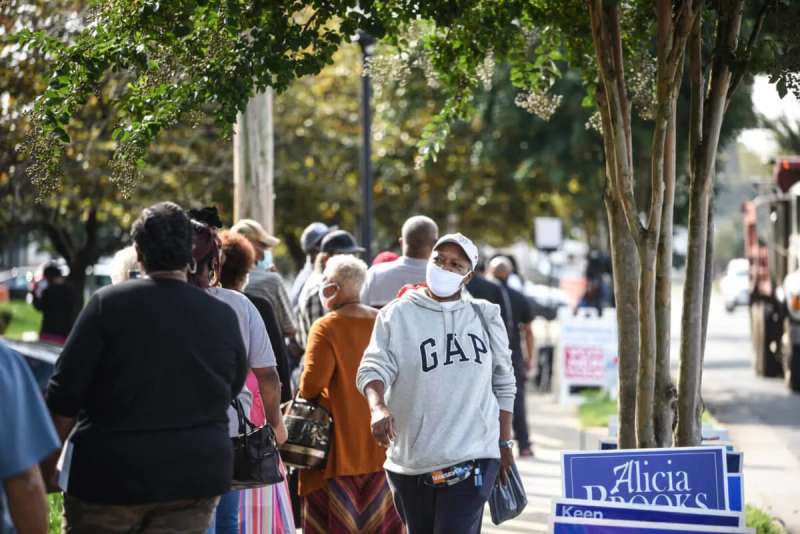
On the first day of early voting in North Carolina, elections officials say, more than 333,000 cast their vote, a record number.
“Aside from long wait lines at some voting sites,” a news release from the North Carolina State Board of Elections stated, “voters experienced few disruptions across the state.”
So far so good, but potential disruptions are what voting rights groups had been worried about.
For weeks, President Trump has sought to cast doubt on the integrity of the voting process and has called on his supporters to show up en masse at polling stations to guard against fraud. Trump’s tweets and outright solicitations had raised fears of widespread voter intimidation efforts. Elected officials in North Carolina as well as many voting rights groups either based in or focused on the pivotal swing state have spent the last several weeks shoring up their contingency plans and reasserting the rules already in place to guard against voter intimidation at the polls.
“We’re working with trusted partners across the state to document any voter intimidation at the polls,” said Joselle Torres, the communications manager for the voting rights group Democracy NC.
It’s clear that tensions are high. On Friday, the second day of early voting, former GOP state lawmaker Gary Pendleton was accused of pushing an Wake County election worker after Pendleton became upset that he wasn’t allowed into the polling place before it opened, according to reporting from the Washington Post. Pendleton was serving as an election observer for the Republican Party, but is now facing a misdemeanor assault charge and disallowed from serving as an observer for the rest of the election season.
READ MORE: Your Guide to Voting in North Carolina in 2020
Voter intimidation can come in several forms, voting rights groups say. There are the obvious signs, like masses of armed people blocking the entrance to polling stations (which is illegal) and more subtle signs, like an official poll worker who may deliberately mislead a voter.
While there have only been scattered reports of voter intimidation efforts across the country so far, here is a guide on what voters should do if they encounter deliberate attempts to deny their vote, as well as a breakdown of your specific rights as you vote, either during the early voting window or on Election Day (Nov. 3).
Call for Help
Democracy North Carolina, a voting rights group that is leading a widespread poll monitoring network, has published a Voter’s Bill of Rights reminding people of the hours polls should be open, of the ability to have someone assist you if you have a disability or have language challenges, and that you can get a new ballot if you make a mistake while voting (but before it has been processed).
Their first recommendation is to print out the list (available here) and take it with you as you vote.
And the best thing to do is something doesn’t feel right at the polls? Call the group’s “election protection hotline” at 888-OUR-VOTE (888-687-8683). It will be staffed by legal experts who will guide you through your response, explain your rights and, if needed, contact state elections officials immediately.
A partnership of voting right groups, which includes North Carolina Black Alliance, is also deploying “vote protectors” across the state, volunteers who will legally offer assistance in de-escalation practices, provide a support system for voters and report any intimidation they see.
They will also work with judges, Torres said, to call for extensions at voting sites of any voter suppression efforts, or even just good faith delays, prohibiting anyone from voting.
Know Your Rights
Here are some of the rights you have as a voter, according to Democracy NC.
- NO PHOTO IDs: Early voting sites allow you to register as well as vote. If you are registering to vote you will need identification and proof of residence, but if you are already properly registered, “you do not need a photo ID to vote in 2020.” If a poll official tells you you need an ID to VOTE, call the hotline.
- PROVISIONAL BALLOTS: “If any problem arises, you have a right to vote with a provisional ballot.” If you believe you have registered but your name is not on the rolls or if you are told you are in the wrong precinct, you can ask for and must be given a provisional ballot. You must also be given a way to find out if the provisional ballot was counted, and if not, the reason it was rejected. If you are denied a provisional ballot, call the hotline.
- SPOILED BALLOTS: You are allowed to make a mistake on a ballot and request a new one. You can have up to three chances to get it right.
- ASSISTANCE: “If you have a disability or difficulty reading (due to language ability, vision, etc.), you have a right to assistance from anyone of your choice, except your employer or union agent.” If a poll worker or official operative tells you otherwise in any of these cases, call the hotline.
- LONG LINES: Voting rights groups see excessively long lines as a form of voter suppression, but with people expected to vote in unprecedented numbers in 2020, long lines might be unavoidable. By most accounts yesterday, the lines moved pretty quickly and some of the lines are because of the need to limit the amount of people inside a building in light of COVID-19. But, the rules are there to protect you. Even during early voting, when each site has its own hours, you must be allowed to vote if you are in line or inside the polling place at the time it closes. Call the hotline if you have problems.
- CURBSIDE VOTING: “If the polling place is difficult to reach due to your age or physical disability, you have a right to vote in a vehicle at the curb or at the door of the polling place.” Access must also be granted for your vehicle, Torres said. So anyone blocking vehicle access at the site or designated parking areas could be prosecuted through anti-intimidation laws.
These are your rights, what you should expect and are entitled to.
What to Do if Things Go Wrong
Here are the procedures in place in case those rights are violated.
On Oct. 9, Karen Brinson Bell, the Executive director of the State Board of Elections, sent a memo to all the county boards, detailing the official guidance for “ensuring all voters have a safe experience, free from intimidation and harassment, when they cast their ballot.”
If you spot issues, reach out to the chief judge, who is in charge at every voting precinct and responsible for making sure everyone can vote without facing intimidation.
Here is a look at the rules as articulated by the board and NC Attorney General Josh Stein’s office,
- THE “BUFFER ZONE”: No campaign signs, pleads for votes, persuasion attempts or other forms of electioneering are allowed within 50 feet of most polling places. This would include large numbers of people draped in American Flags yelling at you. “Buffer zones protect voters from harassment and intimidation when entering a polling place,” the NCBOE says.
- ENFORCEMENT: Ensuring the clear laws are followed falls to each site’s chief judge or polling place manager. If things progress beyond their control, they are required to immediately contact the NCBOE or, if needed, law enforcement (see more on this below.)
- POLL WATCHERS AND OBSERVERS: According to Stein’s office, there are strict and specific rules for official election observers. They must “be designated in advance by the county party chair,” and they “may not interfere with voters casting ballots.” Self-designated poll watchers responding to a tweet from Trump would not count. “A political candidate’s supporters who aren’t official election observers can’t simply ‘go into the polls and watch,’” Stein’s office said, quoting the president. If the supporters are outside the buffer zone, they can hand out literature and hold signs, but they “cannot interfere or intimidate any voter. A supporter who is not an official election observer is not a ‘poll watcher’ and has no legal authority.” And even official observers have restrictions. “Election observers and private citizens cannot question voters on their qualifications to vote.”
- POLICE PRESENCE: Police intimidation was a key tool in the voter suppression efforts of Jim Crow South and memories are long. In the memo to county boards, Bell wrote that, “It is not appropriate or permissible for law enforcement to be stationed at a voting place.” Officers can help with parking and traffic issues, but they must be in plain clothes, and at sites with heightened and verified security concerns, they may “periodically drive by,” the memo says. If voter intimidation from outside groups threatens anyone’s safety, however, elections officials are to “immediately call” law enforcement. “The chief judge,” Stein’s office says, “may order the arrest of any person violating any provision of the election laws, but such arrest shall not prevent the person from registering or voting if they are entitled to do so.” If you feel there is an unnecessary police presence, call the hotline.
- MASKS: All official poll watchers and elections staff are required to wear masks. While voters will not be required to wear masks, there will be masks to hand out at polling stations for voters who need them. The sites will also include PPE and lots of hand sanitizer. The pens used to mark the ballots will be single use, you get them home with you, and there may not be“I Voted” stickers handed out at all sites. Many health officials say that in-person voting is relatively low risk as long as everyone is wearing masks. For those that are high-risk for contracting COVID, or exhibiting COVID-19 symptoms, curbside voting is an option at every polling place for those unable to physically enter a building.
Torres made a point to say that any news coverage of the threat of intimidation should be careful not to be self-fulling. If you shout warnings about intimidation, even if like on Thursday when they were only rumors, that alone might intimidate voters and keep from them the polls.
Point taken.
But, if these reports of record-breaking numbers of people casting votes so far are any indication, voters aren’t being intimidated. And that is the key weapon against any bad actors seeking to deny your vote: patience and resolve.
“People need to vote like their life depends on it,” said Valerie Jones, a member of North Carolina Black Alliance and the Mayor Pro-Tem of Sedalia in Guilford County
“We have had this masks-and-COVID situation for so long, we’ve had to learn patience,” Jones said.
Bring your lawn chair, she said, if there are long lines. Bring snacks, bring a book and know your rights.
“If everyone remains patient and kind it will be a quick and painless effort,” Jones said.